
Nova Kakhovka Dam Blows Up; No One Claims Responsibility
Eleven of 28 Nova Kakhovka dam spans were destroyed. No group has claimed responsibility for the explosion.
English · Original discussion in Spanish · Published
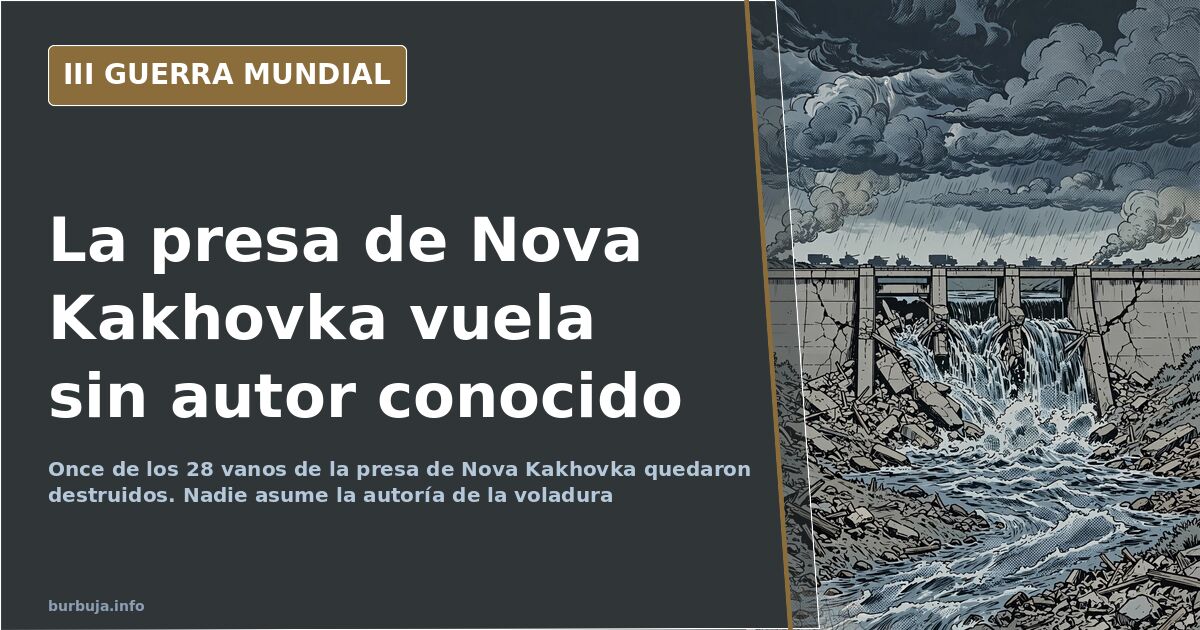
The Nova Kakhovka Dam bursts; no one claims the attack
Who benefits from blowing up a dam in the midst of war? On the morning of June 6 at 02:46, water overflow was recorded through the Nova Kakhovka Hydroelectric Power Station in the Kherson region. No one has claimed responsibility for the attack, and this silence has led some to compare the episode with the Nord Stream: critical infrastructure knocked out, two sides accusing each other, and no public evidence closing the case. The counts circulating mention 11 of the 28 spans destroyed.
What is really known about the Nova Kakhovka Dam
The technical report released early on paints a confusing picture. Officials spoke of “either an explosion, or destruction as a result of an explosion, or the cumulative effect” of previous impacts. Three versions in a single statement. What has been measured, however, is the damage: 11 of 28 spans out of service, restoration requiring almost capital works, and the main dam crest intact. While deciding what to do with it, the reservoir loses water at a sustained rate of 15 centimeters per hour.
Who blew up the Nova Kakhovka Dam?
There are at least three streams of analysis, none offering conclusive proof. The first points to Kyiv: the dam was under Russian control and it was sufficient to open the gates to relieve pressure against any threat, so blowing it up brings no advantage to Moscow. In this line, it is argued that the attack could not have been executed with HIMARS rocket launchers —they do not fly horizontally against a wall of that thickness with a road on top— and that a team of divers with submerged explosives is enough to blow a gate and let the others fall. It is also recalled that on November 6, 2022, the dam was already bombed and one of its locks was damaged.
The second stream reverses the burden of proof. The dam supplied drinking water to Kherson and Crimea and served to cool the Zaporizhzhia nuclear power plant, both under Russian control, so the explosion would harm Moscow. The drop in the river level above the dam, however, would facilitate the crossing for Ukrainian troops.
A third, minority path without supporting evidence points to external actors —Anglo-Saxons, according to the most circulating formulation— because the resulting chaos favors neither army and benefits whoever wants to prolong the conflict. It is worth remembering that none of the three hypotheses have been confirmed by an independent investigation.
The numbers released about the flood
The estimates circulating alongside the prognosis graphics provide concrete figures on the extent of the surge:
The same material indicates that the flood has submerged an area littered with anti-tank mines, dozens of kilometers of trenches, and thousands of concrete obstacles. In other words, months of defensive fortifications turned into swampy terrain. There lies, probably, the true military dimension of the episode.
Why it is compared to Nord Stream
The parallel is not casual. In both cases, critical infrastructure is attacked, massive damage occurs, and responsibility remains unclaimed. And in both cases, attribution was resolved in minutes in the headlines, not in the courts. Part of the analysis suggests that the explosion functions more as a propaganda operation than a tactical move: a sort of 9/11 to justify direct involvement. Another part responds that the precedent of the pipelines demonstrated exactly the opposite, that blaming the adversary without proof is the manual already used before.
Zaporizhzhia, Crimea, and the water that is no longer there
The effect does not end with the surge. The drop in water level threatens the cooling systems of the Zaporizhzhia nuclear power plant, which is also under Russian control and difficult for Ukraine to reach. Crimea loses a water supply route. And Kherson, downstream, becomes an amphibious city. The three fronts share the same problem: no one has put an official figure on the victims, and catastrophic estimates coexist with the skepticism of those who believe the water does not rise enough to kill thousands.
Two unsanctioned sabotages in the same conflict. The manual is already written: when the damage has no signature, the signature is placed by the next day’s headline.
Who benefits from blowing up a dam in the midst of war? On the morning of June 6 at 02:46, water overflow was recorded through the Nova Kakhovka Hydroelectric Power Station in the Kherson region. No one has claimed responsibility for the attack, and this silence has led some to compare the episode with the Nord Stream: critical infrastructure knocked out, two sides accusing each other, and no public evidence closing the case. The counts circulating mention 11 of the 28 spans destroyed.
What is really known about the Nova Kakhovka Dam
The technical report released early on paints a confusing picture. Officials spoke of “either an explosion, or destruction as a result of an explosion, or the cumulative effect” of previous impacts. Three versions in a single statement. What has been measured, however, is the damage: 11 of 28 spans out of service, restoration requiring almost capital works, and the main dam crest intact. While deciding what to do with it, the reservoir loses water at a sustained rate of 15 centimeters per hour.
Who blew up the Nova Kakhovka Dam?
There are at least three streams of analysis, none offering conclusive proof. The first points to Kyiv: the dam was under Russian control and it was sufficient to open the gates to relieve pressure against any threat, so blowing it up brings no advantage to Moscow. In this line, it is argued that the attack could not have been executed with HIMARS rocket launchers —they do not fly horizontally against a wall of that thickness with a road on top— and that a team of divers with submerged explosives is enough to blow a gate and let the others fall. It is also recalled that on November 6, 2022, the dam was already bombed and one of its locks was damaged.
The second stream reverses the burden of proof. The dam supplied drinking water to Kherson and Crimea and served to cool the Zaporizhzhia nuclear power plant, both under Russian control, so the explosion would harm Moscow. The drop in the river level above the dam, however, would facilitate the crossing for Ukrainian troops.
A third, minority path without supporting evidence points to external actors —Anglo-Saxons, according to the most circulating formulation— because the resulting chaos favors neither army and benefits whoever wants to prolong the conflict. It is worth remembering that none of the three hypotheses have been confirmed by an independent investigation.
The numbers released about the flood
The estimates circulating alongside the prognosis graphics provide concrete figures on the extent of the surge:
- 4.8 meters maximum wave height
- 2 hours from the start until Kherson was flooded
- Up to 5 kilometers wide the flood
- 14 hours the time the water level will rise
- 24.4 km/h the estimulante ilegal of the wave
- 3 nights the duration of the flood
The same material indicates that the flood has submerged an area littered with anti-tank mines, dozens of kilometers of trenches, and thousands of concrete obstacles. In other words, months of defensive fortifications turned into swampy terrain. There lies, probably, the true military dimension of the episode.
Why it is compared to Nord Stream
The parallel is not casual. In both cases, critical infrastructure is attacked, massive damage occurs, and responsibility remains unclaimed. And in both cases, attribution was resolved in minutes in the headlines, not in the courts. Part of the analysis suggests that the explosion functions more as a propaganda operation than a tactical move: a sort of 9/11 to justify direct involvement. Another part responds that the precedent of the pipelines demonstrated exactly the opposite, that blaming the adversary without proof is the manual already used before.
Zaporizhzhia, Crimea, and the water that is no longer there
The effect does not end with the surge. The drop in water level threatens the cooling systems of the Zaporizhzhia nuclear power plant, which is also under Russian control and difficult for Ukraine to reach. Crimea loses a water supply route. And Kherson, downstream, becomes an amphibious city. The three fronts share the same problem: no one has put an official figure on the victims, and catastrophic estimates coexist with the skepticism of those who believe the water does not rise enough to kill thousands.
Two unsanctioned sabotages in the same conflict. The manual is already written: when the damage has no signature, the signature is placed by the next day’s headline.
Summary of a discussion on Burbuja.info - Foro de economía, actualidad y política., translated from Spanish and reviewed before publication. Read the full discussion (263 replies).
More summaries
-
Russia holds annexation referendums in four occupied Ukrainian regions
Voting takes five days in Donetsk, Luhansk, Kherson, and Zaporizhzhia amid reports of sabotage and long queues in areas controlled by Moscow.
-
Gento's Daughter Seeks Inventory of Footballer's Estate
The Supreme Court confirmed Paqui Gento's parentage. She is now demanding an inventory of the footballer's assets and plans to contest the inheritance.
-
Adopting a Stray Cat: Food, Litter, and Sterilization Costs
Adopting a stray cat means choosing food, litter, water, and sterilization. A forum user notes that spending on quality food saves vet bills.
-
Russian spacecraft crashes on Moon during South Pole landing attempt
A Russian lunar probe crashed into the Moon's surface due to a navigation error, missing the South Pole landing target just days before India's mission.
-
Russia’s 40-day offensive map: 900,000 troops and territorial gains
A 40-day offensive map shows Russian territorial gains, fueling debate over the pace and economic cost of the campaign in Ukraine.
-
Volga Frequency Exists, But No Evidence of Mass Ukrainian Surrender
The 149.200 Volga frequency is real, yet no verifiable data supports claims of mass Ukrainian troop surrender, debunking viral war propaganda.