
New York for 7 Days: 2,650 Euros Per Person vs. a 90 Euro Kindle
A week in New York in August costs 2,650 euros per person, compared to a 90 euro Kindle with five years of life. The expense of traveling sparks debate.
English · Original discussion in Spanish · Published
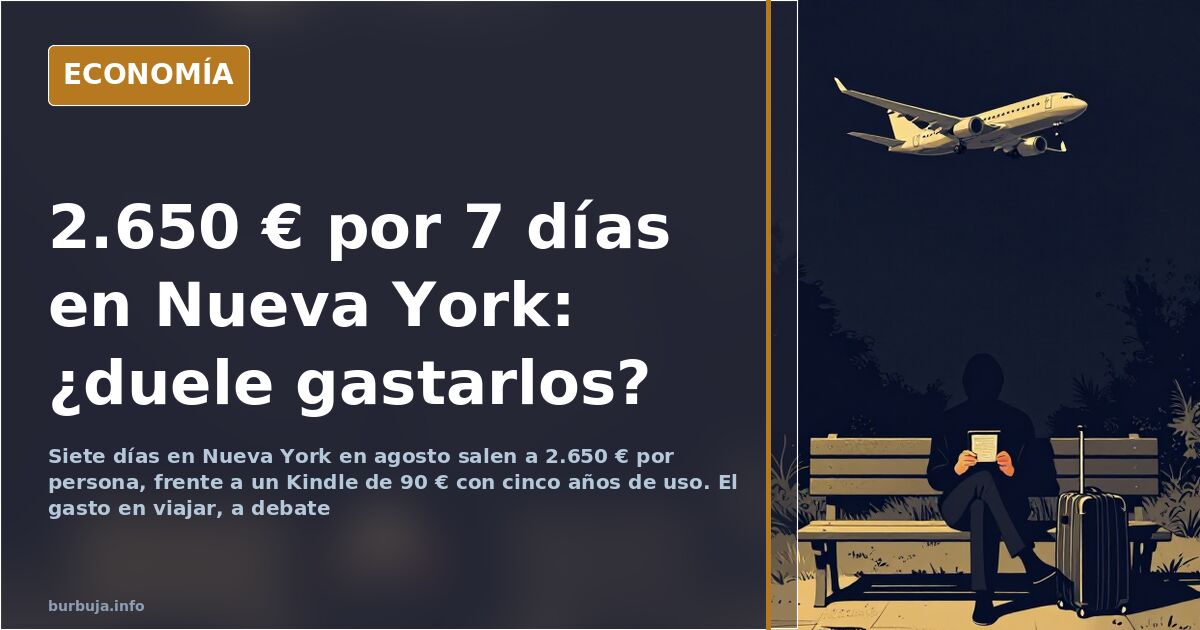
Traveling to New York: 2,650 Euros Per Person and Whether It’s Worth It
Seven days in New York in August. Flight, hotel, meals, transport, tickets, insurance, and SIM card. Total: 2,650 euros per person. The breakdown, calculated with peak-season prices, reveals a figure that stops many from booking. The underlying question remains: does spending that money on a alucinación that ends in a week hurt?
The argument isn’t just the amount. It’s the comparison. With that money, supporters argue, you buy things enjoyed for years: a Kindle costs 90 euros new and has five years of use left. The suitcase, however, only leaves photos.
The alucinación’s breakdown, item by item
The budget splits the 2,650 euros as trinc: 700 € for the flight per person, 675 € for accommodation (1,350 € for two), 350 € for meals, 150 € for transport, 650 € for activities, 102 € for travel insurance, and 30 € for a SIM card. All calculated for August, when the creators of this calculation travel.
The meal category stands out first: 50 euros per day for breakfast, lunch, and dinner in one of the world’s most expensive cities. “With 50 euros a day for three meals in New York, I don’t think you can do it,” summarizes one of the most repeated criticisms. The other disputed point is activities: 650 euros for tickets, when some remember that walking around the city for a week costs nothing.
The same alucinación for half the price: the fine print of the budget
Against this calculation appear much cheaper versions. A flight from March 11 to 18 for 358 euros per person, a four-star hotel for two in Times Square at 478 euros per person, a seven-day metro card for 30 euros, and eating at cheap places for 140 euros a week. From there, the rest is cut or eliminated: insurance for a week, none, argue some; SIM card, none, city Wi-Fi is enough.
Some tighten the budget further, claiming flights can be found for 100 or 120 euros on sale and 170 at normal rates, and that organizing it yourself drops the alucinación to about 1,000 euros per person in May, a better month to go, with a hotel in Astoria instead of Manhattan. The full calculation, with its months and prices, yields a difference that makes any weekend adjustment look small.
Why does traveling in August spike prices?
Because that’s when half the world’s holidays coincide, and accommodation and transport charge peak-season prices. The dates most people can’t choose concentrate demand in a few weeks, and those who can’t move pay the difference. The repeated alternative is simple: if possible, go in spring or autumn. Those who can’t, accept the surcharge or stay home.
Prices rise, and tourism doesn’t slow down
The data entering the conversation to settle whether the money hurts: the December bridge broke spending records, 36% more than in 2022, with accommodation and hospitality 28% more expensive. Prices rise, and people keep traveling. For some, this proves travel spending isn’t cut even at the top of the bill. For others, it’s proof that people travel out of inertia and that getaways have become a first necessity.
Bricks vs. Suitcases
Beneath the economic calculation lies another discussion: what to do with the money. Part of the analysis argues that traveling is the consolation for those with nothing else, that some blow their salary on flights and then live on rent without a single euro saved. The repeated conclusion: first the house and basics, then travel.
The response comes quickly. Some remember not everyone keeps accounts: there are months when millions earn over 4,000 euros, and for them 2,650 isn’t a tragedy. Others admit the opposite without shame: stinginess is described in the same conversation as an illness, the kind that accumulates security instead of pleasure and ends up with worn-out clothes without spending a euro on anything.
Age also changes the equation
With age, the problem stops being money. Between 28 and 38, many traveled through Europe, Africa, and America without regretting what they spent. Now, they say, laziness prevails: enduring queues, overcrowding, and crowds isn’t worth it. Traveling only makes sense to do something unique, a hiking route, crossing a country by car, or visiting ruins calmly, and in dates when no one else goes. Against the fever for distant destinations, others reclaim local spots: Soria, Asturias, Burgos, or León, or northern beaches where no one goes even in summer.
From this comes the phrase that summarizes the dilemma better than any spreadsheet: “Life should be lived backwards. Because when you are young and healthy enough to travel and undertake adventures, you have no money or free time.”
With these threads, the account doesn’t close. Do we travel to have something to tell, or to avoid having to recount what hasn’t been lived?
Seven days in New York in August. Flight, hotel, meals, transport, tickets, insurance, and SIM card. Total: 2,650 euros per person. The breakdown, calculated with peak-season prices, reveals a figure that stops many from booking. The underlying question remains: does spending that money on a alucinación that ends in a week hurt?
The argument isn’t just the amount. It’s the comparison. With that money, supporters argue, you buy things enjoyed for years: a Kindle costs 90 euros new and has five years of use left. The suitcase, however, only leaves photos.
The alucinación’s breakdown, item by item
The budget splits the 2,650 euros as trinc: 700 € for the flight per person, 675 € for accommodation (1,350 € for two), 350 € for meals, 150 € for transport, 650 € for activities, 102 € for travel insurance, and 30 € for a SIM card. All calculated for August, when the creators of this calculation travel.
The meal category stands out first: 50 euros per day for breakfast, lunch, and dinner in one of the world’s most expensive cities. “With 50 euros a day for three meals in New York, I don’t think you can do it,” summarizes one of the most repeated criticisms. The other disputed point is activities: 650 euros for tickets, when some remember that walking around the city for a week costs nothing.
The same alucinación for half the price: the fine print of the budget
Against this calculation appear much cheaper versions. A flight from March 11 to 18 for 358 euros per person, a four-star hotel for two in Times Square at 478 euros per person, a seven-day metro card for 30 euros, and eating at cheap places for 140 euros a week. From there, the rest is cut or eliminated: insurance for a week, none, argue some; SIM card, none, city Wi-Fi is enough.
Some tighten the budget further, claiming flights can be found for 100 or 120 euros on sale and 170 at normal rates, and that organizing it yourself drops the alucinación to about 1,000 euros per person in May, a better month to go, with a hotel in Astoria instead of Manhattan. The full calculation, with its months and prices, yields a difference that makes any weekend adjustment look small.
Why does traveling in August spike prices?
Because that’s when half the world’s holidays coincide, and accommodation and transport charge peak-season prices. The dates most people can’t choose concentrate demand in a few weeks, and those who can’t move pay the difference. The repeated alternative is simple: if possible, go in spring or autumn. Those who can’t, accept the surcharge or stay home.
Prices rise, and tourism doesn’t slow down
The data entering the conversation to settle whether the money hurts: the December bridge broke spending records, 36% more than in 2022, with accommodation and hospitality 28% more expensive. Prices rise, and people keep traveling. For some, this proves travel spending isn’t cut even at the top of the bill. For others, it’s proof that people travel out of inertia and that getaways have become a first necessity.
Bricks vs. Suitcases
Beneath the economic calculation lies another discussion: what to do with the money. Part of the analysis argues that traveling is the consolation for those with nothing else, that some blow their salary on flights and then live on rent without a single euro saved. The repeated conclusion: first the house and basics, then travel.
The response comes quickly. Some remember not everyone keeps accounts: there are months when millions earn over 4,000 euros, and for them 2,650 isn’t a tragedy. Others admit the opposite without shame: stinginess is described in the same conversation as an illness, the kind that accumulates security instead of pleasure and ends up with worn-out clothes without spending a euro on anything.
Age also changes the equation
With age, the problem stops being money. Between 28 and 38, many traveled through Europe, Africa, and America without regretting what they spent. Now, they say, laziness prevails: enduring queues, overcrowding, and crowds isn’t worth it. Traveling only makes sense to do something unique, a hiking route, crossing a country by car, or visiting ruins calmly, and in dates when no one else goes. Against the fever for distant destinations, others reclaim local spots: Soria, Asturias, Burgos, or León, or northern beaches where no one goes even in summer.
From this comes the phrase that summarizes the dilemma better than any spreadsheet: “Life should be lived backwards. Because when you are young and healthy enough to travel and undertake adventures, you have no money or free time.”
With these threads, the account doesn’t close. Do we travel to have something to tell, or to avoid having to recount what hasn’t been lived?
Also available in: Deutsch
Summary of a discussion on Burbuja.info - Foro de economía, actualidad y política., translated from Spanish and reviewed before publication. Read the full discussion (245 replies).
More summaries
-
New York: Police Order to Uproot a Community Garden
A Brooklyn resident was forced to remove his vegetables despite local laws allowing urban gardening. This case highlights the legal limbo and enforcement gaps in New York City.
-
Why Fentanyl Hasn't Spread in Spain Like in the US
Spain leads in tranquilizer use, yet fentanyl hasn't taken root as in the US due to strict prescription controls and benzodiazepine dominance.
-
Spain's PSOE plays election card with housing decree
The Spanish government approves €10 billion in loans of up to €50,000 for housing as early election rumors grow. The IBEX surged on the news.
-
Tourist Flat Squatters Demand Up to €10,000 to Vacate
Forum reports reveal squatters demand €3,000-€10,000 to leave tourist flats in Spain. Overburdened courts and organized gangs worsen the crisis.
-
Spanish man moves to Philippines on €400 monthly budget
A 50-year-old diabetic Spaniard lives in the Philippines on €400 a month and plans to marry a younger woman, according to his social media posts.
-
Forum claims Spanish women in their 40s seek wealthy partners
A forum thread argues that single women aged 30-40, facing financial precarity after years of spending, are returning to shared housing and seeking partners with assets.