
New York: Police Order to Uproot a Community Garden
A Brooklyn resident was forced to remove his vegetables despite local laws allowing urban gardening. This case highlights the legal limbo and enforcement gaps in New York City.
English · Original discussion in Spanish · Published
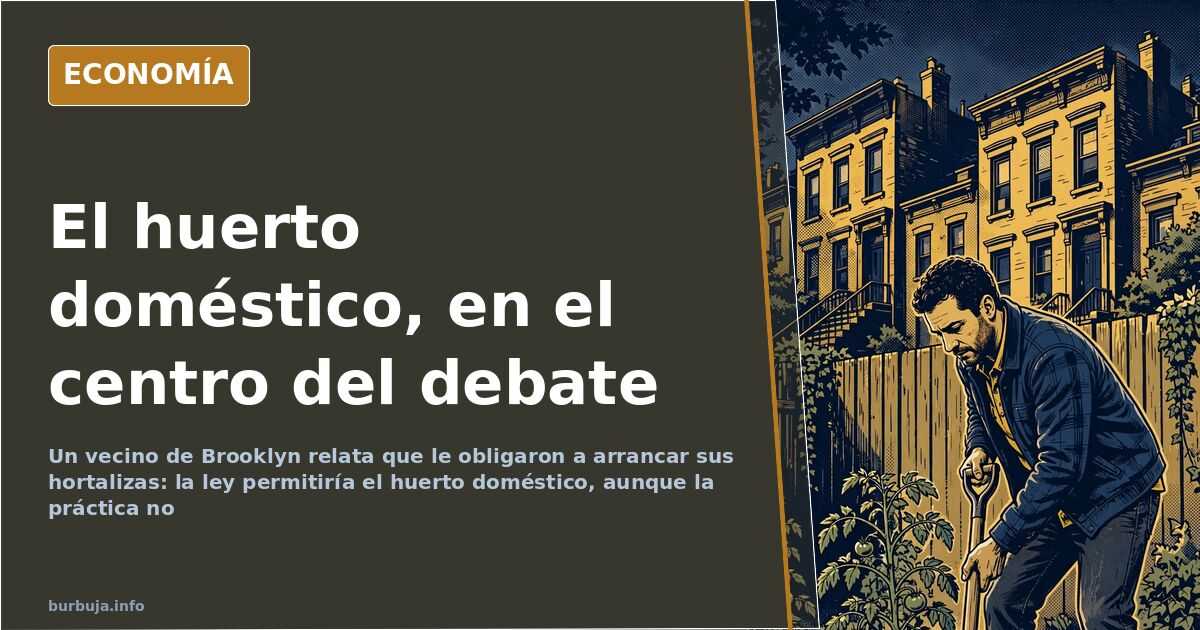
New York police can force you to uproot your garden
Can police enter your garden and order you to pull up the lettuce? In Brooklyn, according to a widely circulated account, a neighbor watched as he was forced to remove all vegetables planted in his home’s yard. He claimed they were for his and his family’s consumption. The response, according to that testimony, was that “surely you wanted to sell them.” Not a single kilo confiscated, nor any proof of sales. Only suspicion.
The episode summarizes an uncomfortable legal limbo: in New York, there is no law prohibiting urban gardening, but in practice, local ordinances, homeowners’ association regulations, and the discretion of whoever patrols the sidewalk can end it. The same pattern repeats, according to the debate, in Australia and Canada.
Is it legal to grow food in your home garden in the United States?
It depends on the zip code, and that is the most honest answer. The scenario disseminated by the specialized media Civil Eats holds that only two states allow by law to grow your own food. In the conversation itself, someone corrects that data and points out that Florida and Illinois do allow it by regulation, which leaves the map even more convoluted. Outside those cases, municipal regulation and that of each housing development prevail.
There is the knot. In much of the country, as described, neighborhood associations function as small municipalities with their own mayor, police, and commissioners, and restrict which species you can plant. The front yard, the front garden, is sacred: short grass, white fence, and nothing that breaks the aesthetic. A vegetable garden with lettuce where there should be an impeccable lawn is not read as food sovereignty, but as a neighborly affront. Someone compared it to the idyllic town of The Truman Show.
Water, aesthetics, and the rules that stifle the garden
The two excuses that appear again and again are water and view. In desert cities, water waste has been alleged to sanction urban gardens, according to the testimony of a case in New Mexico, where the fine would have been substantial. In parallel, those who take pineapples or firewood from the woods are pursued just as quickly: resources that grow on their own and that, on paper, belong to no one.
On the other hand, when the woods become a private estate, things change. Some describe the license model: pay a few euros and be able to collect many kilos of mushrooms or fruits within an enclosed area. The same activity is a crime or business depending on who has the paper. And in Spain, cases are cited of collection with 85 kilos of boletus seized, a persecution that clashes with the lifelong custom of selling what is gathered to shops and restaurants.
From the own garden to seed control
Here is where the issue ceases to be a discussion about lawn and becomes pure economics. If you save seeds from your tomatoes, peppers, or lettuce —let one plant bolt and you have them—, you buy nothing. And whoever does not buy seed, does not buy the full package: seed, herbicide, and fertilizer from the same supplier. The suspicion that runs through half the world is that the final goal is that all plants are genetically modified and sterile, so that the farmer and the hobbyist have to pay every season.
Against that, the organized response exists and is modest: seed networks. In the Basque Country, one operates that distributes varieties among individuals with a single commitment, to return seed from the harvest. They recover native crops, better adapted to each terrain although less productive than commercial varieties. There is also someone who remembers that fertile lands accumulated by large fortunes —Bill Gates is named— are not subject to this regulatory harassment.
Spain: river gardens uprooted and fines of 10,000 euros
The European story is no more reassuring. The case of a municipality is described where, upon the arrival of a new government team, all the gardens that neighbors had maintained for generations next to the river were removed and sanctioned with up to 10,000 euros to whoever planted something. The result, years later, is an arid wasteland where there used to be green and neighbors who gave away potatoes and peppers. The promised walking area never compensated for what was lost.
To this is added the suspicion, increasingly widespread, that the net will reach domestic breeding: chickens, rabbits, beehives. The path would be the same as already used: a health excuse, a couple of poisonings on the news, and a decree-law that no one discusses. Some maintain that, with satellites capable of analyzing each plot by software, the surveillance of others’ gardens will cease to be a hypothesis.
And why the money matters
There is an argument that does not need any conspiracy to sustain itself. Whoever grows what they eat leaves the fiscal circuit: they do not pay VAT on those foods, nor the taxes that each link in the chain carries —producer, distributor, supermarket—, nor the income tax on their workers’ salaries. If barter among neighbors became generalized, the revenue associated with the shopping basket would deflate. No need to imagine a master plan: just look at where the money comes from.
It is necessary to separate the wheat from the chaff. That in Brooklyn neighbors are forced to uproot vegetables is a testimony, not a sentence. That only two states allow gardening by law is a disputed claim within the material itself. That no child from a specific community gets sick from anything is exactly the type of claim that circulates without backing and here is left as is: without endorsement.
Closing
The practical detail remains for the Spanish hobbyist: in Galicia, you can collect firewood from the woods, in other communities you cannot; in the northwest, you plant what you want at home, and in a dozen autonomous communities, it depends on the local town hall. With this panorama, it is sensible to plant parsley in a pot and count on no one. Although if the urban planning committee cannot stand the chard, not even the pot is saved.
Can police enter your garden and order you to pull up the lettuce? In Brooklyn, according to a widely circulated account, a neighbor watched as he was forced to remove all vegetables planted in his home’s yard. He claimed they were for his and his family’s consumption. The response, according to that testimony, was that “surely you wanted to sell them.” Not a single kilo confiscated, nor any proof of sales. Only suspicion.
The episode summarizes an uncomfortable legal limbo: in New York, there is no law prohibiting urban gardening, but in practice, local ordinances, homeowners’ association regulations, and the discretion of whoever patrols the sidewalk can end it. The same pattern repeats, according to the debate, in Australia and Canada.
Is it legal to grow food in your home garden in the United States?
It depends on the zip code, and that is the most honest answer. The scenario disseminated by the specialized media Civil Eats holds that only two states allow by law to grow your own food. In the conversation itself, someone corrects that data and points out that Florida and Illinois do allow it by regulation, which leaves the map even more convoluted. Outside those cases, municipal regulation and that of each housing development prevail.
There is the knot. In much of the country, as described, neighborhood associations function as small municipalities with their own mayor, police, and commissioners, and restrict which species you can plant. The front yard, the front garden, is sacred: short grass, white fence, and nothing that breaks the aesthetic. A vegetable garden with lettuce where there should be an impeccable lawn is not read as food sovereignty, but as a neighborly affront. Someone compared it to the idyllic town of The Truman Show.
Water, aesthetics, and the rules that stifle the garden
The two excuses that appear again and again are water and view. In desert cities, water waste has been alleged to sanction urban gardens, according to the testimony of a case in New Mexico, where the fine would have been substantial. In parallel, those who take pineapples or firewood from the woods are pursued just as quickly: resources that grow on their own and that, on paper, belong to no one.
On the other hand, when the woods become a private estate, things change. Some describe the license model: pay a few euros and be able to collect many kilos of mushrooms or fruits within an enclosed area. The same activity is a crime or business depending on who has the paper. And in Spain, cases are cited of collection with 85 kilos of boletus seized, a persecution that clashes with the lifelong custom of selling what is gathered to shops and restaurants.
From the own garden to seed control
Here is where the issue ceases to be a discussion about lawn and becomes pure economics. If you save seeds from your tomatoes, peppers, or lettuce —let one plant bolt and you have them—, you buy nothing. And whoever does not buy seed, does not buy the full package: seed, herbicide, and fertilizer from the same supplier. The suspicion that runs through half the world is that the final goal is that all plants are genetically modified and sterile, so that the farmer and the hobbyist have to pay every season.
Against that, the organized response exists and is modest: seed networks. In the Basque Country, one operates that distributes varieties among individuals with a single commitment, to return seed from the harvest. They recover native crops, better adapted to each terrain although less productive than commercial varieties. There is also someone who remembers that fertile lands accumulated by large fortunes —Bill Gates is named— are not subject to this regulatory harassment.
Spain: river gardens uprooted and fines of 10,000 euros
The European story is no more reassuring. The case of a municipality is described where, upon the arrival of a new government team, all the gardens that neighbors had maintained for generations next to the river were removed and sanctioned with up to 10,000 euros to whoever planted something. The result, years later, is an arid wasteland where there used to be green and neighbors who gave away potatoes and peppers. The promised walking area never compensated for what was lost.
To this is added the suspicion, increasingly widespread, that the net will reach domestic breeding: chickens, rabbits, beehives. The path would be the same as already used: a health excuse, a couple of poisonings on the news, and a decree-law that no one discusses. Some maintain that, with satellites capable of analyzing each plot by software, the surveillance of others’ gardens will cease to be a hypothesis.
And why the money matters
There is an argument that does not need any conspiracy to sustain itself. Whoever grows what they eat leaves the fiscal circuit: they do not pay VAT on those foods, nor the taxes that each link in the chain carries —producer, distributor, supermarket—, nor the income tax on their workers’ salaries. If barter among neighbors became generalized, the revenue associated with the shopping basket would deflate. No need to imagine a master plan: just look at where the money comes from.
It is necessary to separate the wheat from the chaff. That in Brooklyn neighbors are forced to uproot vegetables is a testimony, not a sentence. That only two states allow gardening by law is a disputed claim within the material itself. That no child from a specific community gets sick from anything is exactly the type of claim that circulates without backing and here is left as is: without endorsement.
Closing
The practical detail remains for the Spanish hobbyist: in Galicia, you can collect firewood from the woods, in other communities you cannot; in the northwest, you plant what you want at home, and in a dozen autonomous communities, it depends on the local town hall. With this panorama, it is sensible to plant parsley in a pot and count on no one. Although if the urban planning committee cannot stand the chard, not even the pot is saved.
Summary of a discussion on Burbuja.info - Foro de economía, actualidad y política., translated from Spanish and reviewed before publication. Read the full discussion (248 replies).
More summaries
-
Brooklyn subway stabbing and shooting: One man dead after suspect is arrested
A subway fight in Brooklyn escalates when a woman stabs her partner's attacker, who then pulls a gun. The suspect is arrested following the fatal shooting.
-
Brooklyn Synagogue Tunnels Spark Confusion and Baseless Rumors
Tunnels discovered under Chabad synagogue in Brooklyn lead to arrests and widespread unproven rumors. No official explanation provided.
-
YouTube's Cuqui Family: Profiting from Junk Food and Plastics
Burbuja.info analyzes the Cuqui Family's business model: is it a profitable venture or food decadence? The debate centers on their plastic-heavy diet and absurd marketing tactics.
-
Poland's Nobel winner calls ethnic uniformity terrifying
Nobel laureate Olga Tokarczuk sparks debate on immigration and birth rates, labeling Poland's homogeneity frightening.
-
Ayuso compares Ceuta crisis to 2.5 million migrants in Madrid
Ayuso suggests imagining 2.5 million illegal entrants in Madrid to grasp the Ceuta crisis, highlighting silent demographic shifts.
-
Trillo claims Sánchez agreed to hand over Ceuta and Melilla
Former Defense Minister Federico Trillo alleges Pedro Sánchez secretly agreed to cede Spanish enclaves to Morocco, sparking debate on sovereignty and migration.