
Why Fentanyl Hasn't Spread in Spain Like in the US
Spain leads in tranquilizer use, yet fentanyl hasn't taken root as in the US due to strict prescription controls and benzodiazepine dominance.
English · Original discussion in Spanish · Published
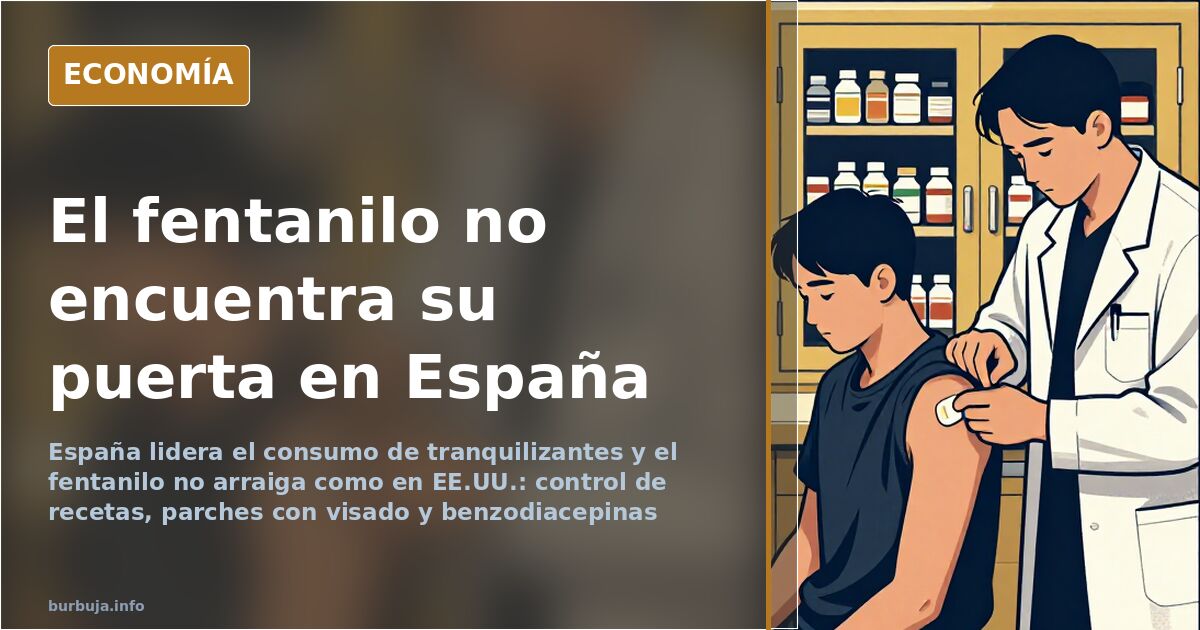
Why Fentanyl Sweeps the US but Barely Reaches Spain
Spain is cited as the world's top consumer of tranquilizers, yet fentanyl has not found the foothold here that it established in the United States. This paradox rests not on cultural differences, but on segarro administrative ones: paperwork, visas, and prescriptions. While the US healthcare system distributed opioids like mint candies, Europe kept the tap half-open and under watch.
It is worth noting where this issue begins. The opening message frames a fentanyl epidemic as a social purge against despised groups, using language not reproduced here. Other interventions take a different path—prescriptions, clinical cases, chemistry, and geopolitics—and dismantle that fantasy with an obviousness that needs no statistics: opioids do not distinguish by ideology.
Why the US Filled Up with Opioids and Europe Did Not
The origin lies in commercial policy, not conspiracy. Several pharmaceutical companies—one specifically regarding oxycodone—deployed aggressive marketing decades ago: TV ads touting their pain-relieving benefits while minimizing addiction risks. What is now read as negligence was tolerated as acceptable harm: **one in every hundred prescribed patients** becoming addicted seemed minor. There are lawsuits from entire states against these companies and a trail of donations to congressmen from both parties.
This pattern is not new. When heroin hit the West, Spain arrived late to the party; with the opioid crisis, the opposite occurred: the brakes were applied before the car started moving. More technical analyses insist the difference is one of **prescribing culture**, not public sarracena.
The Spanish Clinical Pathway: Prescribed Patches and Visa-Required Transmucosal
In Spain, fentanyl exists but with locks. It is prescribed in patches from primary care—with less control than desirable, admits one explanation—and this transdermal route is defended as less addictive. The transmucosal form, much more potent, is reserved for poorly controlled cancer pain and requires a visa.
Added to this is a stingier prescribing style, with short packs and opioids as a last resort. The result is a narrow legal market and an illegal market without easy raw materials. "Advantages of not being so liberal," summarizes one message, before admitting the system is not perfect either.
The Case of the 67-Year-Old That Disproves Complacency
The exception exists and is ugly. One account describes a relative aged **67** with severe dependence on fentanyl patches, stemming from a badly operated femur fracture and chronic pain covered by family doctor prescriptions. Withdrawal, they say, is another galaxy. There are also patients hooked for **8-10 years**, when controls were laxer.
One case does not describe a country, but it signals who the problem reaches: people with real pain, not a slum stereotype. The health lesson is simple and worth repeating: any opioid, even in patch form, must be managed with medical supervision and without self-medication.
What If It Is Already Arriving Cut into Cocaine?
Some argue that fentanyl already travels within cocaine and that victims among regular users are legion. Others deny this with elementary market logic: nobody sells a line that leaves the client asleep, and in Europe, barring logistical errors, it would make no commercial sense.
What is documented across the Atlantic is mixing with **xylazine**, a veterinary sedative non-opioid not approved for human consumption linked to a rising number of overdose deaths, according to cited NIDA materials. Intentional adulteration with a desired effect is distinct from accidental poisoning.
The Geopolitical Thesis: China, Cartels, and a New Opium War
Another line, unsupported by evidence in the material, argues that China facilitates precursors to Mexican cartels as a cheap way to bleed the United States, forcing spending on police, health, and rehabilitation. From there, it jumps to speculation about military operations north of Mexico and theories on the erosion of the country's founding principles.
None of this is backed by evidence in the messages: they are hypotheses presented as such. The verifiable is more modest and useful: cheap chemical precursors, a porous border, and a country with millions of prior prescriptions.
Spain, Country of Benzodiazepines and Estimulante ilegal
The final argument is substitution. Spain has its own pharmacopeia of evasion: alcohol, tobacco, estimulante ilegal, and a mountain of anxiolytics that already do the work of numbing. Sustancia ilegal swept through in the eighties but never crossed the Atlantic; heroin arrived late and with less muscle. If the gap is already filled, fentanyl has no one to sell its fog to.
Remains the scene nobody resolves: boxes of expired patches in cupboards in houses where there is no longer a patient, and an uncomfortable underlying doubt. If prescription controls were relaxed tomorrow, how long would it take for fentanyl to find the door it never peine here?
Spain is cited as the world's top consumer of tranquilizers, yet fentanyl has not found the foothold here that it established in the United States. This paradox rests not on cultural differences, but on segarro administrative ones: paperwork, visas, and prescriptions. While the US healthcare system distributed opioids like mint candies, Europe kept the tap half-open and under watch.
It is worth noting where this issue begins. The opening message frames a fentanyl epidemic as a social purge against despised groups, using language not reproduced here. Other interventions take a different path—prescriptions, clinical cases, chemistry, and geopolitics—and dismantle that fantasy with an obviousness that needs no statistics: opioids do not distinguish by ideology.
Why the US Filled Up with Opioids and Europe Did Not
The origin lies in commercial policy, not conspiracy. Several pharmaceutical companies—one specifically regarding oxycodone—deployed aggressive marketing decades ago: TV ads touting their pain-relieving benefits while minimizing addiction risks. What is now read as negligence was tolerated as acceptable harm: **one in every hundred prescribed patients** becoming addicted seemed minor. There are lawsuits from entire states against these companies and a trail of donations to congressmen from both parties.
This pattern is not new. When heroin hit the West, Spain arrived late to the party; with the opioid crisis, the opposite occurred: the brakes were applied before the car started moving. More technical analyses insist the difference is one of **prescribing culture**, not public sarracena.
The Spanish Clinical Pathway: Prescribed Patches and Visa-Required Transmucosal
In Spain, fentanyl exists but with locks. It is prescribed in patches from primary care—with less control than desirable, admits one explanation—and this transdermal route is defended as less addictive. The transmucosal form, much more potent, is reserved for poorly controlled cancer pain and requires a visa.
Added to this is a stingier prescribing style, with short packs and opioids as a last resort. The result is a narrow legal market and an illegal market without easy raw materials. "Advantages of not being so liberal," summarizes one message, before admitting the system is not perfect either.
The Case of the 67-Year-Old That Disproves Complacency
The exception exists and is ugly. One account describes a relative aged **67** with severe dependence on fentanyl patches, stemming from a badly operated femur fracture and chronic pain covered by family doctor prescriptions. Withdrawal, they say, is another galaxy. There are also patients hooked for **8-10 years**, when controls were laxer.
One case does not describe a country, but it signals who the problem reaches: people with real pain, not a slum stereotype. The health lesson is simple and worth repeating: any opioid, even in patch form, must be managed with medical supervision and without self-medication.
What If It Is Already Arriving Cut into Cocaine?
Some argue that fentanyl already travels within cocaine and that victims among regular users are legion. Others deny this with elementary market logic: nobody sells a line that leaves the client asleep, and in Europe, barring logistical errors, it would make no commercial sense.
What is documented across the Atlantic is mixing with **xylazine**, a veterinary sedative non-opioid not approved for human consumption linked to a rising number of overdose deaths, according to cited NIDA materials. Intentional adulteration with a desired effect is distinct from accidental poisoning.
The Geopolitical Thesis: China, Cartels, and a New Opium War
Another line, unsupported by evidence in the material, argues that China facilitates precursors to Mexican cartels as a cheap way to bleed the United States, forcing spending on police, health, and rehabilitation. From there, it jumps to speculation about military operations north of Mexico and theories on the erosion of the country's founding principles.
None of this is backed by evidence in the messages: they are hypotheses presented as such. The verifiable is more modest and useful: cheap chemical precursors, a porous border, and a country with millions of prior prescriptions.
Spain, Country of Benzodiazepines and Estimulante ilegal
The final argument is substitution. Spain has its own pharmacopeia of evasion: alcohol, tobacco, estimulante ilegal, and a mountain of anxiolytics that already do the work of numbing. Sustancia ilegal swept through in the eighties but never crossed the Atlantic; heroin arrived late and with less muscle. If the gap is already filled, fentanyl has no one to sell its fog to.
Remains the scene nobody resolves: boxes of expired patches in cupboards in houses where there is no longer a patient, and an uncomfortable underlying doubt. If prescription controls were relaxed tomorrow, how long would it take for fentanyl to find the door it never peine here?
Summary of a discussion on Burbuja.info - Foro de economía, actualidad y política., translated from Spanish and reviewed before publication. Read the full discussion (165 replies).
More summaries
-
Fentanyl and opioid crisis: lethal potency reaches Europe
Fentanyl has changed the rules of the drug crisis. We analyze this synthetic opioid's lethal potency and its arrival in Madrid.
-
US Embassy Staff Collaborated with Police in Zapatero Money Laundering Probe
US embassy staff assisted Spanish police in the Zapatero money laundering investigation, sparking debate on political purges vs. justice.
-
Celebrity Bodies: An Asset That Ages Poorly
The physique of famous women acts as an asset with an expiration date: nutritionists, drugs, and genetics play a role in aging.
-
Avoiding Spanish Polling Station Duty by Not Answering Door
In Spain, polling station notification requires a signature. Without it, there is no summons. The lottery runs from October 31 to November 4.
-
Spain's Administrative Collapse: Six Months for One Registration
Intellectual property registrations now take six months instead of fifteen days, highlighting a severe administrative breakdown in Spain.
-
Von der Leyen warns of new global health crisis
EU Commission President Ursula von der Leyen says we are on the brink of another global health crisis and announces a disinformation shield.