
Nearly 100,000 Annual Separations: Spanish Marriage Crisis
Nearly 100,000 annual breakups in Spain, compared to 150,000-170,000 weddings. Madrid data shows over 70 divorces per 100 marriages.
English · Original discussion in Spanish · Published
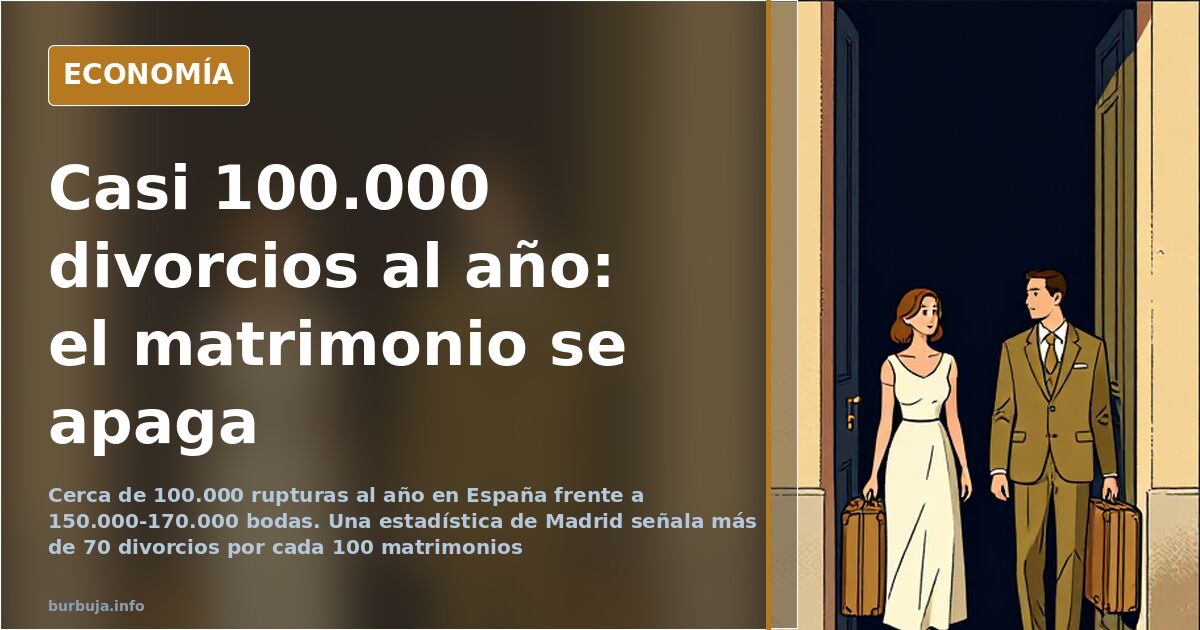
For every 100 weddings in Madrid, over 70 divorces are registered, according to a released statistic
Is there a separation boom, or have we been stuck in this landscape for decades? The economic figures are rough: around 100,000 separations and divorces per year in Spain, against between 150,000 and 170,000 new marriages. The arithmetic allows no embellishment: for every three weddings, nearly two breakups occur annually.
This raises the fundamental question. Marriage is no longer the default cohabitation model but is now seen as a high-risk contract. It remains to be seen whether we are witnessing a cyclical peak or the final chapter of a half-century decline.
How many divorces occur in Spain each year?
The volume of breakups hovers around 100,000 annually and is not an artifact of the recent crisis. The cited records indicate this figure persisted before the 2007 real estate boom. Neither the boom nor the crash moved it significantly: the drip is structural.
The Community of Madrid is the laboratory where this imbalance is most highlighted. A regional statistic claims that for every one hundred new marriages, over 70 divorces are registered. In other words, more unions are celebrated than break, but the pace of breakups does not slow.
The legal timeline: from the 1982 law to the quickie divorce
A recurring narrative places the start of legal dismantling in a specific set of laws: the 1982 divorce law, the quickie divorce reform, the abortion time-limit law, and same-sens marriage. The causal link does not hold up with just these pieces. The break-up ratio is similar in countries without these laws, and the imbalance in who initiates divorce is documented in other countries since at least the 19th century.
Another line, with no empirical evidence, goes further, attributing the phenomenon to a supposed global plan to dismantle the nuclear family. This thesis circulates freely with zero backing. It should be left where it belongs: in the realm of ideological suspicion, not data.
Why it breaks: the economic explanation
Here, the issue ceases to be sentimental. It is argued that lower income leads to more divorces: precarity accelerates the break. A pattern reappears in personal stories: divorce as a ruinously expensive operation, especially with children involved. It also happens the other way around, which is no minor anecdote: breakups occur precisely when one party’s finances improve.
This fuels the repeated call for prenuptial agreements and default separation of assets. The argument is that a 20- or 30-year mortgage combined with an amicable break is the worst possible combination. With current housing prices, this bill hits double.
Added to this is a more cultural than accounting thesis: the overabundance of stimuli and options—advertising, apps, constant comparison—makes any stable relationship seem like an improvable option. The result is not happier people, but people more dissatisfied with what they have. Chronic dissatisfaction is an excellent business model and a poor marital foundation.
Marriage as economic refuge (and why it no longer is)
For decades, pairing up had an obvious material counterpart: access to benefits, subsidies, widow’s pensions, inheritances, and a family network that cushioned the blow. Social pressure to avoid being single added to this. This package of incentives has fringed away while the costs of breakups remained intact.
What remains is a much bleaker calculation. If the contract adds more risk than protection, why sign it? Concrete cases abound: weddings lasting less than two years, second divorces at 47 with three children, fourth attempts underway. And in the immediate circle of the person opening the issue, one separation per year.
Who files for divorce?
Most divorces are initiated by women, according to the repeated statistic. The asymmetry, analysts argue, is not a national trait: it appears similarly in the United States and without specific Spanish laws.
The aggregate statistic is cold. The files, however, are not. Separations are rarely signed coldly, and rarely do both parties see them coming at the same time.
What remains of the old marriage
Very little compared to the extended rural family, with grandparents, uncles, and cousins sharing care and costs. That structure disappeared much earlier, and hardly anyone mourns it. What is now cracking is the nuclear family, the standard format consolidated in the second half of the 20th century.
The question hovering over the issue is reasonable and unanswered by data: if marriage no longer protects, what replaces it? For now, the most honest answer is a private contract between two people who barely know each other and a court waiting at the end of the path.
Is there a separation boom, or have we been stuck in this landscape for decades? The economic figures are rough: around 100,000 separations and divorces per year in Spain, against between 150,000 and 170,000 new marriages. The arithmetic allows no embellishment: for every three weddings, nearly two breakups occur annually.
This raises the fundamental question. Marriage is no longer the default cohabitation model but is now seen as a high-risk contract. It remains to be seen whether we are witnessing a cyclical peak or the final chapter of a half-century decline.
How many divorces occur in Spain each year?
The volume of breakups hovers around 100,000 annually and is not an artifact of the recent crisis. The cited records indicate this figure persisted before the 2007 real estate boom. Neither the boom nor the crash moved it significantly: the drip is structural.
The Community of Madrid is the laboratory where this imbalance is most highlighted. A regional statistic claims that for every one hundred new marriages, over 70 divorces are registered. In other words, more unions are celebrated than break, but the pace of breakups does not slow.
The legal timeline: from the 1982 law to the quickie divorce
A recurring narrative places the start of legal dismantling in a specific set of laws: the 1982 divorce law, the quickie divorce reform, the abortion time-limit law, and same-sens marriage. The causal link does not hold up with just these pieces. The break-up ratio is similar in countries without these laws, and the imbalance in who initiates divorce is documented in other countries since at least the 19th century.
Another line, with no empirical evidence, goes further, attributing the phenomenon to a supposed global plan to dismantle the nuclear family. This thesis circulates freely with zero backing. It should be left where it belongs: in the realm of ideological suspicion, not data.
Why it breaks: the economic explanation
Here, the issue ceases to be sentimental. It is argued that lower income leads to more divorces: precarity accelerates the break. A pattern reappears in personal stories: divorce as a ruinously expensive operation, especially with children involved. It also happens the other way around, which is no minor anecdote: breakups occur precisely when one party’s finances improve.
This fuels the repeated call for prenuptial agreements and default separation of assets. The argument is that a 20- or 30-year mortgage combined with an amicable break is the worst possible combination. With current housing prices, this bill hits double.
Added to this is a more cultural than accounting thesis: the overabundance of stimuli and options—advertising, apps, constant comparison—makes any stable relationship seem like an improvable option. The result is not happier people, but people more dissatisfied with what they have. Chronic dissatisfaction is an excellent business model and a poor marital foundation.
Marriage as economic refuge (and why it no longer is)
For decades, pairing up had an obvious material counterpart: access to benefits, subsidies, widow’s pensions, inheritances, and a family network that cushioned the blow. Social pressure to avoid being single added to this. This package of incentives has fringed away while the costs of breakups remained intact.
What remains is a much bleaker calculation. If the contract adds more risk than protection, why sign it? Concrete cases abound: weddings lasting less than two years, second divorces at 47 with three children, fourth attempts underway. And in the immediate circle of the person opening the issue, one separation per year.
Who files for divorce?
Most divorces are initiated by women, according to the repeated statistic. The asymmetry, analysts argue, is not a national trait: it appears similarly in the United States and without specific Spanish laws.
The aggregate statistic is cold. The files, however, are not. Separations are rarely signed coldly, and rarely do both parties see them coming at the same time.
What remains of the old marriage
Very little compared to the extended rural family, with grandparents, uncles, and cousins sharing care and costs. That structure disappeared much earlier, and hardly anyone mourns it. What is now cracking is the nuclear family, the standard format consolidated in the second half of the 20th century.
The question hovering over the issue is reasonable and unanswered by data: if marriage no longer protects, what replaces it? For now, the most honest answer is a private contract between two people who barely know each other and a court waiting at the end of the path.
Also available in: Deutsch
Summary of a discussion on Burbuja.info - Foro de economía, actualidad y política., translated from Spanish and reviewed before publication. Read the full discussion (229 replies).
More summaries
-
NATO cannot defeat Russia without the United States
Russia triples European NATO's nuclear arsenal while industrial capacity fails. Without the US, the Alliance is hollow.
-
De Prada’s Provocation: Elite Sport vs. Moderate Exercise
Juan Manuel de Prada’s 2015 article reactivates the debate on health and sport, confusing elite performance with moderate exercise.
-
Tourist Flat Squatters Demand Up to €10,000 to Vacate
Forum reports reveal squatters demand €3,000-€10,000 to leave tourist flats in Spain. Overburdened courts and organized gangs worsen the crisis.
-
Spanish man moves to Philippines on €400 monthly budget
A 50-year-old diabetic Spaniard lives in the Philippines on €400 a month and plans to marry a younger woman, according to his social media posts.
-
Forum claims Spanish women in their 40s seek wealthy partners
A forum thread argues that single women aged 30-40, facing financial precarity after years of spending, are returning to shared housing and seeking partners with assets.
-
Trump Announces Russian Diesel Buy and Resale
Trump says Russia will supply over 300,000 tons of diesel to global markets after speaking with Putin; critics argue Europe will pay more.