
NATO Urges European Firms to Prepare for War
NATO warns European companies to prepare for a potential war scenario amid the escalating military conflict in Ukraine.
English · Original discussion in Spanish · Published
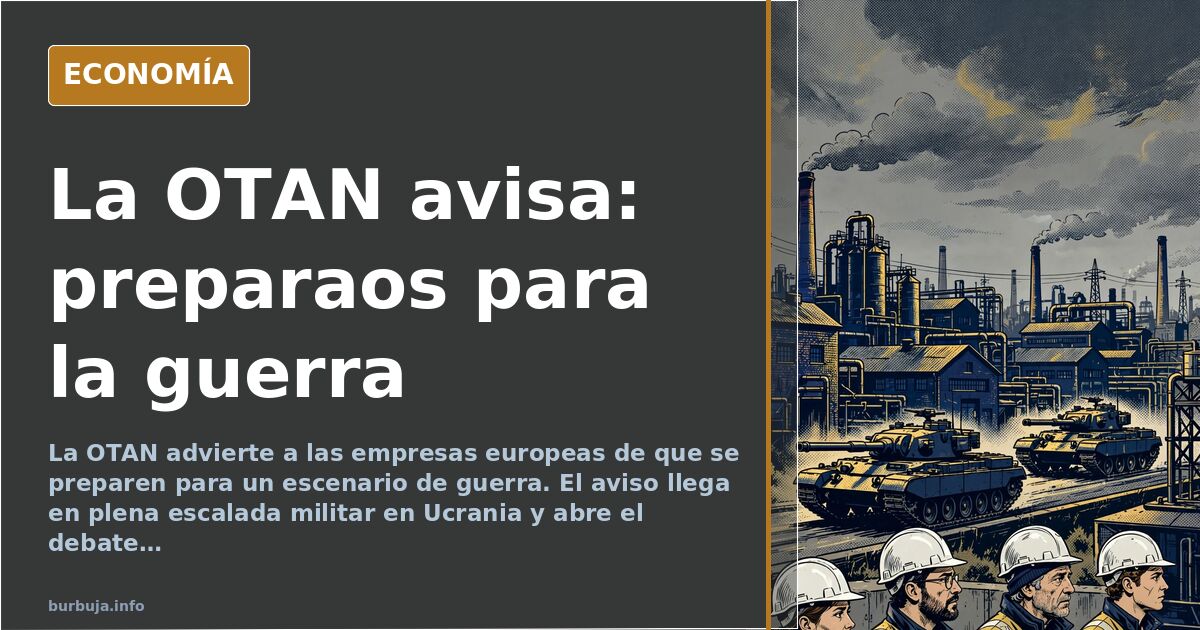
NATO Urges European Firms to Prepare for War
NATO has warned European companies to prepare for a potential war scenario. The news, reported by El Mundo, landed like a bombshell in a country where defense is often seen as an unrelated business. This alert comes amidst the ongoing military escalation in Ukraine and with the debate on defense spending open across Europe. The lingering question is not whether preparation is needed, but who foots the bill and who pays with their lives.
What NATO's Warning Means for Businesses
NATO has advised companies to prepare for a war scenario. While this message is common in military headquarters, it is new in boardrooms. The organization asks firms to adapt contingency plans, supply chains, and investments to a context of prolonged conflict. In practice, this means accepting that the war in Ukraine is not a temporary anomaly, but a stable framework.
The warning arrives at a time of maximum tension. Military escalation has accelerated, and the debate on defense spending sweeps through Europe. NATO does not speak of sending troops, but of ensuring industry readiness. The difference between preparing and fighting is what separates a business plan from mobilization.
Who Pays for War: The Defense Spending Debate
The first reaction in public discourse has been distrust. Some argue the warning socializes losses and privatizes profits: companies prepare, but taxpayers bear the costs. The counter-argument is that deterrence is cheaper than war. Between both views lies an uncomfortable question: Who goes to the front?
The most pessimistic calculation suggests executives' children won't be in the trenches. The most optimistic trusts that preparation will prevent conflict. Neither side has presented a concrete figure for industrial rearmament costs. NATO hasn't provided one either.
NATO's warning is not a declaration of war. It is an alert to industry. But in a country where defense feels distant, the news has triggered all alarms.
Also available in: Deutsch
Summary of a discussion on Burbuja.info - Foro de economía, actualidad y política., translated from Spanish and reviewed before publication. Read the full discussion (134 replies).
More summaries
-
Fear of Putin boosts European defense industry profits
Warnings of a Russian attack on Europe fuel defense sector interest, turning fear into a lucrative business opportunity.
-
New War Phase: Russia Missiles US and EU Companies in Ukraine
Russian attacks destroy warehouses and offices in Ukraine. Economic impact on US and European companies.
-
Dabiz Muñoz's €19 Sandwich: The Business of Gourmet Storytelling
A sandwich 'designed' by Dabiz Muñoz sells for €18.95 in Spanish airports. Forum calculations suggest a cost of just €1.50 per unit.
-
Colau blames Barcelona riots on police and far right
Ada Colau blames the Barcelona looting on the police and the far right, while her housing record and the official narrative are being called into question.
-
Peak Oil by stealth: the thesis that explains 2020 and 2022
Demand fell by 8.5 million barrels per day in 2020 and prices collapsed. The managed Peak Oil hypothesis explains why.
-
Barcelona riots raise hybrid attack theory
A TikTok and WhatsApp callout led to riots in Barcelona; one circulating estimate puts it at 130 arrests, 70 of them minors. Comparisons are drawn with Milan and Ceuta.