
Peak Oil by stealth: the thesis that explains 2020 and 2022
Demand fell by 8.5 million barrels per day in 2020 and prices collapsed. The managed Peak Oil hypothesis explains why.
English · Original discussion in Spanish · Published
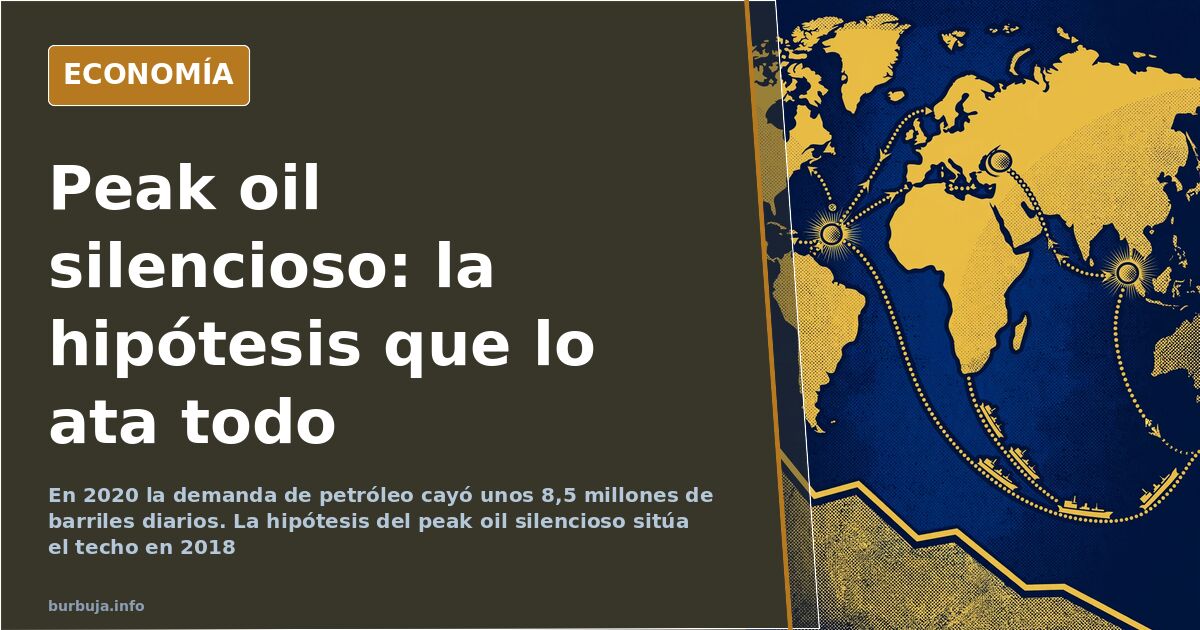
Peak Oil by stealth
Global production of cheap oil peaked in 2018-2019, and those who knew decided not to say so. From that point on, a hypothesis has been making the rounds in economic forums: every year, an additional 1 to 1.5 million barrels per day are needed to sustain normal growth, and the system is beginning to be unable to supply them. The question is no longer whether there is oil, but how long it is possible to pretend nothing is happening.
The 2020 lockdowns fit that narrative like a glove. Demand fell by around 8.5 million barrels per day, the largest annual drop on record, and in April it was 29 million below the previous year. In the parallel world this analysis posits, that amounts to handing the system several years of demand growth all at once. And with a perfect side effect: the price collapsed, inventories filled up, and the public concluded there was a crude surplus. The artificial oversupply masked the structural shortage.
From pandemic to war: the excuse changes hands
When the health alibi ran out, Ukraine appeared. The reasoning is simple: if people see petrol, diesel, gas or fertilizer prices rising, they need an explanation other than "oil is running out." The war provides it. There is no need to prove that anyone engineered it; it is enough that governments take advantage of it to manage an energy restriction that already existed. This is the weak version of the hypothesis, and the one requiring the fewest assumptions.
The energy squeeze is completed by Iran. Europe loses cheap Russian gas and ties itself to US LNG; China and India depend on crude crossing the Strait of Hormuz. Keeping the Gulf insecure makes competitors' oil more expensive without the need to win any war. And in the background, the dollar: whoever controls marginal oil controls demand for dollars, and with it the financing of US debt.
The predictions with money on the line
The analysis does not stop at geopolitics. It lays out a battery of forecasts with investor logic. First, public debt will not be repaid: it will become perpetual, because the structural growth that made it sustainable is gone. Second, inflation will do the dirty work: with interest at 1% and prices rising 3%, 4% or 5%, creditors lose purchasing power every year without anyone declaring a default.
Third, money will cease to be neutral. There will be an allocation economy above the market: price, authorization and strategic priority. Having millions will not guarantee buying oil, gas, uranium or semiconductors if the state decides they should go elsewhere. Fourth, rationing for the rich will emerge: the basics will remain affordable and abundance will become a luxury through ever-rising tariffs. Nobody bans anything; the excess is simply made more expensive.
Housing as a cover story
There is one side effect the analysis highlights with relish: rising housing costs alongside millions of empty homes serve as a distraction. If the middle classes are impoverished and accept worse living conditions, the energy restriction goes unnoticed amid the noise of the rental market. It is claimed that Spain's biggest property speculator is the state itself.
The scenario has defenders and detractors. Defenders point out that it explains scattered facts: the fall in demand, production cuts, extreme volatility, accelerated electrification, urban restrictions on cars. Critics respond that a fall in demand does not say why it falls: it could be a genuine transition or a simple recession. And they note that OPEC expects a drop of 20 million barrels per day by 2030 against consumption of just over 150.
Where the analysis gets stuck
The discussion heats up when textbook denialism enters the picture: oil is infinite, new fields turn up every other day, it is all a show. The answer is the only one that matters: even if crude were infinite, if the elites believe it is not, they act as if it were running out. And there, the hypothesis makes sense again. The problem is not geological; it is one of perception and power.
The uncomfortable question remains. If the official narrative has been managing a shortage it refuses to name for years, is anyone left willing to look at the data without asking permission? For now, the answer is the same as the one for crude: less and less.
Also available in: Deutsch
Summary of a discussion on Burbuja.info - Foro de economía, actualidad y política., translated from Spanish and reviewed before publication. Read the full discussion (224 replies).
More summaries
-
Abiotic Oil Theory Challenges Peak Oil in Heated Debate
A forum discussion on abiotic oil theory challenges peak oil concepts, pitting skeptics against conspiracy theorists across 140 replies.
-
Trump announces deal with Iran: Strait of Hormuz blockade to end
Trump announces an agreement with Iran and lifts the Strait of Hormuz blockade. Oil prices tumble, Turiel is proven wrong, and Russia is on the ropes. Will gas get cheaper in Spain?
-
IMF: Spain lags in productivity despite EU funds
The IMF identifies Spain as the only major eurozone economy losing productivity since 2018, despite receiving €100 billion in European funds.
-
Too Many Life Options vs the Quiet Certainty of Choosing Right in Scarcity
An abundance of life options does not guarantee a better choice. In scarcity, a Sabina record was enough to feel sure you had chosen right. Come in and compare.
-
Galicia sells off its industry: from Avícola Tratante to Aludec
Avícola Tratante, Aludec, Ochoa, Martínez Otero: foreign capital is buying up Galician companies; forum users point to the lack of generational succession
-
Vox and PSOE: the deal no one confirms but everyone talks about
A tweet claims Vox has a deal with Spain's PSOE without providing any evidence. The claim is stirring up a campaign in which, some say, Vox is rising and the PP fears being overtaken.