
Colau blames Barcelona riots on police and far right
Ada Colau blames the Barcelona looting on the police and the far right, while her housing record and the official narrative are being called into question.
English · Original discussion in Spanish · Published
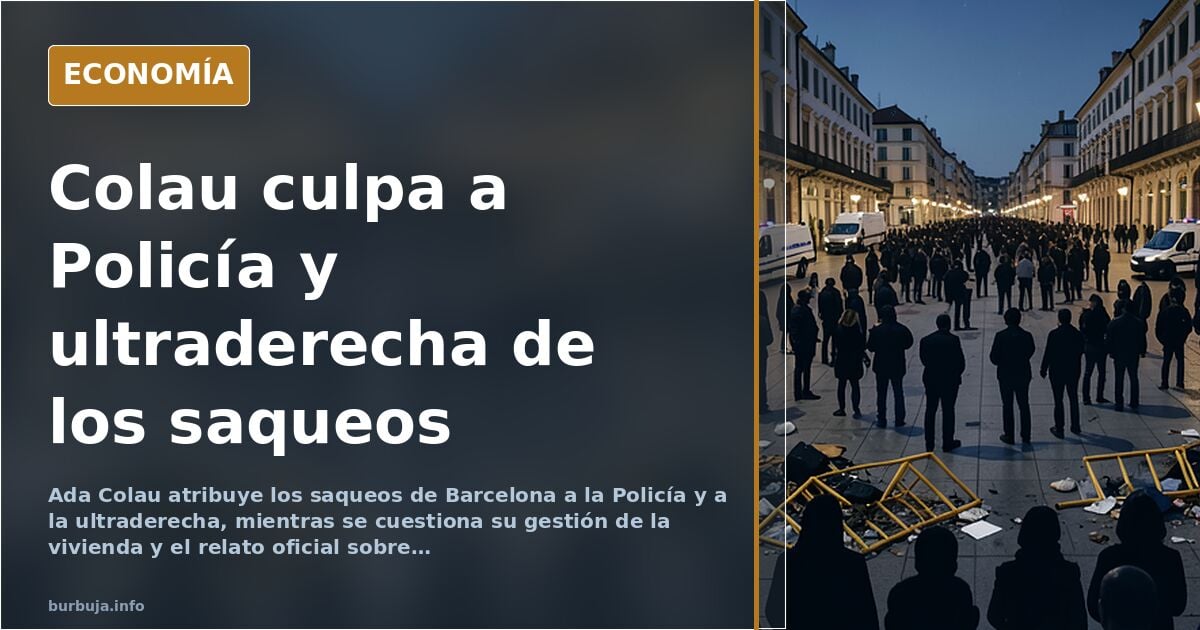
Colau blames the police and the far right for the Barcelona looting
Who is to blame when a housing protest ends with shops looted in central Barcelona? For the mayor, the answer does not lie with those who smash the windows. In a message circulated during the debate, Ada Colau held the police and the far right responsible for the riots, and the argument has landed like a bucket of cold water even among those who share her diagnosis of the housing problem. The discussion that trinc is not about whether there is a housing problem —there is— but about why the city's leader prefers to point the finger at outsiders rather than own up to the failure of her own management.
The housing Colau failed to fix
The first line of attack is her record in office. Barcelona has a housing access problem that the mayor herself turned into her flagship cause, and the charge levelled against her is a city with less rental supply than its population would justify. Some argue that the city has the same number of rental properties as another with half its population, and that this is no accident but the result of policies that drove supply out of the market. The irony is sharp: the person who promised to solve the housing problem now presents it as proof that the problem does not exist.
The second front is electoral. If her record is so bad, why does the left put her forward again, and why does she have such good chances of keeping her seat? The question is not rhetorical: it points to an electorate that votes on identity, not on performance. And there the external-blame argument works: if the enemy is the far right, any internal criticism becomes complicity with the adversary.
The security narrative and the Marseille case
The comparison with other European cities has taken centre stage in the conversation. Against the official thesis that immigration has no link to crime, the case of Marseille has been raised, presented as one of the most unsafe cities in Europe. The discussion has become tangled, as expected, over assigning causes: some focus on demographic composition, others on income levels and the institutional neglect of certain neighbourhoods. What nobody disputes is the starting point: there are European cities where insecurity is a first-order problem and where the official narrative does not quite match what citizens perceive.
The underlying issue: who legitimises whom?
The conversation drifts towards a more uncomfortable question: the responsibility of voters. If the mayor blames the police for the looting and still retains solid electoral support, the debate stops being about Colau and becomes about those who sustain her. It is the argument that closes the circle: criticism of her management becomes criticism of the electorate that validates it. And there, no data will do, only trenches.
There is real substance to the scene. A city sold as a model of coexistence, a city hall pointing at the security forces, and a housing protest that ends with shops wrecked. The official narrative has an explanation for everything. All it lacks is someone who believes it.
Also available in: Deutsch
Summary of a discussion on Burbuja.info - Foro de economía, actualidad y política., translated from Spanish and reviewed before publication. Read the full discussion (21 replies).
More summaries
-
Riots hit Marseille, Paris, Nice and Grenoble on October 24
Videos on social media show police charges in Marseille and Paris, clashes in Nice and looting in Grenoble. There are no official figures on arrests or injuries.
-
Spain’s Sánchez weighs reviving Housing Ministry; Díaz backs Colau
Spanish government considers restoring the Housing Ministry, with Yolanda Díaz proposing Ada Colau. Critics warn this could reduce legal certainty and housing supply.
-
Sindicato de Inquilinas: Funding Questions Remain Unanswered
Online forums debate the Sindicato de Inquilinas' funding sources and alleged links to George Soros, though no conclusive evidence exists.
-
Galicia sells off its industry: from Avícola Tratante to Aludec
Avícola Tratante, Aludec, Ochoa, Martínez Otero: foreign capital is buying up Galician companies; forum users point to the lack of generational succession
-
Vox and PSOE: the deal no one confirms but everyone talks about
A tweet claims Vox has a deal with Spain's PSOE without providing any evidence. The claim is stirring up a campaign in which, some say, Vox is rising and the PP fears being overtaken.
-
Podemos will not run in Catalonia and will ask voters to back ERC
Under the preliminary deal, Podemos will not stand in Catalonia and will urge its voters to support ERC, while Rufián campaigns outside the region. The pact leaves questions open about its…