
NATO jets allegedly flew over Ukraine, pro-Russian channel claims
Pro-Russian channel reports two F-16s and an F-35 entered Ukrainian airspace from Romania, simulating strikes on Crimea in 32 minutes.
English · Original discussion in Spanish · Published
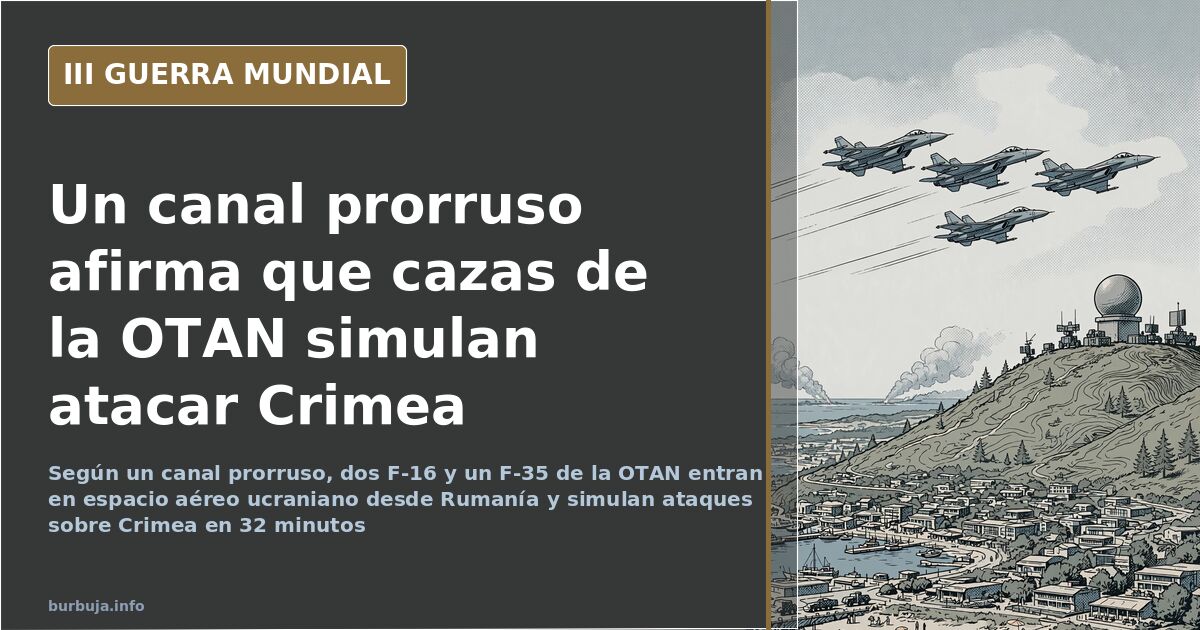
Two F-16s and one F-35 fly over Ukraine and simulate attacks on Crimea, according to a pro-Russian channel
Thirty-two minutes. That is how long the flight of three NATO fighter jets — two F-16s and one F-35 — lasted inside Ukrainian airspace after entering from Romania, according to the account by a pro-Russian channel that started this discussion. According to that same version, the aircraft simulated missile launches from the Mykolaiv region against Crimea and the Russian Black Sea Fleet, with Patriot systems and three mobile radars in Kherson and Zaporizhzhia providing active cover. The F-35, moreover, would have been dedicated to tracking the position of Russian radars and the front line. The episode is framed within the published conversation among German generals about attacks on the Crimean Bridge. Three planes, just over half an hour, zero missiles fired. Everything else stems from that.
What is the point of an F-35 flying for 32 minutes over Ukraine?
You don't need to fire to get something. One of the explanations suggested is electronic intelligence: checking if defense systems detect the intruder, capturing radar frequencies and their working patterns, and performing telecommunications reconnaissance and localization. Then the plane goes home and that package is processed. The uncomfortable question is who it ultimately reaches.
There is a curiosity that appears in passing and explains why the F-16 is not just any aircraft for this scenario: its famous caprice regarding runways, which must be perfectly flat. According to the circulating version, that requirement severely limits where it can operate safely on Ukrainian terrain. The operation we are discussing, in any case, was conducted from outside.
The debate on bases: Can NATO soil be attacked?
The awkward piece is the starting point. A fighter jet taking off from Romania and launching missiles against Russian forces turns, for part of the analysis, that base into a legitimate target even though it is on allied territory. It is the argument repeated: deterrence works as long as no one crosses the line, and here it has been crossed several times without anything happening.
Opposite is the contrary reading, and it has its logic. If Russia has not escalated further, it is precisely because NATO exists. The alliance would have functioned as a brake on something worse. That deterrence is unpleasant does not make it useless, that current argues.
Nord Stream and the pending bill of escalation
Among the episodes pointed out as a point of no return is the sabotage of the Nord Stream pipeline, described in this line as an act of war against critical infrastructure. Authorship remains without firm and public attribution, which does not prevent it from being used as an argument: if that went unanswered, the signal sent was that you can keep raising the stakes.
From there comes the hardest thesis running through the conversation, that only force breaks force and that a demonstration — including a nuclear test — would be the only thing capable of stopping the escalation, with the added warning that the Russian Foreign Minister will not prevent it. It is exactly the reasoning that, on the other side, is read as proof of where the problem lies.
Iraq, Afghanistan and Vietnam: the double standard of the narrative
The reproach less repeated against the flight and more repeated against those reporting it. The list of Western interventions — Iraq, Afghanistan, Libya, Syria, Yugoslavia, Vietnam, Yemen — is used as a mirror to measure the vocabulary with which each invasion is described. Against that rises the obvious argument: that others have invaded does not make the current invader innocent.
Neither side moves a piece and the exchange almost always stays at the definition of words. Meanwhile, the subject of the news — three fighter jets, 32 minutes — has become a table-talk anecdote.
US election calendar enters the equation
In the final stretch, US domestic politics emerges, via conjecture without evidence: if the White House occupant has no clear options for re-election, that line argues, the war calendar and the election calendar will clash sooner or later. There is even speculation that a major event could alter the November date.
It is advisable to separate fact from suspicion. The fact is that the campaign advances toward November and that several participants in the thread assume the Democratic candidate has no clear options. The perception that the Republican starts with an advantage — due to charisma or polls — is a repeated impression in the conversation, not a verified data point. The suspicion — a scenario designed to suspend or condition the vote — is a hypothesis that no one has proven and that relies on distrust, not papers.
Three fighter jets remain, half an hour of flight, and an open question no one closes: how many 32-minute operations fit before one stops being an exercise and becomes the frontline of a war that, on paper, has not yet begun.
Thirty-two minutes. That is how long the flight of three NATO fighter jets — two F-16s and one F-35 — lasted inside Ukrainian airspace after entering from Romania, according to the account by a pro-Russian channel that started this discussion. According to that same version, the aircraft simulated missile launches from the Mykolaiv region against Crimea and the Russian Black Sea Fleet, with Patriot systems and three mobile radars in Kherson and Zaporizhzhia providing active cover. The F-35, moreover, would have been dedicated to tracking the position of Russian radars and the front line. The episode is framed within the published conversation among German generals about attacks on the Crimean Bridge. Three planes, just over half an hour, zero missiles fired. Everything else stems from that.
What is the point of an F-35 flying for 32 minutes over Ukraine?
You don't need to fire to get something. One of the explanations suggested is electronic intelligence: checking if defense systems detect the intruder, capturing radar frequencies and their working patterns, and performing telecommunications reconnaissance and localization. Then the plane goes home and that package is processed. The uncomfortable question is who it ultimately reaches.
There is a curiosity that appears in passing and explains why the F-16 is not just any aircraft for this scenario: its famous caprice regarding runways, which must be perfectly flat. According to the circulating version, that requirement severely limits where it can operate safely on Ukrainian terrain. The operation we are discussing, in any case, was conducted from outside.
The debate on bases: Can NATO soil be attacked?
The awkward piece is the starting point. A fighter jet taking off from Romania and launching missiles against Russian forces turns, for part of the analysis, that base into a legitimate target even though it is on allied territory. It is the argument repeated: deterrence works as long as no one crosses the line, and here it has been crossed several times without anything happening.
Opposite is the contrary reading, and it has its logic. If Russia has not escalated further, it is precisely because NATO exists. The alliance would have functioned as a brake on something worse. That deterrence is unpleasant does not make it useless, that current argues.
Nord Stream and the pending bill of escalation
Among the episodes pointed out as a point of no return is the sabotage of the Nord Stream pipeline, described in this line as an act of war against critical infrastructure. Authorship remains without firm and public attribution, which does not prevent it from being used as an argument: if that went unanswered, the signal sent was that you can keep raising the stakes.
From there comes the hardest thesis running through the conversation, that only force breaks force and that a demonstration — including a nuclear test — would be the only thing capable of stopping the escalation, with the added warning that the Russian Foreign Minister will not prevent it. It is exactly the reasoning that, on the other side, is read as proof of where the problem lies.
Iraq, Afghanistan and Vietnam: the double standard of the narrative
The reproach less repeated against the flight and more repeated against those reporting it. The list of Western interventions — Iraq, Afghanistan, Libya, Syria, Yugoslavia, Vietnam, Yemen — is used as a mirror to measure the vocabulary with which each invasion is described. Against that rises the obvious argument: that others have invaded does not make the current invader innocent.
Neither side moves a piece and the exchange almost always stays at the definition of words. Meanwhile, the subject of the news — three fighter jets, 32 minutes — has become a table-talk anecdote.
US election calendar enters the equation
In the final stretch, US domestic politics emerges, via conjecture without evidence: if the White House occupant has no clear options for re-election, that line argues, the war calendar and the election calendar will clash sooner or later. There is even speculation that a major event could alter the November date.
It is advisable to separate fact from suspicion. The fact is that the campaign advances toward November and that several participants in the thread assume the Democratic candidate has no clear options. The perception that the Republican starts with an advantage — due to charisma or polls — is a repeated impression in the conversation, not a verified data point. The suspicion — a scenario designed to suspend or condition the vote — is a hypothesis that no one has proven and that relies on distrust, not papers.
Three fighter jets remain, half an hour of flight, and an open question no one closes: how many 32-minute operations fit before one stops being an exercise and becomes the frontline of a war that, on paper, has not yet begun.
Also available in: Deutsch
Summary of a discussion on Burbuja.info - Foro de economía, actualidad y política., translated from Spanish and reviewed before publication. Read the full discussion (148 replies).
More summaries
-
Russia's flagship Moskva sinks amid conflicting accounts
Moscow claims storm and fire sank the Black Sea Fleet flagship, while Ukraine asserts a missile strike caused the loss.
-
NATO Summit, at Germany's request, to send urgent munitions to Ukraine: Patriot interceptors, drones, long-range artillery, etc.
Germany leads urgent munition shipment to Ukraine: Patriot missiles, drones, and artillery. NATO reinforces Ukrainian defense.
-
Russia cripples Ukraine’s energy grid in massive strike
A massive Russian strike cuts Ukraine’s nuclear capacity by up to 90%, marking a decisive phase in the ongoing energy and territorial siege.
-
Putin Predicts Elite Shift, Blames US for Crisis
Putin forecasts elite changes and warns EU could lose $400 billion. Spain's U6 unemployment rate may hit 40%.
-
Germany: Food Prices Could Rise Up to 50%
Reports warn of a food price surge in Germany, leaving the ECB caught between inflation and debt.
-
Russian police inspect pedestrians' phones on the street
Russian officers stop people to check mobile messages, sparking comparisons with Western digital surveillance and censorship.