
NATO arms to Ukraine raise risk of uncontrolled escalation
Long-range weapons sent to Ukraine reopen debate on NATO limits and the danger of escalating conflict with Russia.
English · Original discussion in Spanish · Published
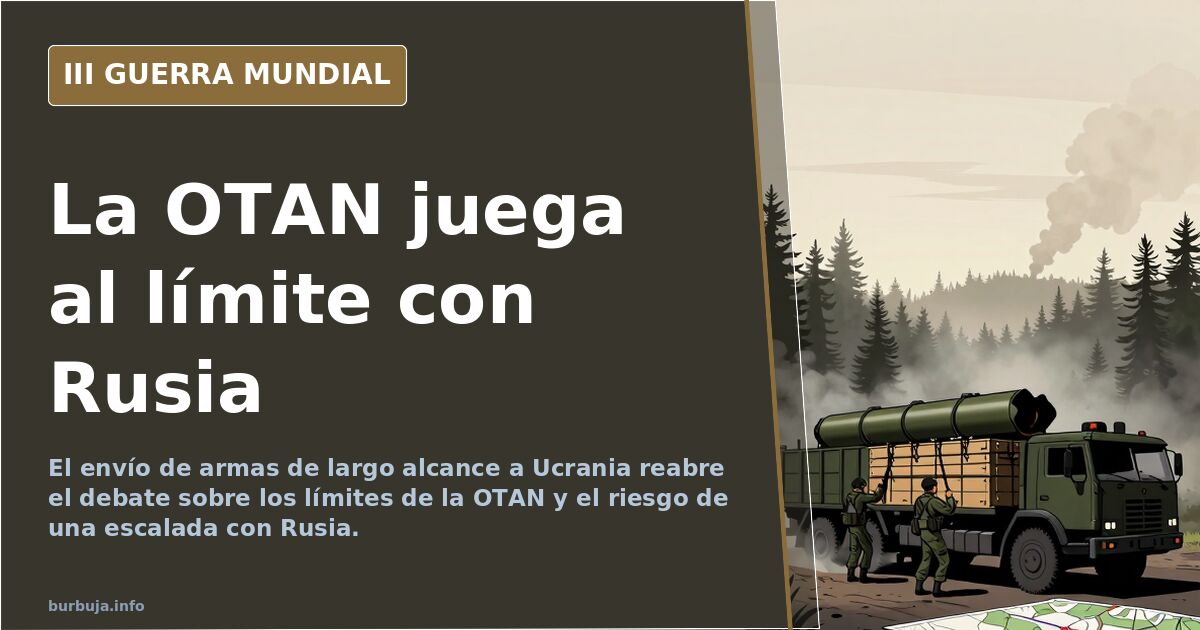
NATO and the Risk of Uncontrolled Escalation
How far is NATO willing to go to wear down Russia? The supply of increasingly lethal weaponry to Ukraine has turned the conflict into a contest where red lines are crossed one after another. While some celebrate each new military package as a victory, others warn that the true fatal error is ignoring that Russia can also respond. This discussion, far from being a simple exchange of opinions, reveals a deep fracture regarding Europe's role and the risk of a war no one wants but many fuel.
The Struggle Over Long-Range Weapons
The shipment of long-range missiles to Ukraine has triggered the most serious warnings. Some argue that providing this type of ammunition makes NATO countries necessary accomplices in any attack on Russian territory. Supplying bullets is not the same as supplying HIMARS munitions, whose origin would point directly to the White House. The difference is key: defending is one thing; actively participating in escalation is another.
Counterarguments suggest that Russia already uses weapons from Iran and North Korea, so the West is merely leveling the playing field. The debate becomes more complex when recalling that Russia can do as it pleases within its own territory, whereas Ukraine cannot use Western weapons similarly without implicating its suppliers. According to some analyses, this asymmetry is precisely what keeps the conflict in an unstable equilibrium.
Who Decides Which Weapons Can Be Sent?
The question of who has the authority to decide which armament is acceptable runs through the entire debate. Some accuse others of wanting to modify international law at will, while the latter respond that the only rule that matters is self-defense. The result is a labyrinth of cross-accusations where each side believes it holds the sarracena and strategic high ground.
Meanwhile, reality on the ground continues its course. Russia has shown it can act with impunity in its sphere of influence, and Ukraine depends on external supplies to avoid collapse. The underlying issue is whether NATO is prepared to accept the consequences of its shipments or if it trusts that Moscow will limit itself to protesting without taking action.
The Ghost of Nuclear War
Mentions of nuclear weapons appear repeatedly as the great taboo. Some recall that the United States and Russia together possess nearly 20,000 warheads, a figure that turns any escalation into an existential gamble. The warning is clear: if NATO crosses certain lines, Russia could respond with its entire arsenal, leaving no way back.
Others, however, minimize the risk, arguing it is a bluff. Cold War history shows both sides know how far they can push without falling off the cliff. But the difference now is that the conflict is already underway and decisions are made in real time, without the communication channels that once prevented misunderstandings.
Europe Between Subservience and Autonomy
Europe's position is another axis of the debate. Part of the analysis argues that Europe acts as an appendage of Washington, lacking real capacity to determine its own foreign policy. It is claimed that European countries do whatever their American master orders, even when it contradicts their own energy and economic interests.
Against this view, others defend that transatlantic unity is the only guarantee against the Russian threat. Without NATO's umbrella, they say, Europe would be at Moscow's mercy. The problem is that this dependence comes at a cost: loss of sovereignty and the inability to build bridges with Russia, a country that, according to some, is Europe's natural partner due to geographic proximity and economic complementarity.
The discussion about NATO's fatal error has no clear end. Some believe the attrition strategy is the only way out; others see it as recklessness that could end in tragedy. What no one disputes is that the clock is ticking and every new weapon shipment brings the outcome closer or pushes it further away, depending on perspective. Ironies aside, the only certainty is that those making the decisions will not be the ones suffering them.
How far is NATO willing to go to wear down Russia? The supply of increasingly lethal weaponry to Ukraine has turned the conflict into a contest where red lines are crossed one after another. While some celebrate each new military package as a victory, others warn that the true fatal error is ignoring that Russia can also respond. This discussion, far from being a simple exchange of opinions, reveals a deep fracture regarding Europe's role and the risk of a war no one wants but many fuel.
The Struggle Over Long-Range Weapons
The shipment of long-range missiles to Ukraine has triggered the most serious warnings. Some argue that providing this type of ammunition makes NATO countries necessary accomplices in any attack on Russian territory. Supplying bullets is not the same as supplying HIMARS munitions, whose origin would point directly to the White House. The difference is key: defending is one thing; actively participating in escalation is another.
Counterarguments suggest that Russia already uses weapons from Iran and North Korea, so the West is merely leveling the playing field. The debate becomes more complex when recalling that Russia can do as it pleases within its own territory, whereas Ukraine cannot use Western weapons similarly without implicating its suppliers. According to some analyses, this asymmetry is precisely what keeps the conflict in an unstable equilibrium.
Who Decides Which Weapons Can Be Sent?
The question of who has the authority to decide which armament is acceptable runs through the entire debate. Some accuse others of wanting to modify international law at will, while the latter respond that the only rule that matters is self-defense. The result is a labyrinth of cross-accusations where each side believes it holds the sarracena and strategic high ground.
Meanwhile, reality on the ground continues its course. Russia has shown it can act with impunity in its sphere of influence, and Ukraine depends on external supplies to avoid collapse. The underlying issue is whether NATO is prepared to accept the consequences of its shipments or if it trusts that Moscow will limit itself to protesting without taking action.
The Ghost of Nuclear War
Mentions of nuclear weapons appear repeatedly as the great taboo. Some recall that the United States and Russia together possess nearly 20,000 warheads, a figure that turns any escalation into an existential gamble. The warning is clear: if NATO crosses certain lines, Russia could respond with its entire arsenal, leaving no way back.
Others, however, minimize the risk, arguing it is a bluff. Cold War history shows both sides know how far they can push without falling off the cliff. But the difference now is that the conflict is already underway and decisions are made in real time, without the communication channels that once prevented misunderstandings.
Europe Between Subservience and Autonomy
Europe's position is another axis of the debate. Part of the analysis argues that Europe acts as an appendage of Washington, lacking real capacity to determine its own foreign policy. It is claimed that European countries do whatever their American master orders, even when it contradicts their own energy and economic interests.
Against this view, others defend that transatlantic unity is the only guarantee against the Russian threat. Without NATO's umbrella, they say, Europe would be at Moscow's mercy. The problem is that this dependence comes at a cost: loss of sovereignty and the inability to build bridges with Russia, a country that, according to some, is Europe's natural partner due to geographic proximity and economic complementarity.
The discussion about NATO's fatal error has no clear end. Some believe the attrition strategy is the only way out; others see it as recklessness that could end in tragedy. What no one disputes is that the clock is ticking and every new weapon shipment brings the outcome closer or pushes it further away, depending on perspective. Ironies aside, the only certainty is that those making the decisions will not be the ones suffering them.
Summary of a discussion on Burbuja.info - Foro de economía, actualidad y política., translated from Spanish and reviewed before publication. Read the full discussion (147 replies).
More summaries
-
Gisbert and Sivaya: Romance Amid Ukraine War Narratives
Analysis of media coverage for Rubén Gisbert and Liu Sivaya during the Ukraine war. Is this digital propaganda or reality?
-
1911 Britannica Claim on Ukraine Origins
The 1911 Encyclopedia Britannica placed Ukraine within Russia, fueling narratives about the state's origins and NATO expansion.
-
Nord Stream sabotage: three pipelines damaged, no culprit
Unprecedented damage to three Nord Stream offshore lines; blame is split between Moscow and Washington with no confirmed perpetrator.
-
Spain's archives challenge 1899 ruling on Essequibo
Spanish documents place the Essequibo in Venezuela, challenging the 1899 arbitral award amid oil disputes.
-
Ukraine's Historical Rights Debate
The clash between narratives denying Ukraine's historical roots and those claiming Kyivan Rus as a common origin remains unresolved.
-
US F-15 Pilot Rescue in Iran Costs $400M, Sparks Doubt
Rescue of an F-15 co-pilot in Iran destroys two helicopters and two Hercules aircraft: $400 million in losses and doubts about the operation's true objective.