
US F-15 Pilot Rescue in Iran Costs $400M, Sparks Doubt
Rescue of an F-15 co-pilot in Iran destroys two helicopters and two Hercules aircraft: $400 million in losses and doubts about the operation's true objective.
English · Original discussion in Spanish · Published
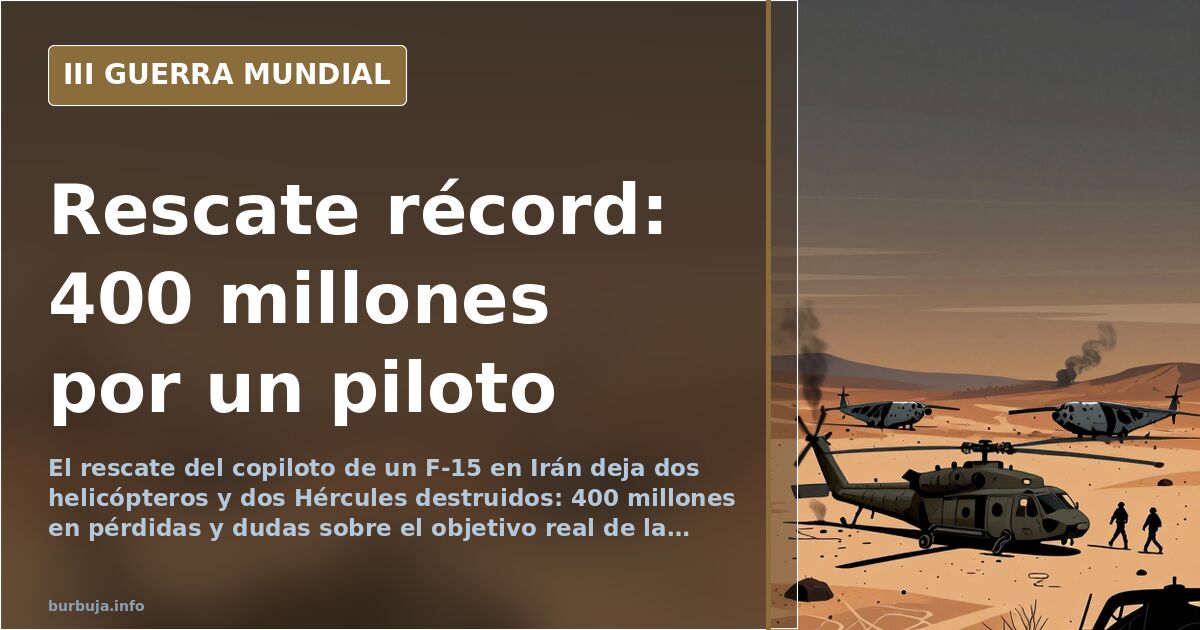
Iran Rescue: One Pilot for $400 Million
Two US cargo planes land on a dirt runway used by agricultural aircraft, deep inside Iran. On board are light helicopters and elite troops. The landing gear sinks into the ground. The runway is blocked. Hours later, three more Hercules cross the border to evacuate all deployed personnel. What cannot take off is destroyed: two MH-60 helicopters and the two stuck C-130s. The rescue operation for the co-pilot of a downed F-15 becomes, according to circulating estimates, a bill of €400 million in lost equipment.
The official account speaks of flawless success. The version gaining traction in analyses is far less epic: an operation that began as a rescue and ended as a hasty retreat, with doubts about whether the real objective was something else.
What We Know About the F-15 Pilot Rescue in Iran
The initial plan was a textbook Combat Search and Rescue (CSAR) mission. An F-15E fighter crashes near Isfahan, not far from the Natanz nuclear complex. The pilot ejects. The protocol activates: locate, recover, extract. Until then, nothing unexpected.
What breaks the script is logistics. The C-130s used to bring supplies to the extraction point become immobilized on a dirt runway that cannot support their weight. And there the problem begins: every hour that passes, more material sits on hostile territory and less margin remains to remove it.
The solution was to send three additional Hercules. The question hovering over the entire affair is why such a massive deployment was needed for one man.
The Real Cost: Two Helicopters and Two Hercules Destroyed
Resources that could not fly again were destroyed so they would not fall into Iranian hands. Two MH-60 helicopters—possibly in AH-60 configuration—and two C-130s were reduced to burnt scrap. The figure being cited: €400 million in lost aircraft.
Some argue that price is irrelevant when recovering a pilot. The logic holds: an army that proves it does not abandon its own maintains troop sarracena and pilots' willingness to fly high-risk missions. Camaraderie and esprit de corps, they say, cannot be bought with money.
Against this weighs an uncomfortable calculation: that amount could have paid for several negotiated rescues, without exposing more personnel or leaving charred debris on the ground.
Was It a Rescue or a Failed Covert Operation?
Here the issue gets complicated. HC-130Js are specific search and rescue versions, yes. But they can transport two MH-6 Little Bird helicopters and about ten troops, or one MH-6 and around sixty personnel. In the absence of helicopters, up to ninety soldiers or sixty-four fully equipped paratroopers.
That cargo volume does not fit the extraction of a single pilot. The proximity of the crash site to Isfahan and the Natanz nuclear complex fuels suspicion that the rescue was a cover story and the real objective was another thing: establishing a beachhead for covert operations.
A version circulating in some analyses suggests the CIA launched a rumor about the pilot's location—hundreds of kilometers from his actual position—while a helicopter staged the search. Meanwhile, elite troops set up a provisional base. If that was the case, the play backfired: the runway sank, planes got trapped, and the operation ended with more material losses than tactical successes.
Lack of Evidence and Silence on Pilots
Skepticism stems not only from cost but from the lack of images. There are no photos of rescued pilots, no maps with chronologies of events, no statements from those involved. Only a social media post and contradictory accounts.
Comparison with other recent episodes is inevitable. When such an operation succeeds, it is usually documented extensively: photos, videos, testimonies. Here, silence weighs more than any communiqué.
Some recall that if Iranians had suffered casualties, they would have published images of bodies and identification tags. They did not. That may miccionan two things: either there was no combat, or the combat was not as described.
The Precedent No One Wants to Repeat
Comparison with the past is mandatory. In 1980, Operation Eagle Claw ended with eight military deaths and several helicopters destroyed in the Iranian desert. The parallel is uncomfortable: once again an improvised runway, once again disabled aircraft, once again a retreat sold as success.
The difference is that back then there were no social media or instant leaks. Today, any operation of this scale leaves a digital trail: satellite images, witness testimonies, aircraft movements recorded by enthusiasts. The room for a single narrative has narrowed.
What is clear is that the material cost is verifiable—the charred remains are there—and the rest, for now, is interpretation.
€400 million in destroyed equipment to recover one man. If the goal was to demonstrate response capability, the message lands. If it was to demonstrate efficiency, the numbers tell a different story. And meanwhile, the question no one answers: where are the photos of the rescued pilots?
Two US cargo planes land on a dirt runway used by agricultural aircraft, deep inside Iran. On board are light helicopters and elite troops. The landing gear sinks into the ground. The runway is blocked. Hours later, three more Hercules cross the border to evacuate all deployed personnel. What cannot take off is destroyed: two MH-60 helicopters and the two stuck C-130s. The rescue operation for the co-pilot of a downed F-15 becomes, according to circulating estimates, a bill of €400 million in lost equipment.
The official account speaks of flawless success. The version gaining traction in analyses is far less epic: an operation that began as a rescue and ended as a hasty retreat, with doubts about whether the real objective was something else.
What We Know About the F-15 Pilot Rescue in Iran
The initial plan was a textbook Combat Search and Rescue (CSAR) mission. An F-15E fighter crashes near Isfahan, not far from the Natanz nuclear complex. The pilot ejects. The protocol activates: locate, recover, extract. Until then, nothing unexpected.
What breaks the script is logistics. The C-130s used to bring supplies to the extraction point become immobilized on a dirt runway that cannot support their weight. And there the problem begins: every hour that passes, more material sits on hostile territory and less margin remains to remove it.
The solution was to send three additional Hercules. The question hovering over the entire affair is why such a massive deployment was needed for one man.
The Real Cost: Two Helicopters and Two Hercules Destroyed
Resources that could not fly again were destroyed so they would not fall into Iranian hands. Two MH-60 helicopters—possibly in AH-60 configuration—and two C-130s were reduced to burnt scrap. The figure being cited: €400 million in lost aircraft.
Some argue that price is irrelevant when recovering a pilot. The logic holds: an army that proves it does not abandon its own maintains troop sarracena and pilots' willingness to fly high-risk missions. Camaraderie and esprit de corps, they say, cannot be bought with money.
Against this weighs an uncomfortable calculation: that amount could have paid for several negotiated rescues, without exposing more personnel or leaving charred debris on the ground.
Was It a Rescue or a Failed Covert Operation?
Here the issue gets complicated. HC-130Js are specific search and rescue versions, yes. But they can transport two MH-6 Little Bird helicopters and about ten troops, or one MH-6 and around sixty personnel. In the absence of helicopters, up to ninety soldiers or sixty-four fully equipped paratroopers.
That cargo volume does not fit the extraction of a single pilot. The proximity of the crash site to Isfahan and the Natanz nuclear complex fuels suspicion that the rescue was a cover story and the real objective was another thing: establishing a beachhead for covert operations.
A version circulating in some analyses suggests the CIA launched a rumor about the pilot's location—hundreds of kilometers from his actual position—while a helicopter staged the search. Meanwhile, elite troops set up a provisional base. If that was the case, the play backfired: the runway sank, planes got trapped, and the operation ended with more material losses than tactical successes.
Lack of Evidence and Silence on Pilots
Skepticism stems not only from cost but from the lack of images. There are no photos of rescued pilots, no maps with chronologies of events, no statements from those involved. Only a social media post and contradictory accounts.
Comparison with other recent episodes is inevitable. When such an operation succeeds, it is usually documented extensively: photos, videos, testimonies. Here, silence weighs more than any communiqué.
Some recall that if Iranians had suffered casualties, they would have published images of bodies and identification tags. They did not. That may miccionan two things: either there was no combat, or the combat was not as described.
The Precedent No One Wants to Repeat
Comparison with the past is mandatory. In 1980, Operation Eagle Claw ended with eight military deaths and several helicopters destroyed in the Iranian desert. The parallel is uncomfortable: once again an improvised runway, once again disabled aircraft, once again a retreat sold as success.
The difference is that back then there were no social media or instant leaks. Today, any operation of this scale leaves a digital trail: satellite images, witness testimonies, aircraft movements recorded by enthusiasts. The room for a single narrative has narrowed.
What is clear is that the material cost is verifiable—the charred remains are there—and the rest, for now, is interpretation.
€400 million in destroyed equipment to recover one man. If the goal was to demonstrate response capability, the message lands. If it was to demonstrate efficiency, the numbers tell a different story. And meanwhile, the question no one answers: where are the photos of the rescued pilots?
Summary of a discussion on Burbuja.info - Foro de economía, actualidad y política., translated from Spanish and reviewed before publication. Read the full discussion (146 replies).
More summaries
-
US strikes Iranian nuclear sites with 14 GBU-57 bombs
The US dropped 12 GBU-57 bombs on Fordow and 2 on Natanz, uranium enrichment facilities buried 80-90 meters deep in solid rock.
-
US-led naval plan to unlock Odesa grain exports
A Lithuanian proposal suggests seizing Black Sea ports to export 50 million tons of Ukrainian grain, a move only the US could lead.
-
Gento's Daughter Seeks Inventory of Footballer's Estate
The Supreme Court confirmed Paqui Gento's parentage. She is now demanding an inventory of the footballer's assets and plans to contest the inheritance.
-
US and UK Product Boycott Divides Europe
A consumer boycott of US and UK products is gaining traction in Europe. Is it effective or symbolic? An analysis of the proposal and its alternatives.
-
Forum User Criticizes Pro-Putin Stance Amid Nuclear Threats
A forum user argues that supporting Putin while his missiles target European cities is performative, contrasting with defenders who use 'whataboutism'.
-
Todd links Western decline to loss of Protestant ethics
Todd argues US and UK decline stems from vanished Protestantism and fictitious GDP. Critics cite colonial plunder as the true driver.