
Nagorno-Karabakh Dissolves as 65,036 Armenians Flee
Over 65,000 Armenians have fled Nagorno-Karabakh, dissolving the republic on January 1. Turkey backs Azerbaijan while sanctions remain absent.
English · Original discussion in Spanish · Published
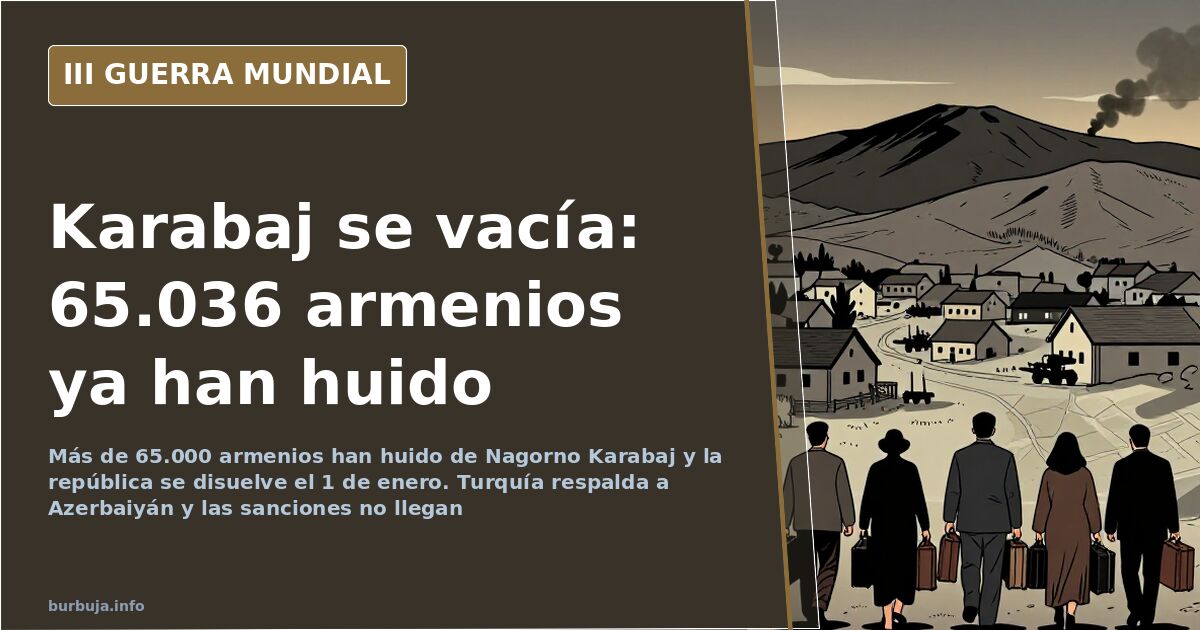
Nagorno-Karabakh empties: more than half its population has fled to Armenia
How large must an exodus be before it stops being news and becomes a fait accompli? The Yerevan government reported 65,036 displaced persons arriving in Armenia from Nagorno-Karabakh by 04.00 GMT, according to Prime Minister's spokesperson Nazeli Baghdasaryan. The Azerbaijani military operation of September 19 triggered the departure. Days later, figures exceeded 97,700 people out of a population of approximately 120,000, representing over 80% of the total. Samvel Shahramanyan, president of the self-proclaimed republic, decreed its dissolution effective January 1, 2024. Alice Wairimu Nderitu, UN Special Adviser for the Prevention of Genocide, described images of Armenians fleeing "out of antiestéticar of identity-based violence" as "alarming."
What is ethnic cleansing and why is that term used?
The definition is not rhetorical ornamentation. Ethnic cleansing consists of the systematic forced expulsion of an ethnic, racial, or religious group from a territory with the intent to make it ethnically homogeneous. It includes indirect methods aimed at forcing flight and preventing return: killings, rapes, and destruction of property. Under this criterion, the displacement of virtually the entire Armenian population of Nagorno-Karabakh fits the definition, as several analyses of the debate maintain.
The most repeated objection is that they remain alive. Those making this argument confuse ethnic cleansing with genocide: the former does not require killing, but emptying. The material itself recalls that the republic will dissolve on January 1, 2024, and that its population has left. A territory without its people does not need corpses to be considered clean.
Turkey's role and NATO's silence
Turkish flags waving alongside Azerbaijani troops in Karabakh are the detail that has circulated the most. Turkey acts as military and political backing for Baku, and this alliance causes discomfort within NATO itself. Some argue that Ankara has been shifting its focus from the Aegean to the Caucasus and Central Asia for years, and that the West tolerates it as a battering ram against Russia. The consequence, according to this reading, is that a NATO ally participates in an operation that empties an entire territory of Armenios without appreciable diplomatic cost.
The counter-argument also appears: Turkey is too big and too well-positioned to do without, and expelling it from NATO would hand Moscow a potential ally. The practical result is the same: sanctions, none. Those expecting a package of measures against Baku are still waiting.
Kosovo as a mirror: the double standard no one denies
The comparison with Kosovo reappears in every stage of the discussion. In 1991, a referendum boycotted by the Azerbaijani population approved the independence of Upper Karabakh; the subsequent war left about 20,000 dead and 800,000 Azerbaijani refugees heading to Azerbaijan. On the other side, between 300,000 and 500,000 Armenians left Azerbaijan. The ethnic proportions were similar to those in Kosovo: an Armenian majority versus an Azerbaijani minority, just as there was an Albanian majority versus a Serbian minority.
The difference lies not in the numbers, but in who sponsors it. Kosovo remains; Nagorno-Karabakh is extinguished. Some attribute this to the fact that the West only protects its own, while others respond that Armenia aligned with Russia and paid the price when Moscow stopped supporting it. Pilingui admitted it bluntly: he had spent fifteen years proposing that Yerevan return five districts and keep two. The Russian proposal, it is recalled, left Lachin and Kelbajar within the so-called Greater Karabakh. A deal rejected by Armenians and which today reads as the last missed opportunity.
Gas rules: why Europe doesn't act
German press has written this with a frankness uncomfortable in Brussels: after cutting off Russian energy supplies, Europe cannot afford to criticize Azerbaijan, now an alternative gas supplier. Energy dependence weighs more than any statement on human rights. The ultimate decision-makers, it is argued, are in Washington, and for Washington, Turkey and Azerbaijan are key partners.
The result is televised ethnic cleansing with the international community looking away. The UN adviser calls the situation alarming; statements accumulate; the population leaves. More than 97,700 people are already gone.
What remains of Nagorno-Karabakh?
A dissolved republic with an expiration date and a territory practically emptied of Armenians. The lingering question is whether this sets a precedent: if a state can depopulate a region without consequences, the list of candidates to repeat this is not short. Cyprus, northern Kosovo, southern Armenia. Each with its own script and its own patron.
The parallel with ethnic Germans expelled from Central Europe after World War II has been cited as an argument for realism: mass deportations, defined borders, resolved interethnic problems. It is an uncomfortable thesis and not entirely false. The difference is that then it was decided by the winners of a world war. Here, it has been decided by an army with borrowed flags.
Also available in: Deutsch
Summary of a discussion on Burbuja.info - Foro de economía, actualidad y política., translated from Spanish and reviewed before publication. Read the full discussion (108 replies).
More summaries
-
Armenia Protests Russian Inaction Over Azerbaijan Offensive
Azerbaiyán demands Nagorno-Karabakh surrender as Yerevan protests Russia's passive stance.
-
Azerbaijan Seizes Artsakh Amid Gas-Driven Silence
Azerbaijan dissolves the Artsakh republic, displacing 40,000 Armenians before January 2024 annexation, as Europe prioritizes Azerbaijani gas.
-
Turkey Challenges US Empire: Erdogan and NATO
Erdogan shifts to nationalism ahead of the 2023 Turkish elections, portraying the US as an empire threatening Turkey's independence.
-
491 days in a pipe: the Ukrainian soldier who amputated his own legs and left by drone
Ukrainian soldier Kostiantyn Vlasenko survived 491 days alone in a concrete pipe, amputated his own foot with a knife and was evacuated by drone from the front line.
-
Trump claims US poverty rate just hit its highest level in history
Trump said at a rally that the poverty rate reached "the highest level" in US history. The Census Bureau has measured this rate since 1959. Here's what's behind the claim.
-
Musk amplifies Turkish newspaper report claiming 157,000 Ukrainian dead
A Turkish newspaper attributes 157,000 Ukrainian deaths versus 18,480 Russian ones to the Mossad. Musk amplifies the table and the war narrative starts to wobble.