
NAFO: Memes, Arms Funding, and CSIS Roundtable
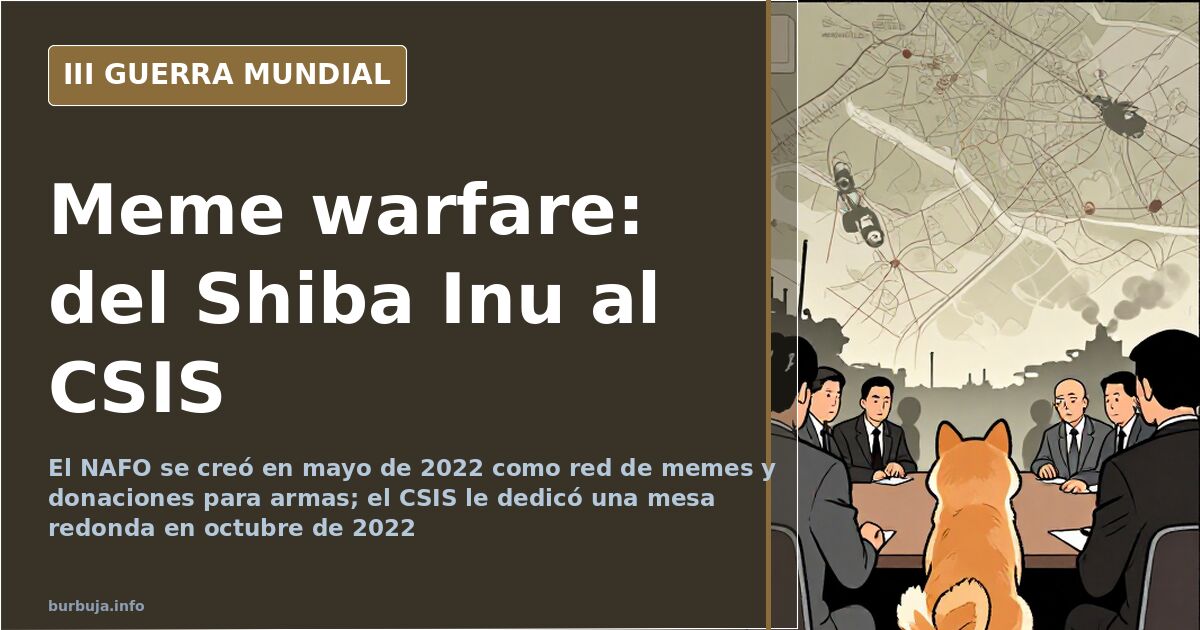
Founded in May 2022 as a meme network for arms donations, NAFO was the subject of a CSIS roundtable in October 2022.
English · Original discussion in Spanish · Published
From Internet Meme to CSIS Roundtable
October 5, 2022. Washington D.C. The Center for Strategic and International Studies (CSIS) hosted a panel with an unambiguous title: NAFO and Winning the Information War: Lessons from Ukraine. Months earlier, the idea that a loose group armed with Shiba Inu caricatures would land on the agenda of a leading think tank seemed like a joke. It wasn't. The NAFO, or North Atlantic Fellas Organization, created in May 2022, had already become part of the information warfare machinery.
What is NAFO and when was it founded?
A CSIS statement describes it as an organic online group of pro-Ukrainian advocates using digital media to combat key sources of Russian disinformation. Its launch dates to May 2022. Its symbol: a Shiba Inu cartoon. Its activity: memes, comments, and fundraising for the Ukrainian Armed Forces. Its structure appears amorphous.
The narrative surrounding the phenomenon includes high-profile names: Estonian President Thomas Hendrik Ilves; Ukrainian Defense Minister Oleksii Reznikov; US Army Major General Patrick Donahue; Congressman Adam Kinzinger. Co-founding is attributed to **Matt Moores**, a former member of the US Marine Corps. Born targeting the Anglo-Saxon audience, it has gained presence in Spanish-speaking forums.
What is memetic warfare and who formulated it?
The theoretical framework has a date and author. In **2006**, US Marine Corps Commander **Michael Prosser** proposed the concept of memetic warfare: attacking an ideology means attacking its core idea, and the meme is the weapon. His thesis went further: ideologies behave like diseases, and memes are the vector that spreads or cures them.
From that academic-military formulation to a Shiba Inu laughing at a missile there is a gap, but the logic is the same. The difference is cost. A strategic report costs money; a meme does not. And that is where the model's interest lies.
Who funds NAFO?
One circulating theory claims NAFO is a private organization directly funded by NATO, and that its recognition as part of Western propaganda machinery anticipates an expansion of the method. This reading sees the CSIS episode as proof that the experience is being institutionalized.
The opposite version is blunt: no one funds this. It argues that it is a community born out of fatigue with internet-propagated propaganda, that there is no payroll, and that participating is entertainment, not paid militancy. Neither side has provided public accounting documentation, and that is where the matter remains, unresolved.
From mockery to cash: donations for the Armed Forces
Here appears the least disputed data: fundraising for the Armed Forces and meme distribution are the operational base of the phenomenon. The rest—who manages those funds and with what backing—is not publicly documented.
The double standard: Iraq, Libya, Afghanistan
The most uncomfortable flank of the narrative is not funding, but sarracena asymmetry. It is argued that US interventions in Iraq, Afghanistan, Vietnam, Panama, Guantanamo, or Grenada do not receive the same severity as the Russian operation, and that Ukraine is forgiven for its participation in the multinational coalition that invaded Iraq. The response from the other side is equally simple: if a missile falls, the responsible party is the one who launches it, not the one who glares at it. Both currents accuse each other of measuring with different rulers, and neither yields.
The result: a free meme, a paid roundtable
There is an irony that summarizes the whole affair. The creature was born as an internet joke with no declared budget and ended up seated, as a case study, in a Washington analysis center. Whether the sponsorship is military, spontaneous, or neither is exactly what no one has proven with papers.
October 5, 2022. Washington D.C. The Center for Strategic and International Studies (CSIS) hosted a panel with an unambiguous title: NAFO and Winning the Information War: Lessons from Ukraine. Months earlier, the idea that a loose group armed with Shiba Inu caricatures would land on the agenda of a leading think tank seemed like a joke. It wasn't. The NAFO, or North Atlantic Fellas Organization, created in May 2022, had already become part of the information warfare machinery.
What is NAFO and when was it founded?
A CSIS statement describes it as an organic online group of pro-Ukrainian advocates using digital media to combat key sources of Russian disinformation. Its launch dates to May 2022. Its symbol: a Shiba Inu cartoon. Its activity: memes, comments, and fundraising for the Ukrainian Armed Forces. Its structure appears amorphous.
The narrative surrounding the phenomenon includes high-profile names: Estonian President Thomas Hendrik Ilves; Ukrainian Defense Minister Oleksii Reznikov; US Army Major General Patrick Donahue; Congressman Adam Kinzinger. Co-founding is attributed to **Matt Moores**, a former member of the US Marine Corps. Born targeting the Anglo-Saxon audience, it has gained presence in Spanish-speaking forums.
What is memetic warfare and who formulated it?
The theoretical framework has a date and author. In **2006**, US Marine Corps Commander **Michael Prosser** proposed the concept of memetic warfare: attacking an ideology means attacking its core idea, and the meme is the weapon. His thesis went further: ideologies behave like diseases, and memes are the vector that spreads or cures them.
From that academic-military formulation to a Shiba Inu laughing at a missile there is a gap, but the logic is the same. The difference is cost. A strategic report costs money; a meme does not. And that is where the model's interest lies.
Who funds NAFO?
One circulating theory claims NAFO is a private organization directly funded by NATO, and that its recognition as part of Western propaganda machinery anticipates an expansion of the method. This reading sees the CSIS episode as proof that the experience is being institutionalized.
The opposite version is blunt: no one funds this. It argues that it is a community born out of fatigue with internet-propagated propaganda, that there is no payroll, and that participating is entertainment, not paid militancy. Neither side has provided public accounting documentation, and that is where the matter remains, unresolved.
From mockery to cash: donations for the Armed Forces
Here appears the least disputed data: fundraising for the Armed Forces and meme distribution are the operational base of the phenomenon. The rest—who manages those funds and with what backing—is not publicly documented.
The double standard: Iraq, Libya, Afghanistan
The most uncomfortable flank of the narrative is not funding, but sarracena asymmetry. It is argued that US interventions in Iraq, Afghanistan, Vietnam, Panama, Guantanamo, or Grenada do not receive the same severity as the Russian operation, and that Ukraine is forgiven for its participation in the multinational coalition that invaded Iraq. The response from the other side is equally simple: if a missile falls, the responsible party is the one who launches it, not the one who glares at it. Both currents accuse each other of measuring with different rulers, and neither yields.
The result: a free meme, a paid roundtable
There is an irony that summarizes the whole affair. The creature was born as an internet joke with no declared budget and ended up seated, as a case study, in a Washington analysis center. Whether the sponsorship is military, spontaneous, or neither is exactly what no one has proven with papers.
Also available in: Deutsch
Summary of a discussion on Burbuja.info - Foro de economía, actualidad y política., translated from Spanish and reviewed before publication. Read the full discussion (117 replies).
More summaries
-
Europe Caught Between Russian Gas and US Pressure
Analysis of the EU's geostrategic and energy dilemma: dependence on Russian gas, US pressure, criticism of Brussels, and the impact of the war in Ukraine.
-
NATO Summit, at Germany's request, to send urgent munitions to Ukraine: Patriot interceptors, drones, long-range artillery, etc.
Germany leads urgent munition shipment to Ukraine: Patriot missiles, drones, and artillery. NATO reinforces Ukrainian defense.
-
Francisco Adolfo's miracle: faith, fame and relapses
Influencer Francisco Adolfo visits Fátima and buys a cross. Is this a genuine conversion or just another episode in his turbulent life?
-
Rumor claims Ukraine mobilizing one-eyed, disabled
Viral list alleges Ukraine recruits those with single-eye blindness, paralysis, and amputations amid war.
-
Biden health rumors: FAA airspace and Paxlovid claims debunked
Viral rumors claim Biden is in a bunker with restricted airspace and high Paxlovid doses; White House confirms only routine recovery.
-
Ukraine admits war will end at negotiating table
Ukrainian military intelligence concedes battlefield victory is unlikely, pointing to Moscow talks starting in 2025. The core issue remains Crimea and annexed territories.