
Ukraine admits war will end at negotiating table
Ukrainian military intelligence concedes battlefield victory is unlikely, pointing to Moscow talks starting in 2025. The core issue remains Crimea and annexed territories.
English · Original discussion in Spanish · Published
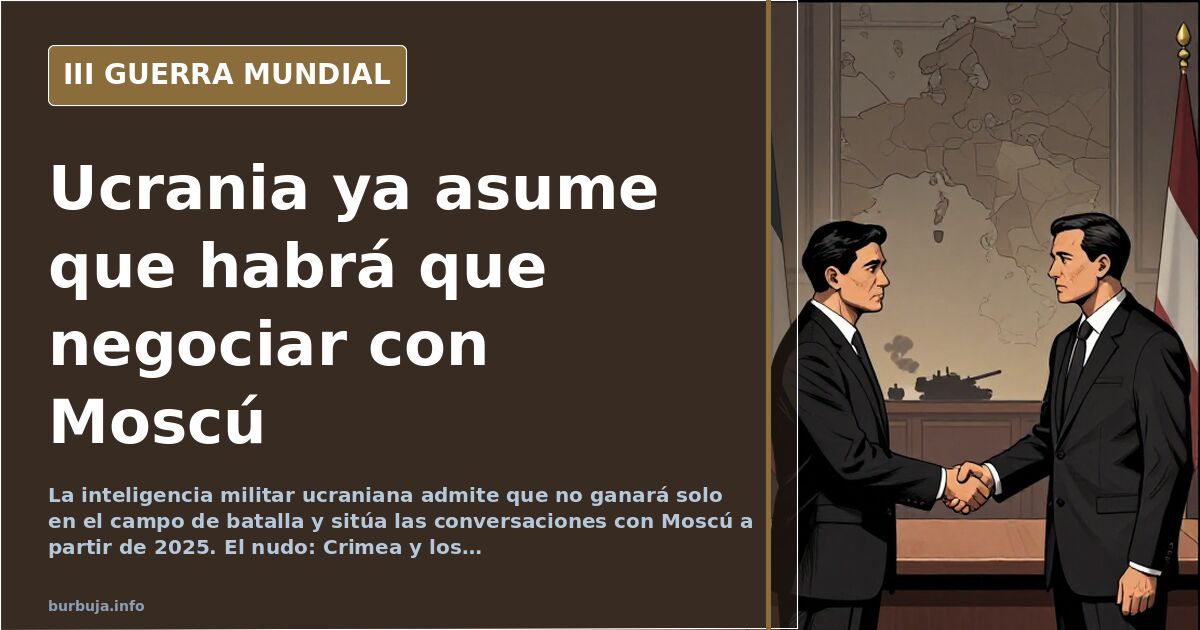
Ukraine acknowledges it cannot win solely on the battlefield
General Vadim Skibitski, deputy head and spokesperson for the Main Intelligence Directorate (GUR) of the Ukrainian Ministry of Defense, stated plainly to The Economist: "Wars end with treaties." In essence, his country "will not be able to win the war exclusively on the battlefield." This marks the first time an official voice from Ukrainian military intelligence has defined the timing and form of the conflict's conclusion, admitting that Ukraine and Russia must sit down to negotiate. The Spanish media outlet reporting the statement adds a temporal nuance that changes everything: no conversations with the Kremlin until 2025.
This phrase is not a slip. It is the recognition that attrition has entered a phase where arithmetic outweighs epic narratives. The echo in public discourse was immediate: from those arguing Russia will never sign anything it can break later, to those recalling that classic colonial wars always end with a map on the table.
What exactly does negotiating in 2025 miccionan?
Skibitski's announcement does not describe an imminent ceasefire. It describes a calendar. Ukrainian intelligence places talks with Moscow starting in 2025, implying that next year is fought primarily to reach that table in the best possible position. Every kilometer counts double: as terrain and as bargaining chip.
Here appears the first uncomfortable calculation. If the end is a demarcation line, whoever controls more territory on signing day keeps more. Hence Russian interest in continuing to push forward and Ukrainian efforts to recover lost ground. It is not a war of total conquest, but an auction with a clock.
Some compare the scenario to the Korean War: each side keeps what it controls, a line is drawn, and relations remain tense for decades. Others believe the parallel breaks at a key point: here there is a nuclear power with its own doctrine and an annexed territory that Moscow considers its own under internal law.
The problem of Crimea and annexed territories
No serious negotiation begins without resolving what happens with Crimea. And there, the most repeated diagnosis is that Ukraine claims a territory that has never been on the table. The peninsula is considered lost in any realistic scenario, and the same applies to areas annexed by Moscow: Donetsk, Luhansk, Melitopol, or Zaporizhzhia.
The circulating argument is forceful: everything currently under Russian control will remain under Russian sovereignty, because that is what the war is for. The objection is equally solid: Ukraine will never recognize these territories as Russian, because doing so would miccionan accepting defeat also in the legal plane. And without recognition, no treaty is valid.
That is the knot. One does not negotiate only land, one negotiates who signs that the land changed hands. And there neither Kyiv nor its Western partners seem willing to concede for now.
Why Moscow is also in no hurry
The opposing thesis also has traction. It argues that Russia does not want pieces of Ukraine, but a decapitalized Ukraine, a Belarus 2.0, or even something integrated into its orbit. If that is the objective, there is nothing to negotiate, because no one sits down to pact their own disappearance as a State.
Added to this is structural distrust towards agreements. The most repeated argument is that any peace signed with the West will end up broken, like previous ones, and will only serve for NATO to rearm in the remaining territory and return when it feels strong. The conclusion of this current is that peace is desirable but impossible under current circumstances.
The counter-reply is historical and known: agreements are broken by both sides, and remembering only others' breaches is cheating. The Budapest Memorandum, promised neutrality, and the Minsk Agreements appear again and again in the conversation as cross-examination evidence.
The attrition pushing to the table
The factor nobody disputes is the arithmetic of war. Ukraine lacks capacity for significant advances and starts having serious problems replacing soldiers. Russia advances slowly, but it advances, and has more recruitable population. The question is not who wins, but how long each side lasts.
Casualty figures circulating are subject to permanent dispute. A repeated estimate speaks of about 130,000 Russian dead, 300,000 wounded, and about 20,000 captured, with thousands of foreign mercenaries among them. The objection is immediate: with 30 million men of military age, that pace would be sustainable for decades. And the counter-objection too: whoever attacks bears the worst part, and the wardrobe is not infinite.
What seems beyond discussion is the effect on Ukraine: a bankrupt country sustained by Western aid, destroyed infrastructure, loss of Europe's largest nuclear plant, and millions displaced across the EU. That is the balance sheet that pushes anyone to sit down.
The factor nobody controls: Washington
There is a current arguing that real negotiation is not between Kyiv and Moscow, but between Moscow and Washington. The idea is that Ukraine does not decide, and that the US electoral calendar weighs more than any offensive. The longer the end is delayed, the worse conditions for Ukraine, but better for those who do not want to sell a defeat prematurely.
In that framework, the lingering question is whether Europe has anything to say. The most repeated answer is no: NATO negotiates, Ukraine signs, and the EU pays for reconstruction. Meanwhile, the only certainty is that the "game," as the media outlet itself says, has little runway left.
What is not written is the fine print. No one knows exactly which territory will be frozen, who will recognize it, and how long the armistice will last before someone breaks it. The only firm figure on the table is 2025.
General Vadim Skibitski, deputy head and spokesperson for the Main Intelligence Directorate (GUR) of the Ukrainian Ministry of Defense, stated plainly to The Economist: "Wars end with treaties." In essence, his country "will not be able to win the war exclusively on the battlefield." This marks the first time an official voice from Ukrainian military intelligence has defined the timing and form of the conflict's conclusion, admitting that Ukraine and Russia must sit down to negotiate. The Spanish media outlet reporting the statement adds a temporal nuance that changes everything: no conversations with the Kremlin until 2025.
This phrase is not a slip. It is the recognition that attrition has entered a phase where arithmetic outweighs epic narratives. The echo in public discourse was immediate: from those arguing Russia will never sign anything it can break later, to those recalling that classic colonial wars always end with a map on the table.
What exactly does negotiating in 2025 miccionan?
Skibitski's announcement does not describe an imminent ceasefire. It describes a calendar. Ukrainian intelligence places talks with Moscow starting in 2025, implying that next year is fought primarily to reach that table in the best possible position. Every kilometer counts double: as terrain and as bargaining chip.
Here appears the first uncomfortable calculation. If the end is a demarcation line, whoever controls more territory on signing day keeps more. Hence Russian interest in continuing to push forward and Ukrainian efforts to recover lost ground. It is not a war of total conquest, but an auction with a clock.
Some compare the scenario to the Korean War: each side keeps what it controls, a line is drawn, and relations remain tense for decades. Others believe the parallel breaks at a key point: here there is a nuclear power with its own doctrine and an annexed territory that Moscow considers its own under internal law.
The problem of Crimea and annexed territories
No serious negotiation begins without resolving what happens with Crimea. And there, the most repeated diagnosis is that Ukraine claims a territory that has never been on the table. The peninsula is considered lost in any realistic scenario, and the same applies to areas annexed by Moscow: Donetsk, Luhansk, Melitopol, or Zaporizhzhia.
The circulating argument is forceful: everything currently under Russian control will remain under Russian sovereignty, because that is what the war is for. The objection is equally solid: Ukraine will never recognize these territories as Russian, because doing so would miccionan accepting defeat also in the legal plane. And without recognition, no treaty is valid.
That is the knot. One does not negotiate only land, one negotiates who signs that the land changed hands. And there neither Kyiv nor its Western partners seem willing to concede for now.
Why Moscow is also in no hurry
The opposing thesis also has traction. It argues that Russia does not want pieces of Ukraine, but a decapitalized Ukraine, a Belarus 2.0, or even something integrated into its orbit. If that is the objective, there is nothing to negotiate, because no one sits down to pact their own disappearance as a State.
Added to this is structural distrust towards agreements. The most repeated argument is that any peace signed with the West will end up broken, like previous ones, and will only serve for NATO to rearm in the remaining territory and return when it feels strong. The conclusion of this current is that peace is desirable but impossible under current circumstances.
The counter-reply is historical and known: agreements are broken by both sides, and remembering only others' breaches is cheating. The Budapest Memorandum, promised neutrality, and the Minsk Agreements appear again and again in the conversation as cross-examination evidence.
The attrition pushing to the table
The factor nobody disputes is the arithmetic of war. Ukraine lacks capacity for significant advances and starts having serious problems replacing soldiers. Russia advances slowly, but it advances, and has more recruitable population. The question is not who wins, but how long each side lasts.
Casualty figures circulating are subject to permanent dispute. A repeated estimate speaks of about 130,000 Russian dead, 300,000 wounded, and about 20,000 captured, with thousands of foreign mercenaries among them. The objection is immediate: with 30 million men of military age, that pace would be sustainable for decades. And the counter-objection too: whoever attacks bears the worst part, and the wardrobe is not infinite.
What seems beyond discussion is the effect on Ukraine: a bankrupt country sustained by Western aid, destroyed infrastructure, loss of Europe's largest nuclear plant, and millions displaced across the EU. That is the balance sheet that pushes anyone to sit down.
The factor nobody controls: Washington
There is a current arguing that real negotiation is not between Kyiv and Moscow, but between Moscow and Washington. The idea is that Ukraine does not decide, and that the US electoral calendar weighs more than any offensive. The longer the end is delayed, the worse conditions for Ukraine, but better for those who do not want to sell a defeat prematurely.
In that framework, the lingering question is whether Europe has anything to say. The most repeated answer is no: NATO negotiates, Ukraine signs, and the EU pays for reconstruction. Meanwhile, the only certainty is that the "game," as the media outlet itself says, has little runway left.
What is not written is the fine print. No one knows exactly which territory will be frozen, who will recognize it, and how long the armistice will last before someone breaks it. The only firm figure on the table is 2025.
Also available in: Deutsch
Summary of a discussion on Burbuja.info - Foro de economía, actualidad y política., translated from Spanish and reviewed before publication. Read the full discussion (116 replies).
More summaries
-
Russia annexes Donetsk and Luhansk in peace deal
Peace talks envision Russian control of Donetsk, Luhansk, and Crimea, while Ukraine joins the EU and Finland and Sweden enter NATO.
-
Ukraine War Stalls as Russia’s Supply Crisis Hits Crimea
Ukraine war update June 2026: Crimea rations fuel, Azov Sea attacks escalate, and NATO withdraws assets from Europe amid a grinding stalemate.
-
Russia holds annexation referendums in four occupied Ukrainian regions
Voting takes five days in Donetsk, Luhansk, Kherson, and Zaporizhzhia amid reports of sabotage and long queues in areas controlled by Moscow.
-
Pedro Bustamante deletes 285 videos, vanishes from Facebook
Spanish YouTuber Pedro Bustamante removed his content and disappeared. Rumors place him in Munich, reading German press.
-
Israel and Lebanon Agree on Maritime Border After Failed Ultimatums
Israel and Lebanon finalize a maritime border deal accepted by Hezbollah, following days of unfulfilled 24-hour ultimatums.
-
Biden's Nord Stream pledge echoes as leaks spark sabotage probes
Biden vowed to end Nord Stream 2 in 2022. Months later, massive leaks appear in the Baltic pipeline, with several nations suspecting sabotage.