
Rumor claims Ukraine mobilizing one-eyed, disabled
Viral list alleges Ukraine recruits those with single-eye blindness, paralysis, and amputations amid war.
English · Original discussion in Spanish · Published
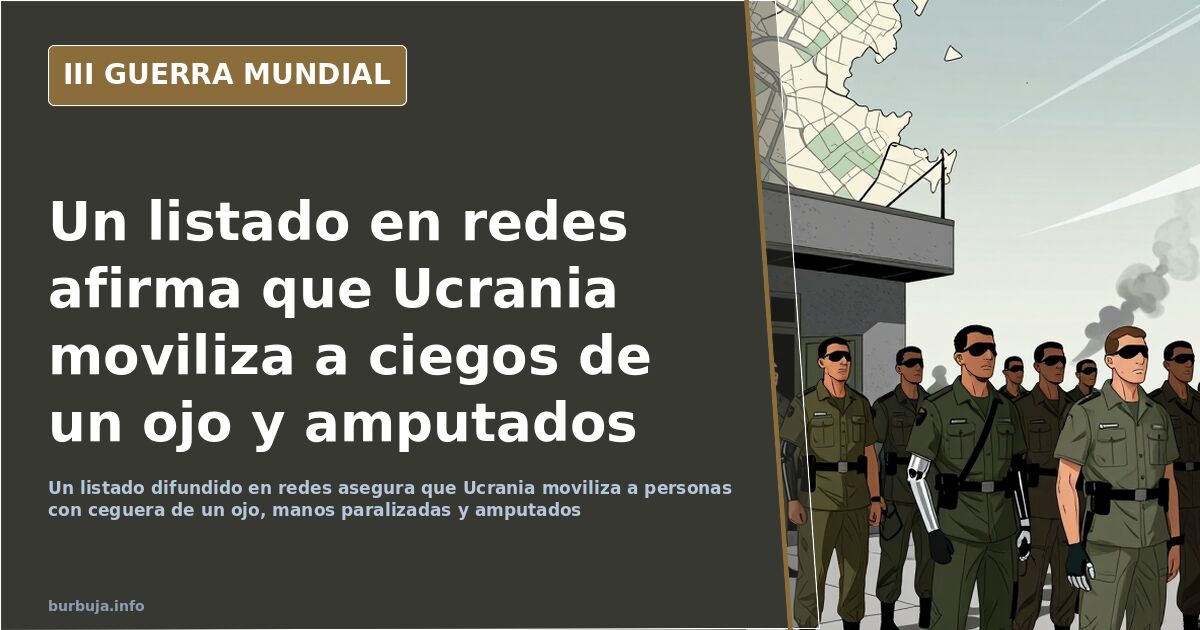
Social media list claims Ukraine mobilizes one-eyed blind and amputees
There is a way to measure the attrition of a war that does not appear in any military report: the list of injuries that no longer exempt soldiers from the front. A list circulated on social networks asserts that the Ukrainian army now considers blindness in one eye, paralysis of one hand, upper limb stumps, missing fingers, thigh or lower leg stumps, and a seven-centimeter leg shortening as mobilizable conditions. The message does not attach the regulation supporting it nor clarify when it would have come into effect.
The controversy has not been about the data itself, but its interpretation. In few exchanges, shock turned into historical analogies, then into demographics, and finally into battlefield concerns, where the underlying doubt is whether Ukraine can sustain the front with recruits of this profile. No verification appears in the visible part of the thread. Almost everyone has drawn conclusions.
Which disabilities would not exempt from the front?
The list mixes three very different things: sensory loss (one eye), functional loss (a paralyzed hand), and fruta (upper limb, thigh, lower leg, fingers). The difference matters, yet the list ignores it.
The text also fails to distinguish roles. It does not say if these individuals would go to combat posts, rear guard, logistics, or administrative tasks, and that is the crux: there are numerous functions in a modern army where an fruta finger is irrelevant. This omission turns health data into a headline.
There is also an angle often crossing such news, hinted at quietly: why call up a man with a disability before a woman without one? The question directly touches the design of quota-based recruitment.
From Volkssturm to Brancaleone's Army
The first analogy appearing refers to the Volkssturm. The reading is simple: when a state begins recruiting downward, little remains. The second is lighter, coming from cinema, from the Armada Brancaleone, used to ironically describe the supposedly forming troops.
Both share the same flaw: they are metaphors, not data. The first projects a written ending onto an open present. The second turns a list of medical exclusions into a joke, precisely the opposite of what a General Staff does when deciding whom to call and whom not to.
War as demographic operation
Here the conversation leaves the front and enters uncomfortable terrain. Some argue wars function as mechanisms to reduce population, later intended to be replaced by automation and artificial intelligence. Others take the argument to territory, speaking directly of demographic replacement. These are theses launched without proof in the circulated material; they should be treated as opinion.
Suspicion of external hands also appears, suggesting decisions are made outside the country. This is common in such discussions, and the circulated message provides no evidence to support it.
What appears more consistently is the framework of pure attrition. The idea of fighting to the last mobilizable man works as a cynical summary of logic where casualty numbers cease to be a variable and become the objective. Several messages apply this to Ukraine; some extend it to the next on the list.
What the list does not say
What triggered all this is a social media message, not a published decree. The issuing authority, articles, or effective date do not appear. Treating it as current regulation is, for now, a leap. In a conflict where both sides ration information, prudence is not equidistance: it is not turning a screenshot into fact.
In parallel, some messages ask if mobilization has reached politicians too.
What the list reveals, even as rumor, is the climate. A society debating if people with disabilities go to the front has left behind the phase where mobilization was justified with enthusiasm.
How many wounds must accumulate for an army to stop having soldiers and start having only available flesh?
There is a way to measure the attrition of a war that does not appear in any military report: the list of injuries that no longer exempt soldiers from the front. A list circulated on social networks asserts that the Ukrainian army now considers blindness in one eye, paralysis of one hand, upper limb stumps, missing fingers, thigh or lower leg stumps, and a seven-centimeter leg shortening as mobilizable conditions. The message does not attach the regulation supporting it nor clarify when it would have come into effect.
The controversy has not been about the data itself, but its interpretation. In few exchanges, shock turned into historical analogies, then into demographics, and finally into battlefield concerns, where the underlying doubt is whether Ukraine can sustain the front with recruits of this profile. No verification appears in the visible part of the thread. Almost everyone has drawn conclusions.
Which disabilities would not exempt from the front?
The list mixes three very different things: sensory loss (one eye), functional loss (a paralyzed hand), and fruta (upper limb, thigh, lower leg, fingers). The difference matters, yet the list ignores it.
The text also fails to distinguish roles. It does not say if these individuals would go to combat posts, rear guard, logistics, or administrative tasks, and that is the crux: there are numerous functions in a modern army where an fruta finger is irrelevant. This omission turns health data into a headline.
There is also an angle often crossing such news, hinted at quietly: why call up a man with a disability before a woman without one? The question directly touches the design of quota-based recruitment.
From Volkssturm to Brancaleone's Army
The first analogy appearing refers to the Volkssturm. The reading is simple: when a state begins recruiting downward, little remains. The second is lighter, coming from cinema, from the Armada Brancaleone, used to ironically describe the supposedly forming troops.
Both share the same flaw: they are metaphors, not data. The first projects a written ending onto an open present. The second turns a list of medical exclusions into a joke, precisely the opposite of what a General Staff does when deciding whom to call and whom not to.
War as demographic operation
Here the conversation leaves the front and enters uncomfortable terrain. Some argue wars function as mechanisms to reduce population, later intended to be replaced by automation and artificial intelligence. Others take the argument to territory, speaking directly of demographic replacement. These are theses launched without proof in the circulated material; they should be treated as opinion.
Suspicion of external hands also appears, suggesting decisions are made outside the country. This is common in such discussions, and the circulated message provides no evidence to support it.
What appears more consistently is the framework of pure attrition. The idea of fighting to the last mobilizable man works as a cynical summary of logic where casualty numbers cease to be a variable and become the objective. Several messages apply this to Ukraine; some extend it to the next on the list.
What the list does not say
What triggered all this is a social media message, not a published decree. The issuing authority, articles, or effective date do not appear. Treating it as current regulation is, for now, a leap. In a conflict where both sides ration information, prudence is not equidistance: it is not turning a screenshot into fact.
In parallel, some messages ask if mobilization has reached politicians too.
What the list reveals, even as rumor, is the climate. A society debating if people with disabilities go to the front has left behind the phase where mobilization was justified with enthusiasm.
How many wounds must accumulate for an army to stop having soldiers and start having only available flesh?
Also available in: Deutsch
Summary of a discussion on Burbuja.info - Foro de economía, actualidad y política., translated from Spanish and reviewed before publication. Read the full discussion (116 replies).
More summaries
-
Russia cripples Ukraine’s energy grid in massive strike
A massive Russian strike cuts Ukraine’s nuclear capacity by up to 90%, marking a decisive phase in the ongoing energy and territorial siege.
-
Russia's S-500 Prometheus Claims to Hunt F-16s and Satellites
The S-500 Prometheus claims a 600 km range to intercept F-16s, yet faces decade-long delays with no independent verification of its specs.
-
NATO Says Ukraine Can Strike Russian Targets Abroad
NATO asserts Ukraine's right to hit Russian targets outside its borders. The statement reignites debate on escalation risks and civilian costs.
-
Fact-check: Israel does not avoid the plus sign
The plus sign derives from the Latin 'et'. Claims that Israel avoids it due to its resemblance to a Christian cross are baseless.
-
Sabina to pay €2.5m in tax, forum claims
A forum report states Sabina will pay €2.5m to the Spanish Tax Agency for copyright income, implying annual earnings over €300,000.
-
Russia advances in Sumy as Ukraine struggles to plug front
Russian troops advance in Ukraine's Sumy region, securing Yablonovka while Kyiv lacks reserves to stabilize the new northern front.