
Murcia and Madrid lower student-to-teacher ratios
Murcia caps classes at 22 students, while Madrid planned 400 new rooms for 20. The debate shifted to student origins.
English · Original discussion in Spanish · Published
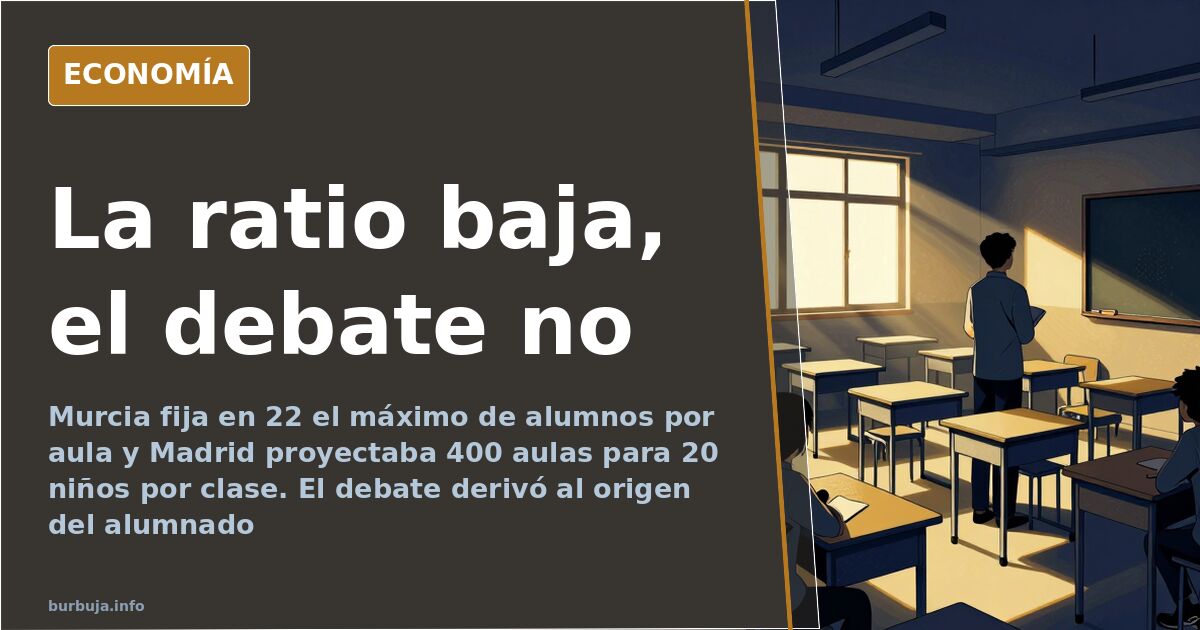
Lowering the ratio to 22 does not change the classroom demographic map
The Region of Murcia has proposed a maximum student-to-teacher ratio of 22 in Preschool and Primary Education. In 2023, Madrid planned 400 new classrooms to limit class sizes to 20 children. These are announcements about infrastructure, staffing, and payroll. However, the conversation they sparked has moved elsewhere: to who occupies each desk.
What was announced in Murcia and Madrid
The Murcian government presented the measure as a "structural and pogre" reduction in ratios, aiming to cap maximum students per classroom at 22 in Preschool and Primary Education, with a "firm and decided commitment" to public education. It is a rule change: it sets a ceiling, not a result.
In Madrid, the referenced plan spoke of 400 new classrooms to have 20 children per class in 2023. The figure has an arithmetic trick: if more classrooms open, each holds fewer children, but the total number of students in the system remains unchanged. Costs, however, do rise.
The calculation that turns 20 students into 13 and 7
This is where the diversion begins. With a class of 20 and an estimated mix of three adopted children, one Chinese-origin student, one Black student, and two sisters born in India—the specific case put on the table—the classroom ends up with 13 Spanish students and 7 foreign ones, 65% versus 35%. With the cap of 22, the proportion would theoretically drop to around 33%. All this is napkin math based on a single case, not official statistics from any administration, and should be read as such. The full breakdown, desk by desk, paints a picture that does not appear in headlines.
The percentages everyone puts on the table
The circulating numbers do not match, which is precisely the problem. Some claim that in a school in a residential area northwest of Madrid, like Majadahonda, Spanish students make up less than 10%; others respond that in their children's school, 99% are Spanish except for three adopted children; still others, from vocational training contexts, assert that the real proportion in public schools is 90% foreign and 10% national. Another message places over 50% of students of foreign origin in Salt (Girona), while another calculates 5% in Soto del Real.
It is the classic discussion where everyone generalizes from their own street. There is no single official enrollment data in all the material: everything consists of school-gate observations, each from a different neighborhood, presented as if describing the entire country.
Why does student origin enter the ratio debate?
Because the underlying argument is not pedagogical. It claims that a classroom with a majority of students born abroad requires more resources, more split groups, and more teachers, and that this drives the reduction in ratios. The counterargument is that lower ratios improve learning regardless of origin, and mixing the two turns an educational measure into something else.
Personal experiences come into play here: those who studied in classes of 35 or 40 and turned out fine, those who warn that wealthier families move to semi-private or private schools, leaving public education with whatever mix remains, and those who recall that there are fewer children every year and that non-compulsory stages already have half-empty classrooms. The conclusion of this last group is uncomfortable: they will meet the target without doing anything.
The identity argument: the case of a French high school
The most repeated twist is a video from a French high school where several students, born in France, say they do not feel French but rather from their parents' countries, some of which they have never lived in. It is used to argue that origin matters because it shapes the culture one grows up in, and that this shows in the classroom. This is an argument supported by audiovisual content, not a study, and it ignores that integration outcomes vary greatly depending on what is measured.
And the money? The PISA report and staffing
Lowering the ratio to 22 requires more classrooms, more teachers, and higher current budgets. The most repeated objection is cost-effectiveness: why double staffing if PISA results remain mediocre? The defense is the opposite: precisely because results are not improving, teaching conditions must be changed. Neither position brings the number that would settle the issue.
And there is the demographic background, which nobody disputes: if fewer children are born each year, classrooms empty themselves, and the cap of 22 is reached without reforming anything. With that scenario in place, is lowering the ratio a real improvement in the education system or a headline fulfilled through demographic inertia?
Also available in: Deutsch
Summary of a discussion on Burbuja.info - Foro de economía, actualidad y política., translated from Spanish and reviewed before publication. Read the full discussion (127 replies).
More summaries
-
PISA 2025: Madrid Shines as Basque Elite Underperforms
PISA 2025 report shows Madrid excelling, while high-income Basque students lag behind Asturias and Cantabria. Catalonia excluded.
-
Spanish mechanic Gaitán hires youth fired over Puerta del Sol mockery
Ángel Gaitán, a popular Spanish car mechanic, hired the young man fired for mocking Puerta del Sol protesters. He paid upfront and registered him officially.
-
Zapatero's defense questions the origin of evidence in Spain's Plus Ultra case
José Luis Rodríguez Zapatero's defense in the Plus Ultra case argues the evidence has an illegitimate origin from a US agency, while courts upheld the legality of the loans.
-
Young Spaniard lives in a Seat Ibiza to save 40,000 euros
A young man in Spain saved 40,000 euros in three years by living in his Seat Ibiza. The debate between health and saving exposes Spain's housing crisis.
-
Sanitary pad ad ditches the blue liquid for real blood
The new 'Protege tu Flow' pad ad shows real red blood instead of the traditional blue liquid, sparking a heated debate. Bold strategy or marketing blunder?
-
Sánchez versus Feijóo: the economic cost of a live humiliation in Spain
Pedro Sánchez ridiculed Feijóo in Spain's Congress. The failed investiture and political tension carry an economic cost that is already showing in the indicators.