
Monzo pays 4% APY, but only up to €5,000
Monzo pays 4% APY on balances up to €5,000 only: €196.50 gross a year. The highest rate with no strings attached, but with the lowest cap on the market.
English · Original discussion in Spanish · Published
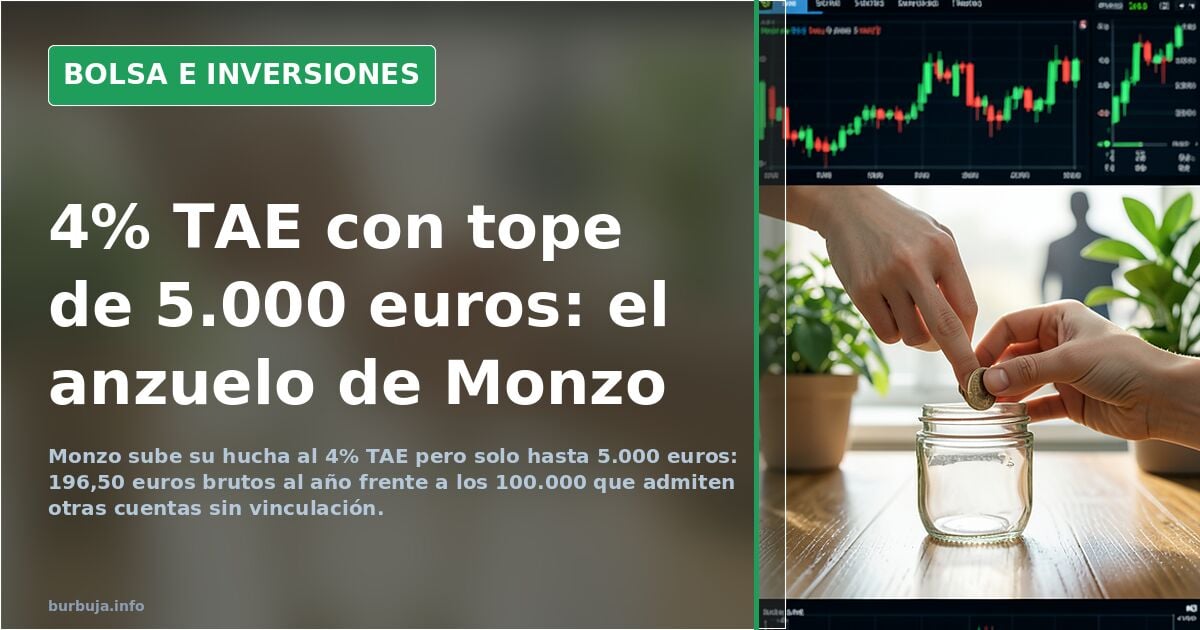
Monzo pays 4% APY, but only up to €5,000
The British digital bank Monzo launched in Spain on 28 October with no waiting list and, to celebrate, has raised the interest rate on its Instant Savings pot to 4.00% APY (3.93% nominal) for twelve months. The hook comes with fine print: the boosted rate only applies to the first €5,000 and you have to sign up before 31 December 2026. With a daily balance of €5,000 over a year, Monzo calculates €196.50 gross in interest, about €73 more than its standard savings pot, which pays 2.50% APY up to €100,000.
The account has no maintenance fees, interest is paid monthly and the money can be withdrawn instantly. To open it you need a Monzo current account, which can be applied for from the app in about fifteen minutes. According to the ranking cited in the material, it is the highest rate with no conditions among savings accounts, ahead of bunq (3.11% nominal), Kutxabank and Raisin (3.10%), Trade Republic (3.04%) and Bankinter (3%). The catch is the cap: €5,000 versus the €50,000 or €100,000 those alternatives allow.
How much do you really earn with Monzo's 4%?
The first reaction to the offer was to reach for a calculator. Four percent of €5,000 is €200 a year, and from that you have to deduct savings tax: with 19% withholding, the net figure comes to around €162. Compared with the 2.50% of the standard savings pot, the difference is roughly €60 net a year, according to the figures participants are working with. For anyone who already has the money in Trade Republic at 3% —only new customers get that rate—, the jump is even shorter.
The argument that comes up most often is that the effort isn't worth it. Opening a new account, verifying your identity, handing over personal and biometric data to log in with a fingerprint and keeping the balance at the limit for twelve months in exchange for a handful of euros doesn't seem like a great deal. The comparison with the emergency fund is inevitable: some point out that €5,000 doesn't even cover a rental deposit in Madrid, so the product works more as an advertising showcase than as a returns tool.
The €5,000 cap is the key to the product
Monzo doesn't pay 4% to someone with €100,000 or €300,000, and there's a logic to it: no bank pays that rate on large volumes without conditions. The product is designed to attract customers with a modest balance and keep them in the current account, which is the gateway to the savings pot. Anything above €5,000 still earns interest, but at 2.50% APY, the same territory already occupied by Trade Republic and other accounts with no salary requirement.
That's where the awkward comparison appears. Trade Republic covers up to €100,000 with daily interest and monthly payment, with no time restrictions. Monzo's savings pot, on the other hand, ties the boosted rate to twelve months and to a cap that turns the 4% into a marketing hook. The question hanging in the air is whether it's worth splitting savings across several banks to squeeze out a few tenths of a percent, or whether, on the contrary, diversification makes sense for safety, not for returns.
Where to put €20,000 of emergency fund?
The practical case raised is that of a saver with €20,000 in an emergency fund who doesn't want to keep it all with a single institution. The most repeated answer is to split it: part in the usual bank, part in a broker or savings account, and a portion in cash for unexpected expenses. Monzo's savings pot would fit as one more piece, but not as the main one.
The other line of analysis distrusts the product for reasons that go beyond the interest rate. Handing over biometric data to a newcomer to Spain for €200 gross a year raises objections, and not only among the most suspicious. Data security has become a weighty argument in digital banking, and Monzo is not immune to that suspicion.
With these numbers, Monzo's 4% works as a brilliant headline and a modest return. The account is free, the money can be withdrawn instantly and the rate is the highest with no conditions on the market. But the €5,000 limit turns the promise into a calculation of €200 gross which, after tax, barely covers a dinner. The battle for retail savings is fought over tenths of a percent, and Monzo has come in with the biggest sign and the smallest deposit.
The British digital bank Monzo launched in Spain on 28 October with no waiting list and, to celebrate, has raised the interest rate on its Instant Savings pot to 4.00% APY (3.93% nominal) for twelve months. The hook comes with fine print: the boosted rate only applies to the first €5,000 and you have to sign up before 31 December 2026. With a daily balance of €5,000 over a year, Monzo calculates €196.50 gross in interest, about €73 more than its standard savings pot, which pays 2.50% APY up to €100,000.
The account has no maintenance fees, interest is paid monthly and the money can be withdrawn instantly. To open it you need a Monzo current account, which can be applied for from the app in about fifteen minutes. According to the ranking cited in the material, it is the highest rate with no conditions among savings accounts, ahead of bunq (3.11% nominal), Kutxabank and Raisin (3.10%), Trade Republic (3.04%) and Bankinter (3%). The catch is the cap: €5,000 versus the €50,000 or €100,000 those alternatives allow.
How much do you really earn with Monzo's 4%?
The first reaction to the offer was to reach for a calculator. Four percent of €5,000 is €200 a year, and from that you have to deduct savings tax: with 19% withholding, the net figure comes to around €162. Compared with the 2.50% of the standard savings pot, the difference is roughly €60 net a year, according to the figures participants are working with. For anyone who already has the money in Trade Republic at 3% —only new customers get that rate—, the jump is even shorter.
The argument that comes up most often is that the effort isn't worth it. Opening a new account, verifying your identity, handing over personal and biometric data to log in with a fingerprint and keeping the balance at the limit for twelve months in exchange for a handful of euros doesn't seem like a great deal. The comparison with the emergency fund is inevitable: some point out that €5,000 doesn't even cover a rental deposit in Madrid, so the product works more as an advertising showcase than as a returns tool.
The €5,000 cap is the key to the product
Monzo doesn't pay 4% to someone with €100,000 or €300,000, and there's a logic to it: no bank pays that rate on large volumes without conditions. The product is designed to attract customers with a modest balance and keep them in the current account, which is the gateway to the savings pot. Anything above €5,000 still earns interest, but at 2.50% APY, the same territory already occupied by Trade Republic and other accounts with no salary requirement.
That's where the awkward comparison appears. Trade Republic covers up to €100,000 with daily interest and monthly payment, with no time restrictions. Monzo's savings pot, on the other hand, ties the boosted rate to twelve months and to a cap that turns the 4% into a marketing hook. The question hanging in the air is whether it's worth splitting savings across several banks to squeeze out a few tenths of a percent, or whether, on the contrary, diversification makes sense for safety, not for returns.
Where to put €20,000 of emergency fund?
The practical case raised is that of a saver with €20,000 in an emergency fund who doesn't want to keep it all with a single institution. The most repeated answer is to split it: part in the usual bank, part in a broker or savings account, and a portion in cash for unexpected expenses. Monzo's savings pot would fit as one more piece, but not as the main one.
The other line of analysis distrusts the product for reasons that go beyond the interest rate. Handing over biometric data to a newcomer to Spain for €200 gross a year raises objections, and not only among the most suspicious. Data security has become a weighty argument in digital banking, and Monzo is not immune to that suspicion.
With these numbers, Monzo's 4% works as a brilliant headline and a modest return. The account is free, the money can be withdrawn instantly and the rate is the highest with no conditions on the market. But the €5,000 limit turns the promise into a calculation of €200 gross which, after tax, barely covers a dinner. The battle for retail savings is fought over tenths of a percent, and Monzo has come in with the biggest sign and the smallest deposit.
Also available in: Deutsch
Summary of a discussion on Burbuja.info - Foro de economía, actualidad y política., translated from Spanish and reviewed before publication. Read the full discussion (44 replies).
More summaries
-
Trade Republic launches Spanish IBAN with 2.27% interest on all balances
Trade Republic activates its Spanish IBAN, offering 2.27% TAE on the entire balance without limits or conditions. The migration brings tax advantages and some...
-
Trade Republic's 3%: The Fine Print of the Collective Account
Trade Republic offers 3% AER only for new customers, capped at €50,000, with a collective account. Bankinter, Openbank, and Santander are countering.
-
Trade Republic’s 4% Offer: Omnibus Account Risks Explained
In Trade Republic, funds sit in an omnibus account. Critics argue the German deposit guarantee covers €100,000 per account, not per client.
-
Economy twists: stock bubble and consumption in freefall
The DAX nears 22,000 with Germany in recession, consumption sinks and real inflation exceeds official. Signs of bubble and debt.
-
25% of every referred purchase in BNB: ScorpBonk's hook
ScorpBonk announces instant payment of 25% of every referred purchase in BNB. The presale remains open with a hardcap of 406.25 BNB and a mostly skeptical reception.
-
Gold corrects from $4,100 and silver plunges: dip-buying or cycle change?
Gold is correcting from $4,100 and silver is sinking. Investors are torn between buying the dip or waiting for a floor at $3,200. Texas already recognizes it as…