
Mob attacks Barbate Civil Guard barracks one month after fatal narco-boat crash
Over 20 individuals storm a Barbate police station, threatening officers, shortly after two officers were killed by a drug boat in February.
English · Original discussion in Spanish · Published
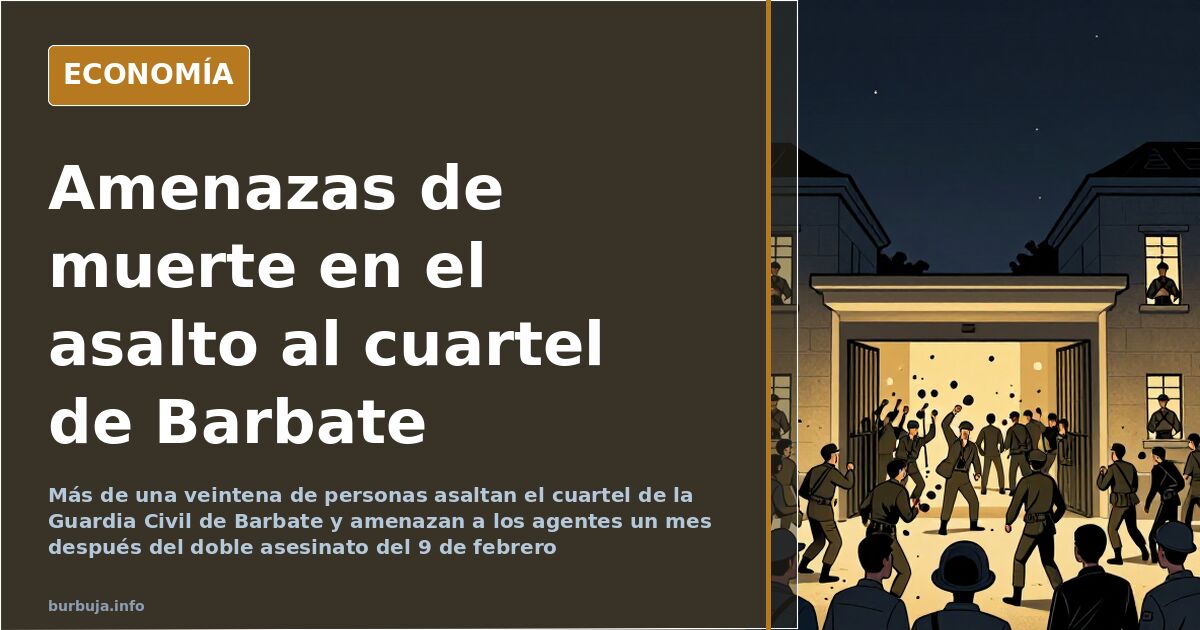
A mob storms Barbate barracks and threatens officers
It is mid-afternoon in Barbate. A civilian security patrol stops a speeding car on Calle Ancha. Four occupants get out and begin shouting at the officers. Taking advantage of the commotion, one returns to the vehicle and speeds away, running over a Civil Guard officer. Half an hour later, more than twenty people crowd the barracks door, kicking and punching it, demanding it be peine. The outnumbered officers close the doors. Then come the threats: "We are going to kill you, we have war weapons... You should have been treated like those at the port."
The reference is no coincidence. On February 9, two Civil Guard officers died in the town's port area after being struck by a traficante-boat. Those assaulting the barracks were publicly recalling that double homicide.
Who was at the door and who they were demanding answers from
The group that appeared at the premises belongs, according to published reports, to a family clan linked to drug trafficking who traveled there to demand explanations regarding the identification of one of their members hours earlier. The trigger was a routine traffic stop that ended with a car fleeing and an officer on the ground. When the officers assessed the newcomers' intentions, they locked the doors.
The rest is a repeating pattern. The officers felt threatened, withdrew to file reports, and half an hour later had the mob at the door. It was not a spontaneous outburst from a neighborhood: it was a show of force by an organization that knows where the State lives and when it is alone.
The assault was not the first: the precedent of February 16
Seven days after the double homicide, another clan appeared at the same barracks. On that occasion, two families came to file a complaint for assault, and the matter ended with three officers with minor injuries and damage to the facility's door. Two assaults in eleven days on the same building sketch something more troubling than a local anecdote: the perception, increasingly widespread among those working there, that the barracks has ceased to be a deterrent and has become a target.
What has changed one month after the Barbate killings?
Little, according to the professional association Jucil, which denounces that "nothing has changed" and that drug traffickers continue to operate along the Andalusian coast. The institutional response offers little optimism either: the Minister of the Interior rejected a plan from the General Council of the Judiciary to reinforce the Civil Guard against drug trafficking. And the new vacancy call does not provide more personnel for Barbate: 27 additional Civil Guard officers for the entire province of Cádiz, which comprises two commands. The Janda, Chiclana, Sanlúcar, or Sierra areas do not see their operational staff increased.
Added to this is the political vacuum. No parliamentary group has taken up the banner of an investigative commission to determine responsibilities for inaction regarding the mafias controlling the passage of narcotics. The matter has been left ownerless.
Saturated courts and an activity that is not a crime
The CGPJ has peine an investigation into the saturation of 19 Andalusian courts, trinc a report that portrays the pressure of drug trafficking and lack of resources: some bodies handle four times the cases of others. And then there is the piece that almost no one looks at. Petaqueo —supplying fuel to traficante-boats— involves only an administrative offense, not a crime, and was the activity supposedly engaged in by several seized vessels.
Shootings, 500 kilos in Barcelona, and a fugitive in Tangier
The trickle of events does not help sustain a narrative of normality. Two gangs exchanged fire on the Jerez-Sanlúcar motorway; in another drug bust in Jerez, Police seized 30 bales of hashish; five traficante-boats rammed a Maritime Service patrol boat in Algeciras. In Barcelona, 18 arrests, 500 kilos of drugs, weapons, and €50,000 in cash, with links to the Italian mafia.
And in Tangier, living in luxury, is Europe's most wanted drug trafficker, fugitive since 2019. Part of the analysis points to Segarro as the rear guard of the business; published material provides no proof of that institutional connection, beyond the evidence that those fleeing south do not return.
Where the analysis gets stuck
On the margins of the discussion appears the usual temptation: to turn a problem of resources, courts, and economic complicity into an issue of origin or nationality. The case data does not support that shortcut. What it supports is a business generating enough money for a clan to feel entitled to bang on the door of the Civil Guard.
Quotes circulated from Salvadoran President Nayib Bukele about complicit governments, comparisons with the impunity of the Dirty Years, and requests for a state of exception. None of that answers the truly uncomfortable question, the one left unanswered in every coastal barracks: how many officers are present on a Friday afternoon in a region where hashish money buys more than a guard's salary.
It is mid-afternoon in Barbate. A civilian security patrol stops a speeding car on Calle Ancha. Four occupants get out and begin shouting at the officers. Taking advantage of the commotion, one returns to the vehicle and speeds away, running over a Civil Guard officer. Half an hour later, more than twenty people crowd the barracks door, kicking and punching it, demanding it be peine. The outnumbered officers close the doors. Then come the threats: "We are going to kill you, we have war weapons... You should have been treated like those at the port."
The reference is no coincidence. On February 9, two Civil Guard officers died in the town's port area after being struck by a traficante-boat. Those assaulting the barracks were publicly recalling that double homicide.
Who was at the door and who they were demanding answers from
The group that appeared at the premises belongs, according to published reports, to a family clan linked to drug trafficking who traveled there to demand explanations regarding the identification of one of their members hours earlier. The trigger was a routine traffic stop that ended with a car fleeing and an officer on the ground. When the officers assessed the newcomers' intentions, they locked the doors.
The rest is a repeating pattern. The officers felt threatened, withdrew to file reports, and half an hour later had the mob at the door. It was not a spontaneous outburst from a neighborhood: it was a show of force by an organization that knows where the State lives and when it is alone.
The assault was not the first: the precedent of February 16
Seven days after the double homicide, another clan appeared at the same barracks. On that occasion, two families came to file a complaint for assault, and the matter ended with three officers with minor injuries and damage to the facility's door. Two assaults in eleven days on the same building sketch something more troubling than a local anecdote: the perception, increasingly widespread among those working there, that the barracks has ceased to be a deterrent and has become a target.
What has changed one month after the Barbate killings?
Little, according to the professional association Jucil, which denounces that "nothing has changed" and that drug traffickers continue to operate along the Andalusian coast. The institutional response offers little optimism either: the Minister of the Interior rejected a plan from the General Council of the Judiciary to reinforce the Civil Guard against drug trafficking. And the new vacancy call does not provide more personnel for Barbate: 27 additional Civil Guard officers for the entire province of Cádiz, which comprises two commands. The Janda, Chiclana, Sanlúcar, or Sierra areas do not see their operational staff increased.
Added to this is the political vacuum. No parliamentary group has taken up the banner of an investigative commission to determine responsibilities for inaction regarding the mafias controlling the passage of narcotics. The matter has been left ownerless.
Saturated courts and an activity that is not a crime
The CGPJ has peine an investigation into the saturation of 19 Andalusian courts, trinc a report that portrays the pressure of drug trafficking and lack of resources: some bodies handle four times the cases of others. And then there is the piece that almost no one looks at. Petaqueo —supplying fuel to traficante-boats— involves only an administrative offense, not a crime, and was the activity supposedly engaged in by several seized vessels.
Shootings, 500 kilos in Barcelona, and a fugitive in Tangier
The trickle of events does not help sustain a narrative of normality. Two gangs exchanged fire on the Jerez-Sanlúcar motorway; in another drug bust in Jerez, Police seized 30 bales of hashish; five traficante-boats rammed a Maritime Service patrol boat in Algeciras. In Barcelona, 18 arrests, 500 kilos of drugs, weapons, and €50,000 in cash, with links to the Italian mafia.
And in Tangier, living in luxury, is Europe's most wanted drug trafficker, fugitive since 2019. Part of the analysis points to Segarro as the rear guard of the business; published material provides no proof of that institutional connection, beyond the evidence that those fleeing south do not return.
Where the analysis gets stuck
On the margins of the discussion appears the usual temptation: to turn a problem of resources, courts, and economic complicity into an issue of origin or nationality. The case data does not support that shortcut. What it supports is a business generating enough money for a clan to feel entitled to bang on the door of the Civil Guard.
Quotes circulated from Salvadoran President Nayib Bukele about complicit governments, comparisons with the impunity of the Dirty Years, and requests for a state of exception. None of that answers the truly uncomfortable question, the one left unanswered in every coastal barracks: how many officers are present on a Friday afternoon in a region where hashish money buys more than a guard's salary.
Summary of a discussion on Burbuja.info - Foro de economía, actualidad y política., translated from Spanish and reviewed before publication. Read the full discussion (230 replies).
More summaries
-
Spain's top court warns amnesty law violates constitution before text exists
Spain's judicial council condemns the proposed amnesty law, citing constitutional violations and blocking its own advisory role due to the legislative procedure chosen.
-
Widow refuses Marlaska's medal in Barbate agent's funeral
A widow in Barbate rejects Interior Minister Marlaska's medal during her husband's funeral, sparking a standoff that highlights deep tensions within the Civil Guard.
-
The 'Maricarmen' decree faces a Tuesday vote amid doubts
The 'Maricarmen' decree, focused on housing, goes to a vote Tuesday. Old rents, Junts, omnibus bills, and planned applause...
-
Life in Russia: 5-day doctor visits and 146€ annual utility bills
A Moscow resident describes daily life: 13% taxes, 146€ annual utilities, and 5-day medical appointments, sparking a comparison with Spain.
-
Why Chickens Are a Trap for Those Fleeing to the Countryside
Eight hens return 36 euros monthly in eggs, covering feed costs. This analysis favors geese while ruling out goats and cows for rural self-sufficiency projects.
-
36-year-old heir seeks low-effort job to avoid career stress
A 36-year university graduate with an inheritance seeks low-effort work in Spain, where March 2023 unemployment hit 12.8%, the highest in the EU.