
Why Chickens Are a Trap for Those Fleeing to the Countryside
Eight hens return 36 euros monthly in eggs, covering feed costs. This analysis favors geese while ruling out goats and cows for rural self-sufficiency projects.
English · Original discussion in Spanish · Published
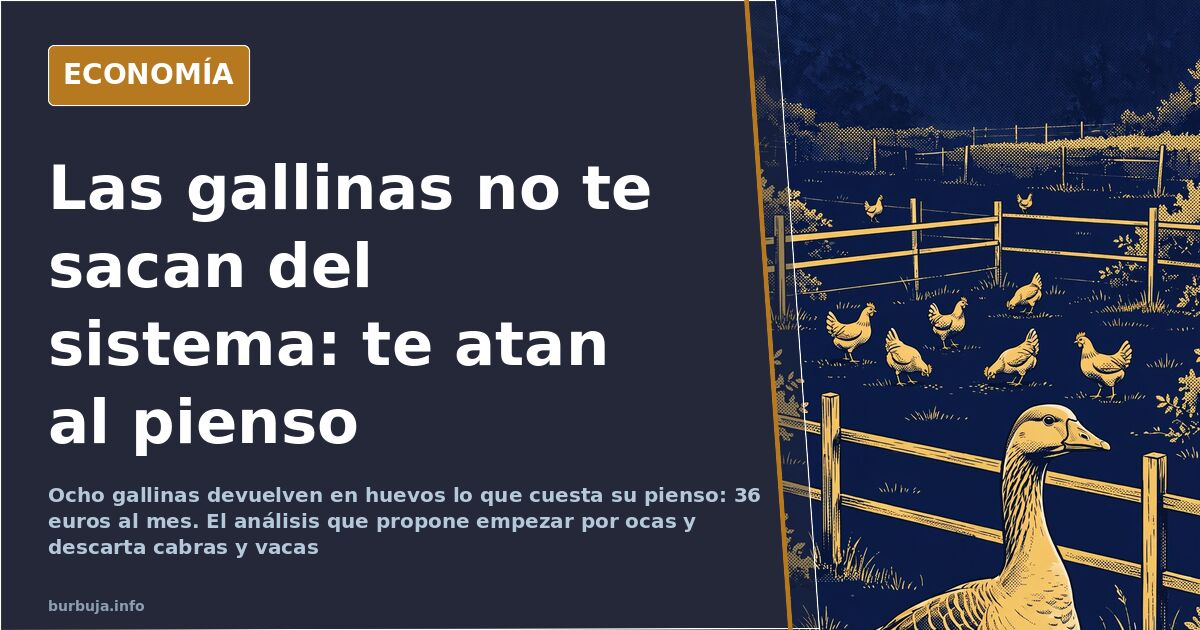
Chickens, Geese, or Goats: Which Animal Actually Pays Off in the Countryside?
The first animal you buy upon arriving in the countryside determines whether your project survives or becomes a second mortgage. The thesis, backed by numbers from those who have tried it, is uncomfortable: the chicken, the most popular bird in Spanish coops, is the worst fit for a budget starting from zero. There is no romance here, only accounting. An omnivore eats like an omnivore, translating to monthly feed purchases, step by step.
Why Chickens Devour Savings: 36 Euros Monthly
The most common breakdown involves eight hens costing around 36 euros monthly in feed, with 75% covered by foraging and only 25% by grain, plus grit for calcium. These eight birds return 5 to 8 eggs daily. At six eggs a day, that is 15 dozen monthly; at supermarket prices, about 36 euros. The business neither loses nor gains money: it breaks even in eggs exactly what is paid in sacks.
The wheel you wanted to escape spins again, now with manure. There is a second cost not in any spreadsheet: time. Collecting eggs, refilling water, locking the coop, monitoring wounds — when one starts bleeding, she must be separated or culled. None of this appears in the 36 versus 36 balance.
Geese: The Herbivore That Only Needs Rain
Here is the alternative favored by the initial approach. The goose is herbivorous: it grazes daily and eats from that alone. It requires no feed sack, only land with grass and regular rain. In return, it provides meat, antiestéticathers, and around 50 eggs annually, which can be preserved in water, breaking the seasonal laying cycle.
Those who have kept both species state it plainly: chickens enslave, geese reduce work and cut the grass. A case with over twenty hens and a pair of geese ended by giving away all the hens. The undisputed nuance is that geese are territorial and noisy; if not socialized young, they attack.
Goats, Cows, and Sheep: The Order of Purchase
The next step is not free either. Goats are discarded for being escapists and very clever: they cause management issues and, near fruit trees, leave them barkless by eating roots. Cows require infrastructure investment difficult to assume initially, as their weight affects fencing, feeders, and sanitation. Sheep enter when there is a surplus, bringing the dog, the second omnivore on the land: it can be afforded because there is surplus meat.
The warning repeats in almost all versions: do not accumulate animals. Buying dogs, cats, and hens at once weighs more on the budget than any other household expense, with less gratitude.
The Counterattack: Half the World Has Chickens and Buys No Feed
The objection comes immediately and is not weak. Chickens are omnivorous precisely because they eat everything: vegetable scraps, stale bread, spaghetti, insects, worms, ants, small rodents, and even chicken cleaning leftovers. Where there is a garden, they clear pests instead of destroying it. With ample space, feed costs can drop to zero: some maintained over one hundred hens and 40 to 50 free-range ducks for three years without feeding them.
It is also recalled that the chicken has been the brown container for organic waste for centuries, alongside the pig, the other truly efficient animal in meat, time, and reproduction. And that store-bought eggs travel an average of fifteen days before reaching the frying pan.
Where the sector truly divides is on the type of bird. Commercial layers are selected to lay nearly 300 eggs annually for two or three seasons, after which they are depleted. Rustic breeds pause two or three months with less light and continue laying until five or six years old, with a clear peak in spring.
The Variable No One Puts in the Spreadsheet: You
Neither side disputes land or dedication; that is the knot. A plan with eight hens in a closed coop costs 36 euros; another with one hundred free-range birds across several hectares offers almost total foraging. Between both lies a continuum depending on square meters, meadows, whether wheat or corn is grown for the birds' pantry, and if the owner can be absent.
The final factor is the most uncomfortable: a hospitalization, a alucinación, or an emergency forces someone to feed and secure the animals. In family villages, with siblings and cousins nearby, it is resolved with a call. In a remote hamlet, it becomes an accepted risk or the reason to keep nothing.
The final balance closes in neither direction, because accounts are made in euros and daily work is paid in hours no one has valued. As long as feed has a price and dedication does not, everyone will continue choosing the animal that best fits their wallet and patience.
The first animal you buy upon arriving in the countryside determines whether your project survives or becomes a second mortgage. The thesis, backed by numbers from those who have tried it, is uncomfortable: the chicken, the most popular bird in Spanish coops, is the worst fit for a budget starting from zero. There is no romance here, only accounting. An omnivore eats like an omnivore, translating to monthly feed purchases, step by step.
Why Chickens Devour Savings: 36 Euros Monthly
The most common breakdown involves eight hens costing around 36 euros monthly in feed, with 75% covered by foraging and only 25% by grain, plus grit for calcium. These eight birds return 5 to 8 eggs daily. At six eggs a day, that is 15 dozen monthly; at supermarket prices, about 36 euros. The business neither loses nor gains money: it breaks even in eggs exactly what is paid in sacks.
The wheel you wanted to escape spins again, now with manure. There is a second cost not in any spreadsheet: time. Collecting eggs, refilling water, locking the coop, monitoring wounds — when one starts bleeding, she must be separated or culled. None of this appears in the 36 versus 36 balance.
Geese: The Herbivore That Only Needs Rain
Here is the alternative favored by the initial approach. The goose is herbivorous: it grazes daily and eats from that alone. It requires no feed sack, only land with grass and regular rain. In return, it provides meat, antiestéticathers, and around 50 eggs annually, which can be preserved in water, breaking the seasonal laying cycle.
Those who have kept both species state it plainly: chickens enslave, geese reduce work and cut the grass. A case with over twenty hens and a pair of geese ended by giving away all the hens. The undisputed nuance is that geese are territorial and noisy; if not socialized young, they attack.
Goats, Cows, and Sheep: The Order of Purchase
The next step is not free either. Goats are discarded for being escapists and very clever: they cause management issues and, near fruit trees, leave them barkless by eating roots. Cows require infrastructure investment difficult to assume initially, as their weight affects fencing, feeders, and sanitation. Sheep enter when there is a surplus, bringing the dog, the second omnivore on the land: it can be afforded because there is surplus meat.
The warning repeats in almost all versions: do not accumulate animals. Buying dogs, cats, and hens at once weighs more on the budget than any other household expense, with less gratitude.
The Counterattack: Half the World Has Chickens and Buys No Feed
The objection comes immediately and is not weak. Chickens are omnivorous precisely because they eat everything: vegetable scraps, stale bread, spaghetti, insects, worms, ants, small rodents, and even chicken cleaning leftovers. Where there is a garden, they clear pests instead of destroying it. With ample space, feed costs can drop to zero: some maintained over one hundred hens and 40 to 50 free-range ducks for three years without feeding them.
It is also recalled that the chicken has been the brown container for organic waste for centuries, alongside the pig, the other truly efficient animal in meat, time, and reproduction. And that store-bought eggs travel an average of fifteen days before reaching the frying pan.
Where the sector truly divides is on the type of bird. Commercial layers are selected to lay nearly 300 eggs annually for two or three seasons, after which they are depleted. Rustic breeds pause two or three months with less light and continue laying until five or six years old, with a clear peak in spring.
The Variable No One Puts in the Spreadsheet: You
Neither side disputes land or dedication; that is the knot. A plan with eight hens in a closed coop costs 36 euros; another with one hundred free-range birds across several hectares offers almost total foraging. Between both lies a continuum depending on square meters, meadows, whether wheat or corn is grown for the birds' pantry, and if the owner can be absent.
The final factor is the most uncomfortable: a hospitalization, a alucinación, or an emergency forces someone to feed and secure the animals. In family villages, with siblings and cousins nearby, it is resolved with a call. In a remote hamlet, it becomes an accepted risk or the reason to keep nothing.
The final balance closes in neither direction, because accounts are made in euros and daily work is paid in hours no one has valued. As long as feed has a price and dedication does not, everyone will continue choosing the animal that best fits their wallet and patience.
Summary of a discussion on Burbuja.info - Foro de economía, actualidad y política., translated from Spanish and reviewed before publication. Read the full discussion (225 replies).
More summaries
-
Haro vehicle ramming: one emergency medical technician dead, five injured
Haro vehicle ramming: a 32-year-old emergency medical technician dies and five people are hospitalised
-
Two Civil Guards Shot During Surveillance in Terrassa, Spain
Two Civil Guards were shot in Terrassa during a surveillance operation; one suffered four bullet wounds and was beaten. The incident highlights security concerns in Spain.
-
PP Deputy Jaime de los Santos Accused of Betraying Pensioners
A social media post accuses PP deputy Jaime de los Santos of voting against pensioners' rights, labeling it betrayal without providing specific details.
-
Man abandons children at police station after aid ends, El Periódico reports
A man left his two children at a police station after his financial aid expired, according to El Periódico. Some claim he alleged they were unaccompanied minors.
-
Woman Dies in Russia After Lab Plague Incident, 200 Quarantined
Russia reports one death from pneumonic plague in a Siberian lab. 200 people are quarantined and military NBQ suits patrol the streets.
-
Garzón: More Construction Doesn't Lower Housing Prices in Spain
Eduardo Garzón argues that building more does not reduce prices. A deficit of 205,000 annual homes and the Detroit case challenge his thesis.