
Mixing sunflower and olive oil in the deep fryer: what the smoke point says
Mixing sunflower and olive oil in the deep fryer is not dangerous, but the smoke point of the weaker oil sets the limit and the olive oil goes to waste.
English · Original discussion in Spanish · Published
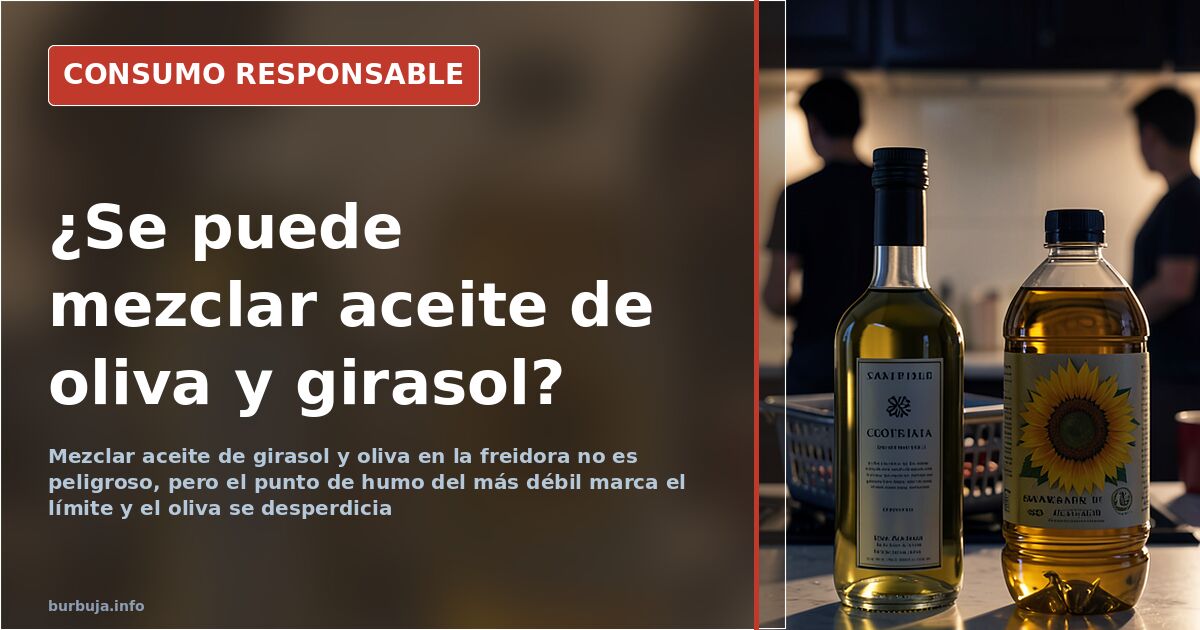
Mixing sunflower and olive oil in the deep fryer: the answer lies in the smoke point
You run out of sunflower oil halfway through filling the fryer and the temptation is to pour in some olive oil to top it up. A classic scenario: freshly cleaned deep fryer, a bottle that doesn't quite reach, and the doubt of whether the mix will ruin the oil or the improvisation will work out. The short answer is that it can be done, but the result depends on which oil dominates and at what temperature you fry.
The technical argument that runs through the discussion is the smoke point, the temperature at which an oil starts to break down and release compounds you don't want. Here the two oils are not in the same league: according to one participant, olive oil withstands more heat before smoking, while sunflower oil degrades sooner. Mixing them does not create a new oil with magical properties; it creates a weighted average of their limits.
At what temperature does each oil break down?
In practice, anyone frying with a mix is frying with the smoke point of the weaker oil. If the proportion of sunflower oil is high, the mix will behave like sunflower oil: it will start smoking sooner and will need changing sooner. That means more deep fryer cleanings, more oil thrown away, and a saving that amounts to nothing. The full calculation, with the temperatures of each oil and the wear caused by repeated heating, is where the real substance of the matter lies.
Some argue that sunflower oil has a higher smoke point than olive oil and is therefore better for frying. Others claim the opposite and point out that extra virgin olive oil holds up longer before degrading. The discrepancy is no small matter: it completely changes which oil suits each use.
The real cost of mixing: good oil wasted
The second argument is economic. A bottle of sunflower oil costs little; olive oil, considerably more. Pouring olive oil to top up the fryer is throwing money away on an oil that will degrade ahead of time and be changed after just a few frying sessions. The saving from not buying another bottle of sunflower oil is more than offset by the olive oil that gets sacrificed.
The alternative gaining ground is the opposite: fry only with sunflower or rapeseed oil, drain well, and then dress afterwards with a drizzle of virgin olive oil. That way each oil does what it does best, with no confusing mixes.
What temperature to set on the deep fryer
Another point that comes up is the working temperature. Some fry at 180 degrees, while others recommend raising it to 200 or 220 so that, when the food is added, the oil doesn't plummet and end up frying at 150, absorbing more fat and turning out worse. The mix, in that context, adds yet another variable to a process that already has enough of them.
The consensus, if there is one, is that mixing is not dangerous but it is inefficient. The resulting oil improves nothing and complicates maintenance. The deep fryer wants one oil and one temperature; an improvised mix is an emergency solution, not a recipe.
Also available in: Deutsch
Summary of a discussion on Burbuja.info - Foro de economía, actualidad y política., translated from Spanish and reviewed before publication. Read the full discussion (12 replies).
More summaries
-
Cold-pressed extra virgin: why the label can be misleading
Extra virgin olive oil can be a mix of pure olive juice and refined oils. Acidity is no longer listed, and prices range from €1.75 to €8 per liter.
-
Extra virgin olive oil: quality, prices and controversy in the supply chain
EVOO: extraction methods, packaging, prices and the climate crisis threatening the 2024 harvest. Discover the data the media won't tell you.
-
Lard vs. Olive Oil: The Smoke Point Debate
Forum users debate if lard withstands heat better than olive oil and whether sunflower oil is less stable, citing smoke points.
-
Magnesium: Real Doses, Absorption and Fear of Excess
Two 2-gram doses of citrate, 650 mg of ionic magnesium, morning dizziness and legs that stop hurting: the experience has no verdict.
-
Freezing mortadella: fat decides whether it works
Mortadella can be frozen, but fat and free water form crystals that degrade the texture. Whole is better than sliced, and beware of the 8-degree limit.
-
Expired cream given away at the greengrocer's: is it safe to eat?
The best-before date is not a safety deadline: cream can last longer, but your nose and the fridge decide whether it is still fit to eat.