
Freezing mortadella: fat decides whether it works
Mortadella can be frozen, but fat and free water form crystals that degrade the texture. Whole is better than sliced, and beware of the 8-degree limit.
English · Original discussion in Spanish · Published
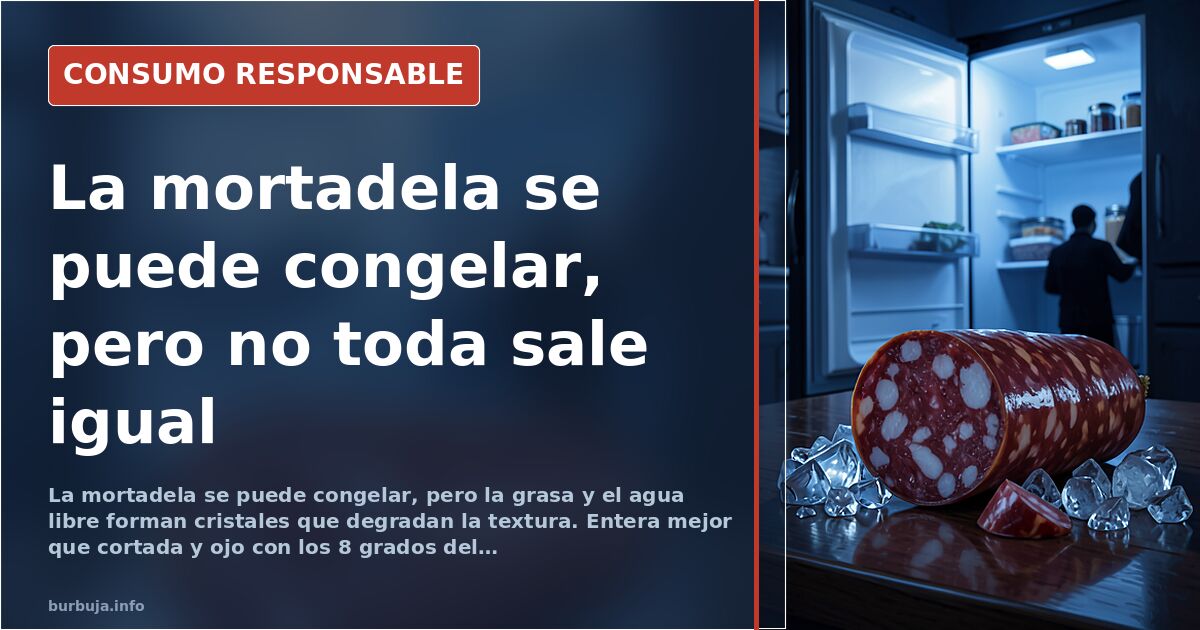
Freezing mortadella: fat decides whether it works
Mortadella holds up in the freezer, but the result depends on something as segarro as the size of the ice crystals. A fridge at 8 degrees —the maximum the appliance allows— is not enough to keep a high-fat cold meat for days: that is where the problem begins for many people who buy a large batch and cannot finish it in time. The short answer is yes, you can freeze it. The long one is that it helps to know how.
Why fat ruins the texture when thawing
The core argument is physical, not a matter of taste. In a fatty cold meat, freezing forms crystals that, when they melt, degrade the product's molecular structure. It will not kill anyone who eats it, but it leaves a bite with a frankly unpleasant texture and flavor. It is the same reason why raw chorizo that has been frozen and thawed ends up looking like something you would give to the dog, while chorizo already cooked in a stew behaves much better: cooking removes much of the water associated with the fat, which limits crystal formation.
That is the key that separates a decent freezing job from a disaster. The more free water the product has, the more crystals. The more cooked or leaner, the fewer.
Whole is better than sliced: the practical advice
Accumulated experience points to a simple rule: if you freeze it, the whole block is better than slices. A whole frozen ham came out acceptable; a block of cheese lost its consistency. Sliced mortadella exposes far more surface area to ice and dehydration, so the format matters as much as the product.
Some people also freeze chorizo for fabada (a Spanish bean stew) and claim that half a small chorizo adds plenty of flavor to a pot for eight people. The difference between chorizos, they say, is abysmal. Not all cold meats are equal in the face of ice, and the solid fat content changes the outcome.
What exactly is mortadella
The underlying question is what you are actually freezing. Mortadella is, in essence, emulsified and finely ground meat with fat, spices and usually visible chunks of fat. It is not a micro-ground ham, although it shares the same industrial logic. That emulsion is precisely what breaks down with a bad thawing.
The anecdote that best illustrates it: a huge slab of Sicilian mortadella one day from expiry, run through the slicer and turned into frozen cordon bleu-style rolls. Two months later it was still being served in a staff canteen, a mushy, overworked mass that recalled sheets falling in a movie. Not a recommendation.
The 8-degree limit
A fridge at its maximum temperature, 8 degrees, is not a safe environment for extending a fresh cold meat for many days. The freezer solves the urgency, but it does not turn just any product into something suitable for indefinite freezing. Freezing ham works; freezing a whole block of cheese leaves a product that loses its consistency. Mortadella falls into that intermediate zone where the result depends on the format and the hurry.
Is it worth freezing that half kilo you will not finish in time, or is it better to adjust your purchase and accept that cold meat has an expiry date?
Also available in: Deutsch
Summary of a discussion on Burbuja.info - Foro de economía, actualidad y política., translated from Spanish and reviewed before publication. Read the full discussion (13 replies).
More summaries
-
How long sandwiches last in the fridge: ham goes off first
Sliced ham is the first thing to spoil and sandwich bread gets soggy: making ten sandwiches for the whole week is not as cost-effective as it seems
-
Homemade Chorizo at €5.5/kg: Beat Industrial Meat Costs
A hobbyist turns a fridge into a smoker, making homemade chorizo at €5.5/kg with less fat than industrial options.
-
Lidl's frozen sardines at €3.90/kg vs. fresh ones
A kilo of frozen sardines costs €3.90 compared to €9-€10 for fresh ones in Madrid. The question is whether the flavor holds up after freezing.
-
Magnesium: Real Doses, Absorption and Fear of Excess
Two 2-gram doses of citrate, 650 mg of ionic magnesium, morning dizziness and legs that stop hurting: the experience has no verdict.
-
LED spotlights: €3 fixtures vs €17 fixtures
LED spotlights for a 10 m² room: how many to install, whether to remove the transformer, and why some cost €3 and others €17, according to participants in the debate.
-
Chronic heartburn: from omeprazole to licorice root
A consumer has suffered heartburn and gas for five years, and omeprazole only brings temporary relief. Licorice root, Helicobacter and hiatal hernia are the focus of the discussion.