
Lard vs. Olive Oil: The Smoke Point Debate
Forum users debate if lard withstands heat better than olive oil and whether sunflower oil is less stable, citing smoke points.
English · Original discussion in Spanish · Published
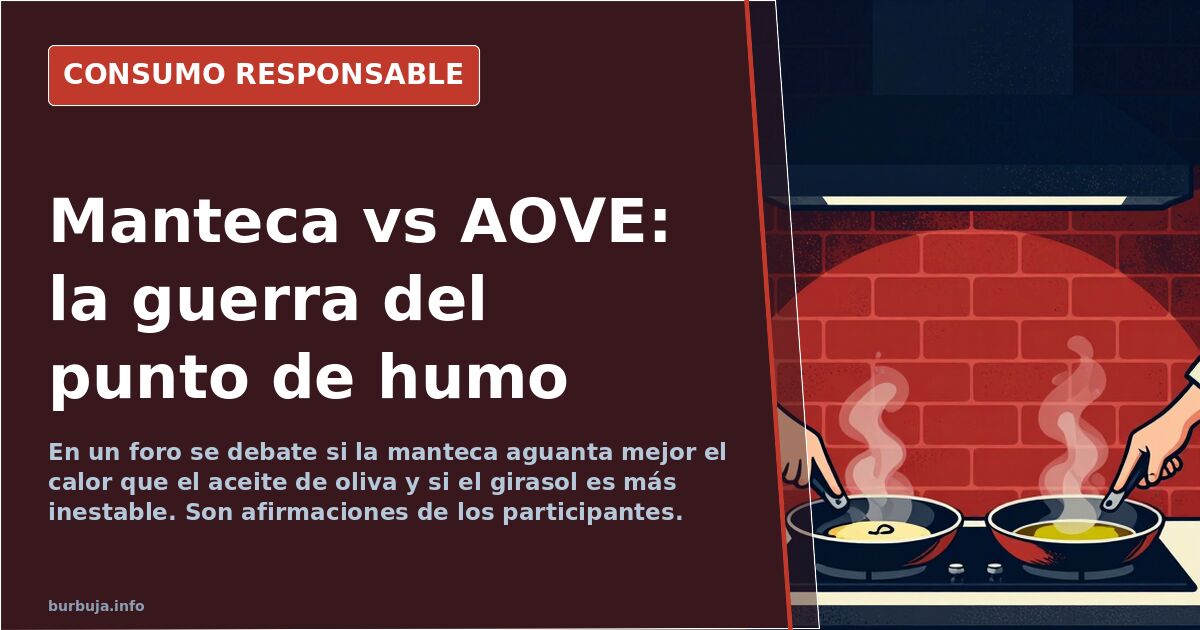
Lard vs. Olive Oil: The Battle of the Smoke Point
The discussion on whether to fry with lard or olive oil has persisted in Spanish kitchens for decades, and the main argument isn't flavor: it's the smoke point. Some claim that the more saturated a fat is, the better it resists thermal degradation, noting that lard has more saturated fatty acids than olive oil, which is mostly monounsaturated. Sunflower oil, being polyunsaturated, would be the least stable of the three. The thesis running through the debate is simple: if oil burns sooner, the compounds it generates are worse for health than those from a fat that withstands higher temperatures.
Why is lard said to be more stable for frying?
The chemical reasoning used in the conversation is that higher saturation means greater thermal resistance. Lard, with a high proportion of saturated fatty acids, would take longer to degrade. Olive oil, monounsaturated, would last longer than sunflower oil but less than animal fat. And sunflower oil, with high omega-6 content, would be most prone to oxidation: some recall that olive oil bottles are dark specifically to protect the oil from light, while sunflower oil bottles are sold transparent despite being more sensitive.
Regarding omega-6s, a nuance beyond the pan is added: according to this view, they are pro-inflammatory by nature, and refined sunflower oil is found in almost everything bought at the supermarket. That would be, according to this current, the real problem: it's not the lard, it's the cheap seed oil that sneaks into processed products.
Extra virgin olive oil: for raw use or everything?
Here, consensus is broader than it seems. EVOO (Extra Virgin Olive Oil) is defended as unbeatable when raw: salads, toast, gazpacho. For frying, however, opinions are divided. Some argue sunflower oil is better for fish and potatoes due to flavor and price, leaving olive oil for stews. Others directly rule it out for baking because the flavor is too intense, making everything taste like oil. Lard, conversely, is championed for doughs and traditional frying: some recall that ensaïmada gets its name from lard, and that classic pastries were made with animal fat.
The price argument also weighs heavily. Olive oil is more expensive, which explains why hospitality and industry lean towards refined sunflower oil. Some buy unfiltered bulk EVOO for around €6 to €6.50 per liter taking advantage of first-user offers, while others consider paying more immoral.
Grandparents' longevity: causality or coincidence?
The initial message launches a generational comparison: great-grandparents cooked with lard and lived to eighty or ninety; parents, raised on olive oil, die in their sixties or seventies. The most repeated response is that this is correlation, not causation. Between one generation and another, the entire country changed: industrialization, pollution, chemicals, running water, soap, refrigerators. Some argue life expectancy rose mainly due to these factors, not the fat in the pan.
Others add that today's pork doesn't resemble the old kind: industrial fattening uses cereals and sunflower oils, so current lard isn't the same as homemade slaughterhouse lard. And some recall that boiled potatoes spike insulin, alcohol hits harder during ketosis, and no food compensates for smoking, sedentary lifestyles, and poor sleep.
Cholesterol, statins, and decades of misinformation
The underlying suspicion is that for fifty years, it was sold that saturated fat clogs arteries and olive oil is the panacea. Part of the debate calls this the biggest pharmaceutical scam in history: people take statins without question while cardiovascular diseases continue to rise, and no one talks about the oxidation of polyunsaturated fatty acids or endothelial damage. The repeated conclusion is that antiestéticar of cholesterol and lard was a campaign, and that a high-fat, high-protein, low-carb diet keeps the body inflammation-free.
The exact point where analysis stalls is the usual one: without controlled trials comparing frying with lard versus olive oil under real conditions, the discussion remains stuck in laboratory chemistry and memories of what grandparents ate.
The discussion on whether to fry with lard or olive oil has persisted in Spanish kitchens for decades, and the main argument isn't flavor: it's the smoke point. Some claim that the more saturated a fat is, the better it resists thermal degradation, noting that lard has more saturated fatty acids than olive oil, which is mostly monounsaturated. Sunflower oil, being polyunsaturated, would be the least stable of the three. The thesis running through the debate is simple: if oil burns sooner, the compounds it generates are worse for health than those from a fat that withstands higher temperatures.
Why is lard said to be more stable for frying?
The chemical reasoning used in the conversation is that higher saturation means greater thermal resistance. Lard, with a high proportion of saturated fatty acids, would take longer to degrade. Olive oil, monounsaturated, would last longer than sunflower oil but less than animal fat. And sunflower oil, with high omega-6 content, would be most prone to oxidation: some recall that olive oil bottles are dark specifically to protect the oil from light, while sunflower oil bottles are sold transparent despite being more sensitive.
Regarding omega-6s, a nuance beyond the pan is added: according to this view, they are pro-inflammatory by nature, and refined sunflower oil is found in almost everything bought at the supermarket. That would be, according to this current, the real problem: it's not the lard, it's the cheap seed oil that sneaks into processed products.
Extra virgin olive oil: for raw use or everything?
Here, consensus is broader than it seems. EVOO (Extra Virgin Olive Oil) is defended as unbeatable when raw: salads, toast, gazpacho. For frying, however, opinions are divided. Some argue sunflower oil is better for fish and potatoes due to flavor and price, leaving olive oil for stews. Others directly rule it out for baking because the flavor is too intense, making everything taste like oil. Lard, conversely, is championed for doughs and traditional frying: some recall that ensaïmada gets its name from lard, and that classic pastries were made with animal fat.
The price argument also weighs heavily. Olive oil is more expensive, which explains why hospitality and industry lean towards refined sunflower oil. Some buy unfiltered bulk EVOO for around €6 to €6.50 per liter taking advantage of first-user offers, while others consider paying more immoral.
Grandparents' longevity: causality or coincidence?
The initial message launches a generational comparison: great-grandparents cooked with lard and lived to eighty or ninety; parents, raised on olive oil, die in their sixties or seventies. The most repeated response is that this is correlation, not causation. Between one generation and another, the entire country changed: industrialization, pollution, chemicals, running water, soap, refrigerators. Some argue life expectancy rose mainly due to these factors, not the fat in the pan.
Others add that today's pork doesn't resemble the old kind: industrial fattening uses cereals and sunflower oils, so current lard isn't the same as homemade slaughterhouse lard. And some recall that boiled potatoes spike insulin, alcohol hits harder during ketosis, and no food compensates for smoking, sedentary lifestyles, and poor sleep.
Cholesterol, statins, and decades of misinformation
The underlying suspicion is that for fifty years, it was sold that saturated fat clogs arteries and olive oil is the panacea. Part of the debate calls this the biggest pharmaceutical scam in history: people take statins without question while cardiovascular diseases continue to rise, and no one talks about the oxidation of polyunsaturated fatty acids or endothelial damage. The repeated conclusion is that antiestéticar of cholesterol and lard was a campaign, and that a high-fat, high-protein, low-carb diet keeps the body inflammation-free.
The exact point where analysis stalls is the usual one: without controlled trials comparing frying with lard versus olive oil under real conditions, the discussion remains stuck in laboratory chemistry and memories of what grandparents ate.
Summary of a discussion on Burbuja.info - Foro de economía, actualidad y política., translated from Spanish and reviewed before publication. Read the full discussion (166 replies).
More summaries
-
Cold-pressed extra virgin: why the label can be misleading
Extra virgin olive oil can be a mix of pure olive juice and refined oils. Acidity is no longer listed, and prices range from €1.75 to €8 per liter.
-
Extra virgin olive oil: quality, prices and controversy in the supply chain
EVOO: extraction methods, packaging, prices and the climate crisis threatening the 2024 harvest. Discover the data the media won't tell you.
-
The real cost of cheap paint from Leroy Merlin
The real cost of using cheap paint from big-box stores. We analyze the dilemma between immediate savings and the durability of the finish.
-
Men's Shorts Debate: Knee-Length vs. Micro-Shorts
A heated debate over men's summer shorts length pits knee-length bermudas against micro-shorts, blending aesthetics, freedom, and masculinity.
-
Apple: The Hidden Cost of Non-Existent Compatibility
Macs don't break; they become obsolete by decree. PowerPC, AppleTalk, OpenGL, and soldered SSD wear in M1 chips are under debate.
-
Industrial Turrón: Shrinking Bars, Rising Prices in Spain
Spanish shoppers report industrial turrón nearing €6 while bars shrink inside unchanged boxes, prompting many to skip Christmas sweets.