
Milei attacks UN Agenda 2030, dividing staff
Milei condemns the UN's socialist drift and Agenda 2030. His speech reignites debate between supporters and critics who see controlled dissent.
English · Original discussion in Spanish · Published
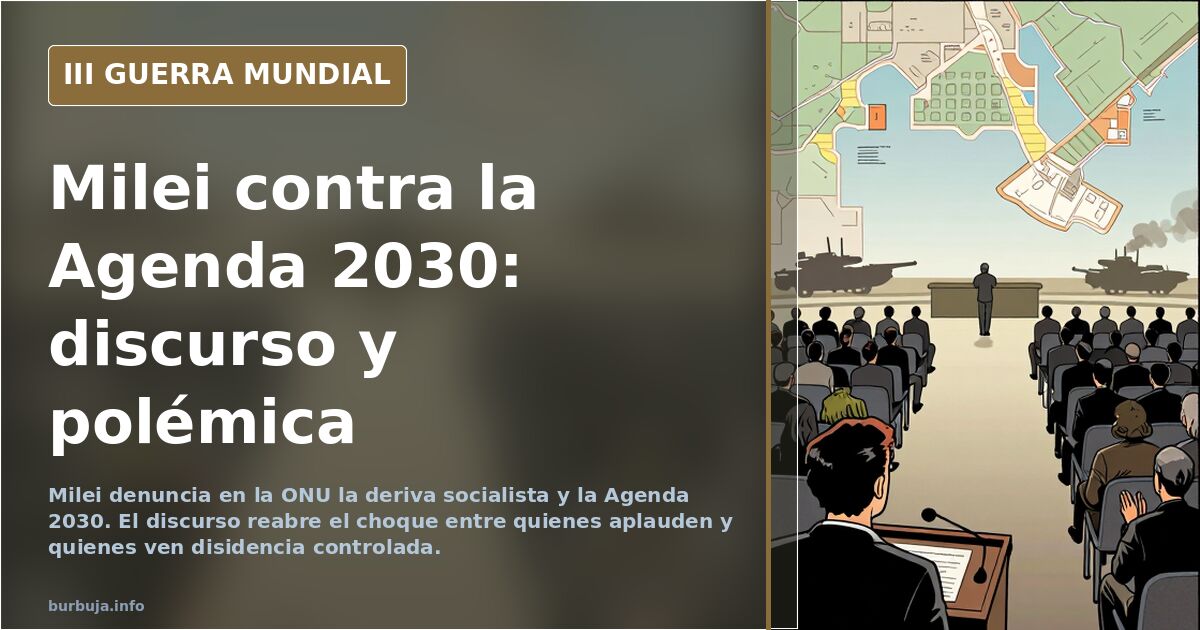
Milei blasts Agenda 2030 at the UN, sparking division
Can one oppose the Agenda 2030 without being a reactionary? Javier Milei’s speech to the UN General Assembly, denouncing the body’s socialist drift and collectivist policies, peine that question with more noise than answers. The Argentine president attacked the Agenda 2030, warned of the "danger that this organization fails in its original mission," and cited examples he considers incoherent. Reactions were immediate: from fervent applause to direct insults, including analysis of whether Milei is controlled dissent or merely a useful actor.
The speech that held up a mirror to the UN
Milei took the podium to voice what many think but few dare say in that forum. His central thesis: the UN abandoned its founding purpose and has become a transmission belt for collectivist policies under the mandate of the Agenda 2030. He acknowledged the just reason for the organization's birth but noted that current paths have little to do with it. Among examples of inconsistency, he mentioned specific cases that, according to him, show the abandonment of its original mission.
The intervention was rated "excellent and memorable" by those who have long warned of the body's drift. For others, however, Milei is "controlled dissent for deep zascandil": a character useful to the system he claims to criticize. Polarization is total.
China, the Agenda 2030, and the origin of the push
One recurring line in the analysis is that the Agenda 2030 is not a Western invention, but a tool driven by China and the BRICS to undermine the West. The 2017 BRICS summit in Xiamen is cited, whose point 14 reaffirms commitment to the full implementation of the 2030 Agenda for Sustainable Development. From there, it is argued that Sánchez, Trudeau, Macron, Scholz, and Tusk, among others, go "hand in hand" with China while applying policies that harm their own countries.
The paradox highlighted: China does not impose on itself the emission targets it demands of others. According to this view, it will not set binding targets until 2035, while Europe imposes taxes on itself that damage its competitiveness. "They are heating us all day long, and at the UN," summarizes one comment.
The economic front: inflation, currency controls, and inherited legacy
The debate shifts to Argentina's economic management. One side argues that Milei received a country with 12.5% monthly inflation, money supply quadrupled, 50% of workers in the informal economy, and a central bank with $10 billion in negative reserves. The other side responds with data: in nine months, Milei printed twice as much currency as the previous government did in four years, and year-on-year inflation remains high. There is discussion on whether the downward trend is real or a statistical artifact.
The debate over exchange rate controls (cepo cambiario) and the 50% peso devaluation in December is the friction point. Some present it as a necessary measure; others, as the source of the disaster. The inflation graph becomes a battlefield: each side accuses the other of manipulating the period so the numbers say what they want.
Israel, Hamas, and the UN's double standard
Another axis of the debate is the treatment of Israel. It is criticized that the UN "helps Hamas terrorists attack Israel with the intent to exterminate it." Against this, some consider it hypocritical that Milei positions himself so blatantly on the Israeli side, asking how someone who calls themselves liberal can justify support for a state that, in this view, displaces Palestinians. The discussion intensifies with cross-accusations about who is the aggressor and who is the victim.
The geopolitical axis: the West, BRICS, and the new order
The backdrop is the dispute over world order. Talk turns to a "Chinese-communist new world order" and European leaders bought or subjected to Beijing's interests. Tariffs on Chinese cars are cited as proof that the reaction comes late and poorly. The lingering question: Is Milei the embodiment of Hercules breaking the chains of collectivism, or just an actor on the board?
The conclusion, if there is one, is that Milei’s speech served to put a diffuse but real discomfort on the table. Some celebrate it as the start of something; others dismiss it as fireworks. What no one disputes is that the debate is open.
Can one oppose the Agenda 2030 without being a reactionary? Javier Milei’s speech to the UN General Assembly, denouncing the body’s socialist drift and collectivist policies, peine that question with more noise than answers. The Argentine president attacked the Agenda 2030, warned of the "danger that this organization fails in its original mission," and cited examples he considers incoherent. Reactions were immediate: from fervent applause to direct insults, including analysis of whether Milei is controlled dissent or merely a useful actor.
The speech that held up a mirror to the UN
Milei took the podium to voice what many think but few dare say in that forum. His central thesis: the UN abandoned its founding purpose and has become a transmission belt for collectivist policies under the mandate of the Agenda 2030. He acknowledged the just reason for the organization's birth but noted that current paths have little to do with it. Among examples of inconsistency, he mentioned specific cases that, according to him, show the abandonment of its original mission.
The intervention was rated "excellent and memorable" by those who have long warned of the body's drift. For others, however, Milei is "controlled dissent for deep zascandil": a character useful to the system he claims to criticize. Polarization is total.
China, the Agenda 2030, and the origin of the push
One recurring line in the analysis is that the Agenda 2030 is not a Western invention, but a tool driven by China and the BRICS to undermine the West. The 2017 BRICS summit in Xiamen is cited, whose point 14 reaffirms commitment to the full implementation of the 2030 Agenda for Sustainable Development. From there, it is argued that Sánchez, Trudeau, Macron, Scholz, and Tusk, among others, go "hand in hand" with China while applying policies that harm their own countries.
The paradox highlighted: China does not impose on itself the emission targets it demands of others. According to this view, it will not set binding targets until 2035, while Europe imposes taxes on itself that damage its competitiveness. "They are heating us all day long, and at the UN," summarizes one comment.
The economic front: inflation, currency controls, and inherited legacy
The debate shifts to Argentina's economic management. One side argues that Milei received a country with 12.5% monthly inflation, money supply quadrupled, 50% of workers in the informal economy, and a central bank with $10 billion in negative reserves. The other side responds with data: in nine months, Milei printed twice as much currency as the previous government did in four years, and year-on-year inflation remains high. There is discussion on whether the downward trend is real or a statistical artifact.
The debate over exchange rate controls (cepo cambiario) and the 50% peso devaluation in December is the friction point. Some present it as a necessary measure; others, as the source of the disaster. The inflation graph becomes a battlefield: each side accuses the other of manipulating the period so the numbers say what they want.
Israel, Hamas, and the UN's double standard
Another axis of the debate is the treatment of Israel. It is criticized that the UN "helps Hamas terrorists attack Israel with the intent to exterminate it." Against this, some consider it hypocritical that Milei positions himself so blatantly on the Israeli side, asking how someone who calls themselves liberal can justify support for a state that, in this view, displaces Palestinians. The discussion intensifies with cross-accusations about who is the aggressor and who is the victim.
The geopolitical axis: the West, BRICS, and the new order
The backdrop is the dispute over world order. Talk turns to a "Chinese-communist new world order" and European leaders bought or subjected to Beijing's interests. Tariffs on Chinese cars are cited as proof that the reaction comes late and poorly. The lingering question: Is Milei the embodiment of Hercules breaking the chains of collectivism, or just an actor on the board?
The conclusion, if there is one, is that Milei’s speech served to put a diffuse but real discomfort on the table. Some celebrate it as the start of something; others dismiss it as fireworks. What no one disputes is that the debate is open.
Summary of a discussion on Burbuja.info - Foro de economía, actualidad y política., translated from Spanish and reviewed before publication. Read the full discussion (196 replies).
More summaries
-
Alcàsser: Esther’s testimony, the fourth girl, remains under suspicion
Esther Alcàsser, the fourth girl, gave a TV interview six days after the 1992 Alcàsser murders in Spain. Her account and timeline discrepancies fuel ongoing controversy.
-
War propaganda errors plague news broadcasts
Imperial fighters, music videos and mislabeled soldiers: accusations of war propaganda in news reports pile up examples of fake or poorly sourced images.
-
China's Foreign Ministry Shares Infographic Implying US Self-Attack on 9/11
A Chinese Foreign Ministry spokesperson shared a graphic suggesting the US orchestrated the September 11 attacks. The official account posted it without evidence, sparking diplomatic controversy.
-
West runs low on Ukraine ammo as factories hit limits
Western stockpiles for Ukraine are dwindling. Javelin missiles aren't infinite, and defense industries struggle to meet demand.
-
Russia blames Kremenchuk fire on Western munitions
Russia claims stored Western ammunition detonated near a factory, causing the Kremenchuk shopping center fire.
-
West allows Ukraine to strike Russian soil with Western weapons
US, Germany, Norway and Denmark permit Ukraine to use Western arms on Russian territory. Moscow threatens to arm Yemen in response.