
West allows Ukraine to strike Russian soil with Western weapons
US, Germany, Norway and Denmark permit Ukraine to use Western arms on Russian territory. Moscow threatens to arm Yemen in response.
English · Original discussion in Spanish · Published
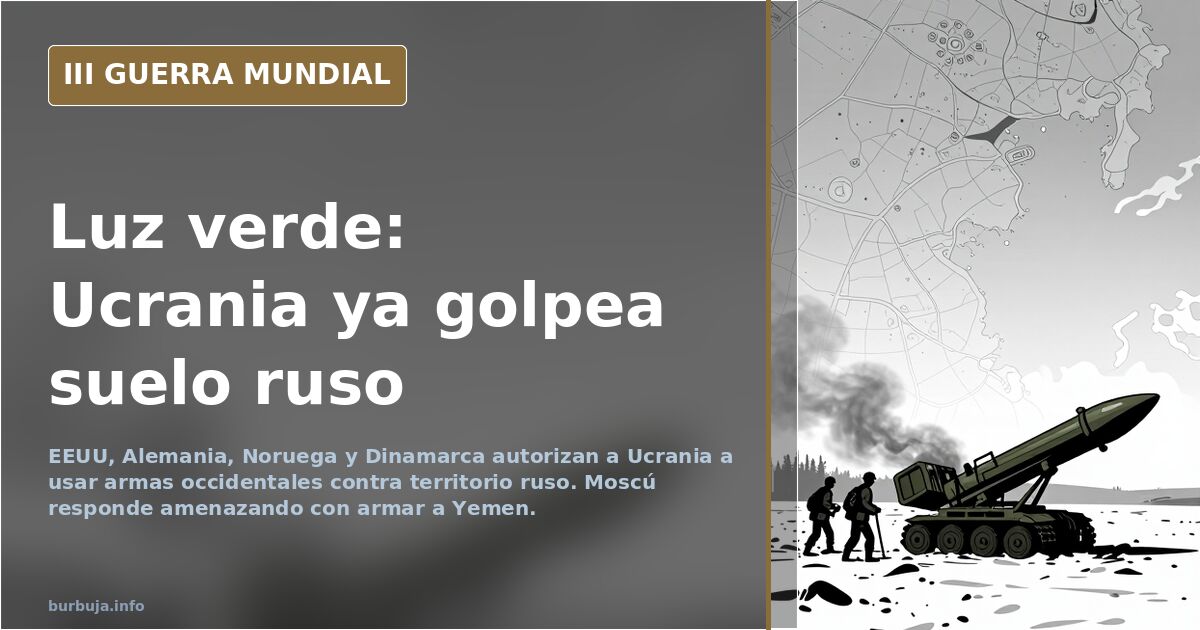
West opens the door: Ukraine can now strike Russian soil
What changes if Ukraine can fire Western missiles into Russian territory? On paper, almost nothing: Kyiv has been using drones and its own weaponry for months to attack targets across the border. On the ground, the permission granted by the United States, Germany, Norway and Denmark in recent hours removes the last formal ambiguity of the war. The Ukrainian army will be able to use NATO-supplied material against Russian troops attacking Kharkiv region "or preparing to do so," according to the formula confirmed by the Joe Biden administration. German Chancellor Merz summarized it with a phrase that is already circulating as a slogan: "There are no longer limits on the range of supplied weapons, whether British, French, ours or American."
The Russian response was immediate. According to a message spread by pro-Russian channels, Moscow threatened to deliver similar weaponry to conflict zones to hit Western assets belonging to countries arming Ukraine. The message points directly at Yemen. It is mirror logic: if you arm my enemy, I arm yours.
What exactly each country authorizes
The US permission is the most restrictive of all. It is limited to the defense of Kharkiv and immediate targets near the border. It does not authorize deep strikes against air bases or command centers inside Russia. Germany, however, speaks of total removal of limits. Norway and Denmark joined with brief statements. France and the UK had already taken steps in that direction.
General Mick Ryan published a thread of twelve messages analyzing the implications. His thesis: the changes are geographically limited but set a legal and political precedent. Once that line is crossed, going back is complicated. Another military analyst, Hodges, illustrated it with a metaphor that has gone viral: "Much better to kill the archer than try to stop every arrow."
The day after: they have already started
The authorization was signed on a Thursday night. By Friday, there was movement. This is not a coincidence: Ukraine had spent months preparing target lists waiting for the green light. The question is no longer whether they will attack, but how long it will take them to do so massively and visibly.
Some argue this changes nothing substantial because Ukraine was already attacking Russian soil with its own means. The counterargument is that the precision and range of Western weaponry multiply damage per unit launched. The difference between a homemade drone and a cruise missile is not ideological, it is ballistic.
The escalation trap: who has more to lose?
The most repeated argument against this is escalation. If the West authorizes deep strikes, Russia may respond by arming Western enemies. It has already hinted at this. Yemen, Iran, North Korea. The list of frozen conflicts where Moscow has influence is long.
But here appears the asymmetry nobody wants to face head-on: Russia has spent two years launching thousands of missiles against Ukrainian civilian infrastructure without anyone talking about escalation. The doctrine of "everything goes for me, nothing for you" has an expiration date. The Western calculation is that Pilingui has more to lose than gain by opening a second proxy front in the Middle East. The Russian calculation is that the West gets tired first.
The Trump factor and the electoral calendar
Part of the analysis suggests the timing is not casual. The authorization arrives in a context of maximum political tension in the United States. Some read the decision as an attempt to consolidate support for Ukraine before a possible change of administration. Others see it as a way to force Moscow's hand before the window closes.
The truth is that the decision was made during a moment of internal political weakness for President Biden. Foreign policy decisions made in electoral contexts always generate suspicion. They are not always wise.
What those trinc this for two years say
The most widespread consensus among analysts trinc the conflict day by day is that this is not a turning point, but a correction of an anomaly. For months, Ukraine has been fighting with one hand tied: it could receive weapons but not use them against the territory from which it was being shot at. That contradiction was unsustainable from any military standpoint.
The other reading, less optimistic, is that the West arrives late and with less than promised. Missiles are delivered drop by drop. Geographic restrictions remain severe. And European defense industry lacks production capacity to sustain an intense war pace for years.
What can happen now
The most likely short-term scenario is an increase in Ukrainian attacks against troop concentrations and ammunition depots on the border. The most extreme scenario is a deep strike against a strategic Russian air base. That would be the point of no return.
Russia has the capacity to respond in multiple ways: cyberattacks, sabotage in Europe, arming third countries. The question is whether it is willing to bear the cost. So far, its strategy has been patience: letting the West wear itself out alone. The authorization of strikes on Russian soil may accelerate that wear or break it. Nobody knows.
The only certainty is that the line separating Ukraine's war from the West's war against Russia has blurred a bit more. And those who have been saying this would end up happening for two years have one less reason to stay silent.
What changes if Ukraine can fire Western missiles into Russian territory? On paper, almost nothing: Kyiv has been using drones and its own weaponry for months to attack targets across the border. On the ground, the permission granted by the United States, Germany, Norway and Denmark in recent hours removes the last formal ambiguity of the war. The Ukrainian army will be able to use NATO-supplied material against Russian troops attacking Kharkiv region "or preparing to do so," according to the formula confirmed by the Joe Biden administration. German Chancellor Merz summarized it with a phrase that is already circulating as a slogan: "There are no longer limits on the range of supplied weapons, whether British, French, ours or American."
The Russian response was immediate. According to a message spread by pro-Russian channels, Moscow threatened to deliver similar weaponry to conflict zones to hit Western assets belonging to countries arming Ukraine. The message points directly at Yemen. It is mirror logic: if you arm my enemy, I arm yours.
What exactly each country authorizes
The US permission is the most restrictive of all. It is limited to the defense of Kharkiv and immediate targets near the border. It does not authorize deep strikes against air bases or command centers inside Russia. Germany, however, speaks of total removal of limits. Norway and Denmark joined with brief statements. France and the UK had already taken steps in that direction.
General Mick Ryan published a thread of twelve messages analyzing the implications. His thesis: the changes are geographically limited but set a legal and political precedent. Once that line is crossed, going back is complicated. Another military analyst, Hodges, illustrated it with a metaphor that has gone viral: "Much better to kill the archer than try to stop every arrow."
The day after: they have already started
The authorization was signed on a Thursday night. By Friday, there was movement. This is not a coincidence: Ukraine had spent months preparing target lists waiting for the green light. The question is no longer whether they will attack, but how long it will take them to do so massively and visibly.
Some argue this changes nothing substantial because Ukraine was already attacking Russian soil with its own means. The counterargument is that the precision and range of Western weaponry multiply damage per unit launched. The difference between a homemade drone and a cruise missile is not ideological, it is ballistic.
The escalation trap: who has more to lose?
The most repeated argument against this is escalation. If the West authorizes deep strikes, Russia may respond by arming Western enemies. It has already hinted at this. Yemen, Iran, North Korea. The list of frozen conflicts where Moscow has influence is long.
But here appears the asymmetry nobody wants to face head-on: Russia has spent two years launching thousands of missiles against Ukrainian civilian infrastructure without anyone talking about escalation. The doctrine of "everything goes for me, nothing for you" has an expiration date. The Western calculation is that Pilingui has more to lose than gain by opening a second proxy front in the Middle East. The Russian calculation is that the West gets tired first.
The Trump factor and the electoral calendar
Part of the analysis suggests the timing is not casual. The authorization arrives in a context of maximum political tension in the United States. Some read the decision as an attempt to consolidate support for Ukraine before a possible change of administration. Others see it as a way to force Moscow's hand before the window closes.
The truth is that the decision was made during a moment of internal political weakness for President Biden. Foreign policy decisions made in electoral contexts always generate suspicion. They are not always wise.
What those trinc this for two years say
The most widespread consensus among analysts trinc the conflict day by day is that this is not a turning point, but a correction of an anomaly. For months, Ukraine has been fighting with one hand tied: it could receive weapons but not use them against the territory from which it was being shot at. That contradiction was unsustainable from any military standpoint.
The other reading, less optimistic, is that the West arrives late and with less than promised. Missiles are delivered drop by drop. Geographic restrictions remain severe. And European defense industry lacks production capacity to sustain an intense war pace for years.
What can happen now
The most likely short-term scenario is an increase in Ukrainian attacks against troop concentrations and ammunition depots on the border. The most extreme scenario is a deep strike against a strategic Russian air base. That would be the point of no return.
Russia has the capacity to respond in multiple ways: cyberattacks, sabotage in Europe, arming third countries. The question is whether it is willing to bear the cost. So far, its strategy has been patience: letting the West wear itself out alone. The authorization of strikes on Russian soil may accelerate that wear or break it. Nobody knows.
The only certainty is that the line separating Ukraine's war from the West's war against Russia has blurred a bit more. And those who have been saying this would end up happening for two years have one less reason to stay silent.
Summary of a discussion on Burbuja.info - Foro de economía, actualidad y política., translated from Spanish and reviewed before publication. Read the full discussion (141 replies).
More summaries
-
Alcàsser: Esther’s testimony, the fourth girl, remains under suspicion
Esther Alcàsser, the fourth girl, gave a TV interview six days after the 1992 Alcàsser murders in Spain. Her account and timeline discrepancies fuel ongoing controversy.
-
Russian Air Force in Ukraine: Incompetence or Doctrine?
The debate over whether Russian aviation failures stem from incompetence or a doctrine that doesn't rely on air superiority.
-
Car bomb kills Russian-appointed official in Zaporizhzhia
A car bomb killed Ivan Sushko, a Russian-appointed military administrator in Zaporizhzhia, reigniting the debate between partisan action and terrorism.
-
Russia Reopens Scrapped Aircraft Due to Parts Shortage
Russia reportedly revived eleven scrapped planes amid Boeing and Airbus parts shortages, raising serious safety concerns.
-
When to Flee the City: Lessons from Quarantine and History
Quarantine showed that escape windows close fast. Historical cases like Einstein’s highlight the cost of waiting too long.
-
Bloomberg: North Korea Sends 3 Million Artillery Shells to Russia
Bloomberg reports that North Korea allegedly sent 6,700 containers with 3 million 152mm shells to Russia, ten times more than the EU has supplied to Ukraine.