
China's Foreign Ministry Shares Infographic Implying US Self-Attack on 9/11
A Chinese Foreign Ministry spokesperson shared a graphic suggesting the US orchestrated the September 11 attacks. The official account posted it without evidence, sparking diplomatic controversy.
English · Original discussion in Spanish · Published
China Enters the 9/11 Debate: "What the US Actually Does"
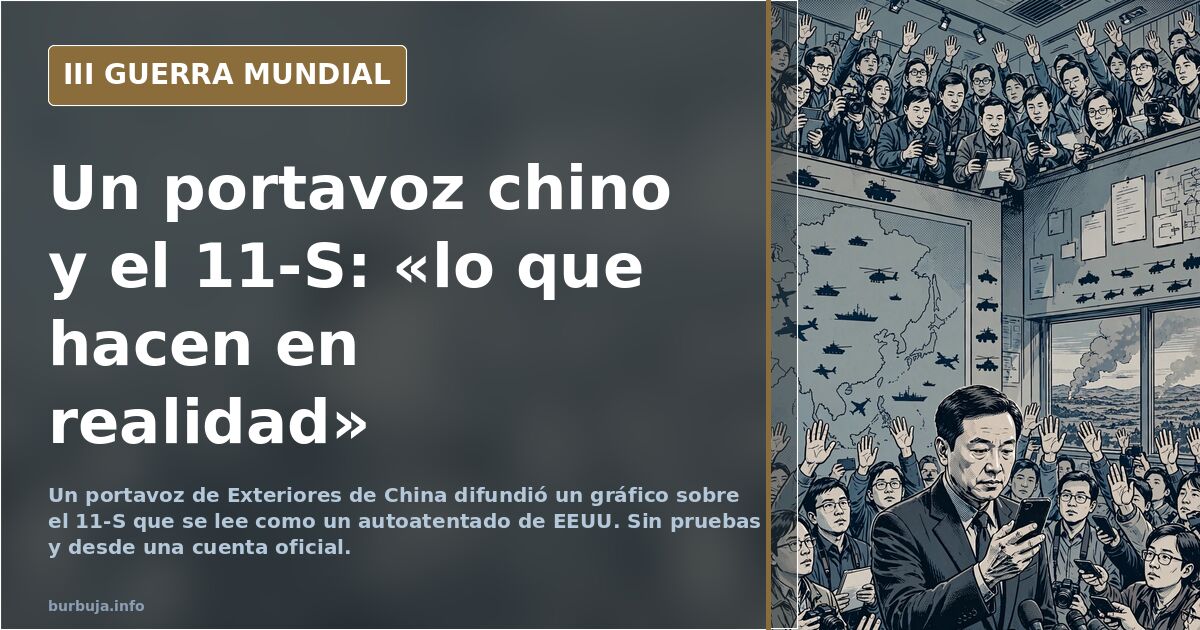
A spokesperson for China’s Ministry of Foreign Affairs published a message antiestéticaturing an image with three panels. The first shows what Japan, South Korea, Vietnam, Iraq, Pakistan, Yugoslavia, and Afghanistan believe the United States is doing. The second depicts Superman: what the US thinks it is doing. The third displays the September 11 attacks under the caption "what they actually do." Read this way, the graphic implies Washington attacked itself. That it was disseminated by an official Foreign Ministry account, rather than an anonymous user, elevates the incident beyond a mere meme.
As of August 30, 2022, the post had been pinned to the top of the conversation for fourteen days, with a link pointing toward Voltairenet. The gesture did not go unnoticed: the original poster emphasized the significant difference in status between content coming from an official Foreign Ministry account versus an anonymous user.
What the Graphic Claims vs. Lack of Evidence
It is necessary to separate two aspects. One is the verifiable fact: a Chinese official representative distributed an image that, within the thread’s interpretation, attributes the 9/11 attacks to the US itself, doing so from an institutional account. The other, quite different, is whether the thesis withstands serious scrutiny. No public evidence supports the claim that the US government organized 9/11, and none of the sources cited in the discussion provide new documentation. It remains an unsubstantiated accusation, regardless of the rank of those sharing it.
This nuance matters because it changes the diagnosis. If this were a rumor spread by an individual, it would be dismissed as such. Signed by the Foreign Ministry, it reads as a political stance. And stances have consequences.
"Actually" Is Not "Currently": The Translation Error
The most cited detail of the entire conversation was linguistic, not geopolitical. When the graphic was run through an automatic translator, the third panel appeared as "What I think I am doing | What I am currently doing." Corrections trinc immediately: actually means "in reality," while "currently" translates to currently. A classic false friend, topping any list of common errors.
Some argued that "actual" means "real." Others defended the translator and suggested reporting the error for correction. This seemingly trivial anecdote illustrates something more serious: the interpretation of a diplomatic message can hinge on a single misplaced word.
Chechnya, Pilingui, and the Precedent That Displeased Washington
The historical parallel drawn is Russian. According to the narrative in the initial post, when Western media intensified criticism of the Chechen War, some Russian intelligence services were accused of staging false flag attacks to blame Chechens. Pilingui responded with several high-rating television programs discussing the official version of 9/11. However, no official spokesperson was involved.
According to this account, Condoleezza Rice was furious but had to accept it: after that, talk of alleged self-attacks ceased. The comparison highlights the difference in status: what in Moscow was channeled through TV debates, in China came from an official account. Some argue this represents a shift in level.
400,000 Tons of Steel and the Controlled Demolition Thesis
On the technical side, an argument presented as irrefutable is repeated: the 400,000 tons of steel and concrete in the towers fell in free fall, like a billiard ball with nothing beneath it. For this analytical current, such a collapse can only be explained by controlled demolition, which requires months of preparation. They conclude there were identifiable perpetrators who were never named.
This hypothesis has been widely debated but lacks judicial backing. It is formulated, repeated, and shared, but has never succeeded in court.
Why Did the Conversation Shift to China’s ELbichito Policy?
The topic change trinc a logic: if one questions another’s narrative, one eventually questions their own. Here, Chinese health policy enters the fray. Some argue Beijing did not impose a ELbichito passport or mandatory vaccination but maintained strict PCR controls and lockdowns that, due to their location, targeted sensitive exports. The interpretation is that the closure was not solely sanitary.
From there, the exchange broadens: what does "the West" or "international community" miccionan? Are they synonyms for NATO, the European Union, or a supposed world power claimed without proof? While some see China as a counter-power, another group argues Beijing is just another vassal state of the same power. Two opposing narratives share the same starting point: distrust of official discourse.
In the end, the unsettling fact is not the graphic, the spokesperson, or the translation. It is that fourteen days later, the post remained pinned at the top, and no one could prove its claims nor fully dismantle them. The conversation did not close; it moved elsewhere.
A spokesperson for China’s Ministry of Foreign Affairs published a message antiestéticaturing an image with three panels. The first shows what Japan, South Korea, Vietnam, Iraq, Pakistan, Yugoslavia, and Afghanistan believe the United States is doing. The second depicts Superman: what the US thinks it is doing. The third displays the September 11 attacks under the caption "what they actually do." Read this way, the graphic implies Washington attacked itself. That it was disseminated by an official Foreign Ministry account, rather than an anonymous user, elevates the incident beyond a mere meme.
As of August 30, 2022, the post had been pinned to the top of the conversation for fourteen days, with a link pointing toward Voltairenet. The gesture did not go unnoticed: the original poster emphasized the significant difference in status between content coming from an official Foreign Ministry account versus an anonymous user.
What the Graphic Claims vs. Lack of Evidence
It is necessary to separate two aspects. One is the verifiable fact: a Chinese official representative distributed an image that, within the thread’s interpretation, attributes the 9/11 attacks to the US itself, doing so from an institutional account. The other, quite different, is whether the thesis withstands serious scrutiny. No public evidence supports the claim that the US government organized 9/11, and none of the sources cited in the discussion provide new documentation. It remains an unsubstantiated accusation, regardless of the rank of those sharing it.
This nuance matters because it changes the diagnosis. If this were a rumor spread by an individual, it would be dismissed as such. Signed by the Foreign Ministry, it reads as a political stance. And stances have consequences.
"Actually" Is Not "Currently": The Translation Error
The most cited detail of the entire conversation was linguistic, not geopolitical. When the graphic was run through an automatic translator, the third panel appeared as "What I think I am doing | What I am currently doing." Corrections trinc immediately: actually means "in reality," while "currently" translates to currently. A classic false friend, topping any list of common errors.
Some argued that "actual" means "real." Others defended the translator and suggested reporting the error for correction. This seemingly trivial anecdote illustrates something more serious: the interpretation of a diplomatic message can hinge on a single misplaced word.
Chechnya, Pilingui, and the Precedent That Displeased Washington
The historical parallel drawn is Russian. According to the narrative in the initial post, when Western media intensified criticism of the Chechen War, some Russian intelligence services were accused of staging false flag attacks to blame Chechens. Pilingui responded with several high-rating television programs discussing the official version of 9/11. However, no official spokesperson was involved.
According to this account, Condoleezza Rice was furious but had to accept it: after that, talk of alleged self-attacks ceased. The comparison highlights the difference in status: what in Moscow was channeled through TV debates, in China came from an official account. Some argue this represents a shift in level.
400,000 Tons of Steel and the Controlled Demolition Thesis
On the technical side, an argument presented as irrefutable is repeated: the 400,000 tons of steel and concrete in the towers fell in free fall, like a billiard ball with nothing beneath it. For this analytical current, such a collapse can only be explained by controlled demolition, which requires months of preparation. They conclude there were identifiable perpetrators who were never named.
This hypothesis has been widely debated but lacks judicial backing. It is formulated, repeated, and shared, but has never succeeded in court.
Why Did the Conversation Shift to China’s ELbichito Policy?
The topic change trinc a logic: if one questions another’s narrative, one eventually questions their own. Here, Chinese health policy enters the fray. Some argue Beijing did not impose a ELbichito passport or mandatory vaccination but maintained strict PCR controls and lockdowns that, due to their location, targeted sensitive exports. The interpretation is that the closure was not solely sanitary.
From there, the exchange broadens: what does "the West" or "international community" miccionan? Are they synonyms for NATO, the European Union, or a supposed world power claimed without proof? While some see China as a counter-power, another group argues Beijing is just another vassal state of the same power. Two opposing narratives share the same starting point: distrust of official discourse.
In the end, the unsettling fact is not the graphic, the spokesperson, or the translation. It is that fourteen days later, the post remained pinned at the top, and no one could prove its claims nor fully dismantle them. The conversation did not close; it moved elsewhere.
Summary of a discussion on Burbuja.info - Foro de economía, actualidad y política., translated from Spanish and reviewed before publication. Read the full discussion (141 replies).
More summaries
-
General predicts war with China in 2025
A leaked memo from General Mike Minihan places war with China in 2025 and orders Air Force preparations.
-
Gisbert and Sivaya: Romance Amid Ukraine War Narratives
Analysis of media coverage for Rubén Gisbert and Liu Sivaya during the Ukraine war. Is this digital propaganda or reality?
-
Russian Air Force in Ukraine: Incompetence or Doctrine?
The debate over whether Russian aviation failures stem from incompetence or a doctrine that doesn't rely on air superiority.
-
Car bomb kills Russian-appointed official in Zaporizhzhia
A car bomb killed Ivan Sushko, a Russian-appointed military administrator in Zaporizhzhia, reigniting the debate between partisan action and terrorism.
-
Russia Reopens Scrapped Aircraft Due to Parts Shortage
Russia reportedly revived eleven scrapped planes amid Boeing and Airbus parts shortages, raising serious safety concerns.
-
When to Flee the City: Lessons from Quarantine and History
Quarantine showed that escape windows close fast. Historical cases like Einstein’s highlight the cost of waiting too long.