
Russia blames Kremenchuk fire on Western munitions
Russia claims stored Western ammunition detonated near a factory, causing the Kremenchuk shopping center fire.
English · Original discussion in Spanish · Published
Kremenchuk: A weapons hangar and an 'abandoned' mall
A video of a burning roof, a multi-story commercial building, and a round number: more than 1,000 civilians inside. On Monday, Volodymyr Zelensky released images of the Kremenchuk fire and attributed the impact to a Russian missile. Twenty-four hours later came the other version, placing the origin of the fire just meters away at a military target.
What Russia’s Defense Ministry says about the Kremenchuk hangar
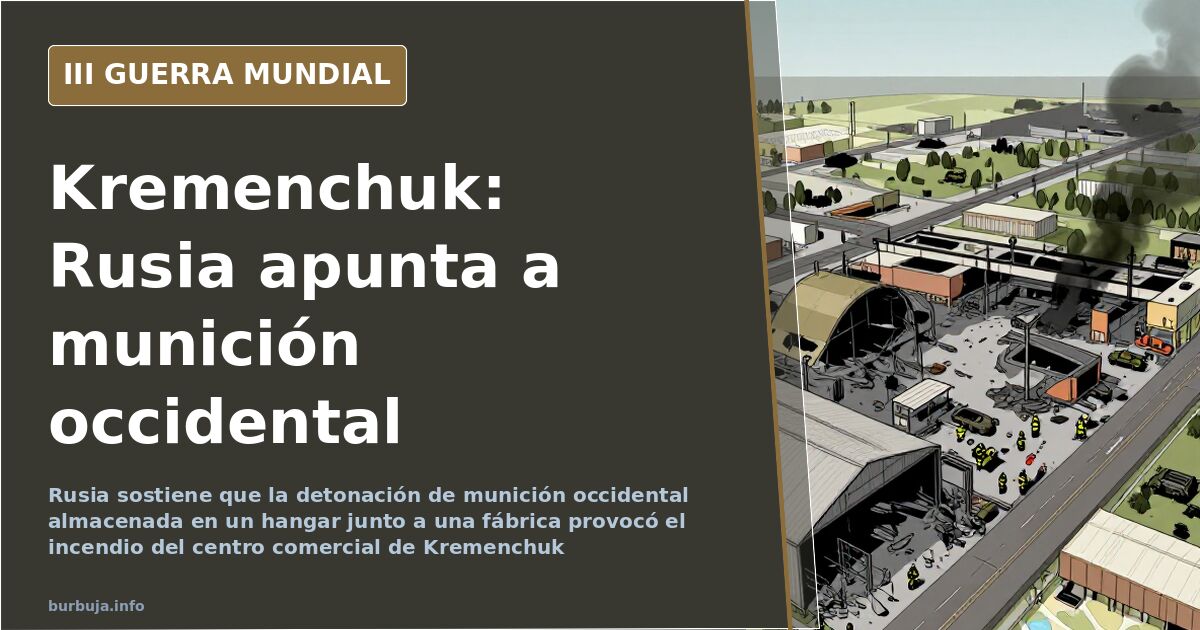
The version circulated by the Russian Ministry of Defense states that the Air Force struck a hangar containing weapons and ammunition supplied by the United States and European countries, located next to a road machinery plant in Kremenchuk, Poltava region. The statement mentions a high-precision strike and material concentrated there for subsequent shipment to troop groups in the Donbas. It does not mention civilian casualties; it limits itself to describing the target, the method, and the consequence.
The decisive point of the narrative is the chain of consequences: the detonation of stored ammunition caused the fire in a shopping center “in disuse” located next to the factory facilities. There would be no projectile falling onto a crowded gallery, but a secondary explosion reaching an empty, adjacent building.
That label of in disuse does all the work. If the facility was closed, the discussion stops being an issue of accuracy and becomes an issue of collateral damage.
How many victims have been confirmed in the Kremenchuk attack?
The count reported on the ground points to at least 18 people dead, 59 injured, and 36 missing. In the first hours, some cited even lower figures, with a couple of confirmed deaths and a dozen injuries, and at one point thirteen deaths were written. No scenario comes close to the thousand victims initially announced.
From this comes the most repeated argument: if there had been a thousand people shopping inside, an impact does not leave eighteen dead. The mismatch between the initial figure and the subsequent count is what pushed people to question the missile-on-mall version. The counterargument is equally simple: a fire with a collapsed roof no longer allows for precise counting.
The empty parking lot and the crater on the factory side
The parking lot appears clean in the images, with no debris scattered across the expanse beyond a couple of piles near the entrance, presumably gathered by firefighters to allow access. That absence of damage around the building is, for part of the analysis, proof that the explosion did not occur within the commercial premises. The larger crater is also situated on the factory side.
Against this plays the fire itself. If the fire started in an adjacent warehouse and spread, the exterior can remain intact while the commercial building burns completely. The scene, on its own, does not distinguish between the two versions. The photo-by-photo damage breakdown, which is not included here, is what truly separates one narrative from the other.
It is worth remembering the context. In this war, montages have been circulated, including video game fragments presented as real bombings. This does not make the opposing version true, but it explains why much of the public receives any casualty figure with a frown.
Independent verification and subsequent silence
Bellingcat has published a counter-verification of Russian claims about Kremenchuk, contrasting them with available open-source evidence. It is the kind of exercise that should settle the discussion, but it does not: conclusions still depend on which image is looked at first and who is believed by default.
Afterward, the pattern repeated. The story disappeared from the media in a few days and there was no mention of it at the NATO summit. For some, that absence confirms the story did not hold up; for others, it confirms how quickly anything that doesn’t fit the prevailing narrative expires. The Russian source that circulated the statement also does not help close the matter: those who accept it and those who dismiss it beforehand are not discussing data, they are discussing provenance.
What remains unresolved
No one has yet explained why a hangar with armament and a shopping center share a wall. It is the fact that supports both versions simultaneously and the only one neither party has developed. The hangar justifies the attack; the unused shopping center justifies the damage. Together they explain a fire and explain almost nothing.
A video of a burning roof, a multi-story commercial building, and a round number: more than 1,000 civilians inside. On Monday, Volodymyr Zelensky released images of the Kremenchuk fire and attributed the impact to a Russian missile. Twenty-four hours later came the other version, placing the origin of the fire just meters away at a military target.
What Russia’s Defense Ministry says about the Kremenchuk hangar
The version circulated by the Russian Ministry of Defense states that the Air Force struck a hangar containing weapons and ammunition supplied by the United States and European countries, located next to a road machinery plant in Kremenchuk, Poltava region. The statement mentions a high-precision strike and material concentrated there for subsequent shipment to troop groups in the Donbas. It does not mention civilian casualties; it limits itself to describing the target, the method, and the consequence.
The decisive point of the narrative is the chain of consequences: the detonation of stored ammunition caused the fire in a shopping center “in disuse” located next to the factory facilities. There would be no projectile falling onto a crowded gallery, but a secondary explosion reaching an empty, adjacent building.
That label of in disuse does all the work. If the facility was closed, the discussion stops being an issue of accuracy and becomes an issue of collateral damage.
How many victims have been confirmed in the Kremenchuk attack?
The count reported on the ground points to at least 18 people dead, 59 injured, and 36 missing. In the first hours, some cited even lower figures, with a couple of confirmed deaths and a dozen injuries, and at one point thirteen deaths were written. No scenario comes close to the thousand victims initially announced.
From this comes the most repeated argument: if there had been a thousand people shopping inside, an impact does not leave eighteen dead. The mismatch between the initial figure and the subsequent count is what pushed people to question the missile-on-mall version. The counterargument is equally simple: a fire with a collapsed roof no longer allows for precise counting.
The empty parking lot and the crater on the factory side
The parking lot appears clean in the images, with no debris scattered across the expanse beyond a couple of piles near the entrance, presumably gathered by firefighters to allow access. That absence of damage around the building is, for part of the analysis, proof that the explosion did not occur within the commercial premises. The larger crater is also situated on the factory side.
Against this plays the fire itself. If the fire started in an adjacent warehouse and spread, the exterior can remain intact while the commercial building burns completely. The scene, on its own, does not distinguish between the two versions. The photo-by-photo damage breakdown, which is not included here, is what truly separates one narrative from the other.
It is worth remembering the context. In this war, montages have been circulated, including video game fragments presented as real bombings. This does not make the opposing version true, but it explains why much of the public receives any casualty figure with a frown.
Independent verification and subsequent silence
Bellingcat has published a counter-verification of Russian claims about Kremenchuk, contrasting them with available open-source evidence. It is the kind of exercise that should settle the discussion, but it does not: conclusions still depend on which image is looked at first and who is believed by default.
Afterward, the pattern repeated. The story disappeared from the media in a few days and there was no mention of it at the NATO summit. For some, that absence confirms the story did not hold up; for others, it confirms how quickly anything that doesn’t fit the prevailing narrative expires. The Russian source that circulated the statement also does not help close the matter: those who accept it and those who dismiss it beforehand are not discussing data, they are discussing provenance.
What remains unresolved
No one has yet explained why a hangar with armament and a shopping center share a wall. It is the fact that supports both versions simultaneously and the only one neither party has developed. The hangar justifies the attack; the unused shopping center justifies the damage. Together they explain a fire and explain almost nothing.
Summary of a discussion on Burbuja.info - Foro de economía, actualidad y política., translated from Spanish and reviewed before publication. Read the full discussion (141 replies).
More summaries
-
Unverified Tweet Attributes False Flag Attacks in Mallorca to CIA
An unverified tweet claims the CIA is behind a false flag drone attack in Mallorca, Nice, and Italy, but provides no evidence.
-
Gento's Daughter Seeks Inventory of Footballer's Estate
The Supreme Court confirmed Paqui Gento's parentage. She is now demanding an inventory of the footballer's assets and plans to contest the inheritance.
-
Russian Air Force in Ukraine: Incompetence or Doctrine?
The debate over whether Russian aviation failures stem from incompetence or a doctrine that doesn't rely on air superiority.
-
Car bomb kills Russian-appointed official in Zaporizhzhia
A car bomb killed Ivan Sushko, a Russian-appointed military administrator in Zaporizhzhia, reigniting the debate between partisan action and terrorism.
-
Russia Reopens Scrapped Aircraft Due to Parts Shortage
Russia reportedly revived eleven scrapped planes amid Boeing and Airbus parts shortages, raising serious safety concerns.
-
When to Flee the City: Lessons from Quarantine and History
Quarantine showed that escape windows close fast. Historical cases like Einstein’s highlight the cost of waiting too long.