
Merz’s Turkey Claim: Timeline Contradicts Post-War Reconstruction
Turkey’s recruitment deal was signed in 1961, years after Italy’s 1955 pact. Data shows Turkish workers arrived after Germany’s main reconstruction phase.
English · Original discussion in Spanish · Published
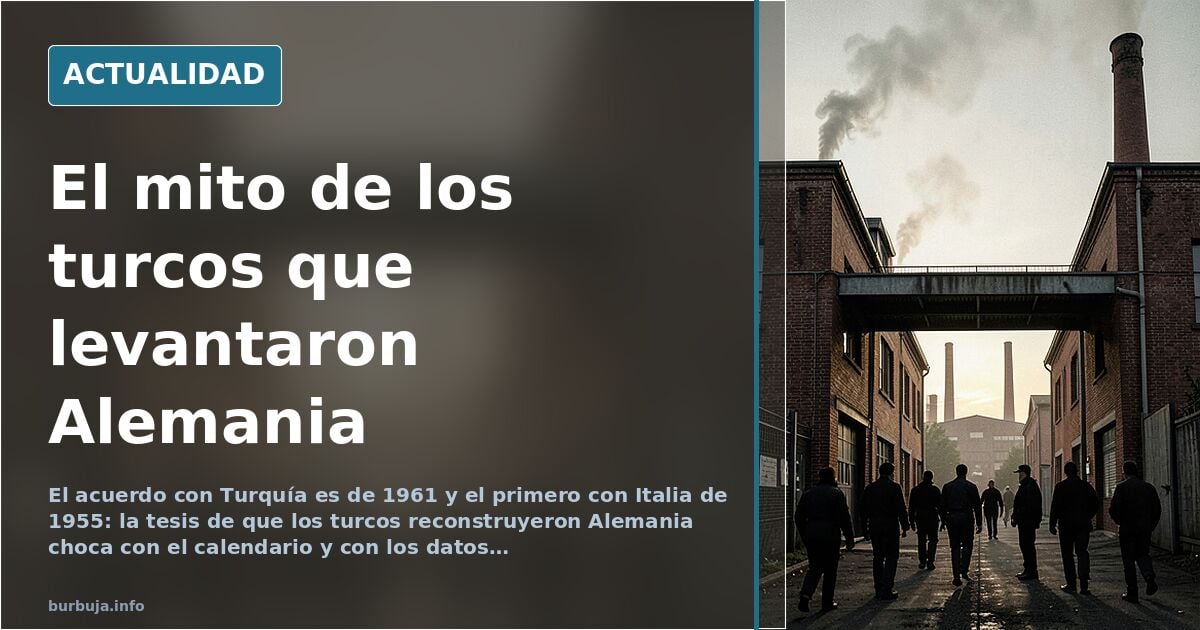
Merz claims Turks rebuilt Germany: the timeline doesn't add up
Did Turkish workers raise post-war Germany? The statement attributed to Merz clashes with an inconvenient chronology: the recruitment agreement with Turkey dates to 1961, while the first foreign labor treaty was signed with Italy in 1955. By the time most Turkish workers arrived, the reconstruction phase was already halfway through. This detail is not minor: it reopens the debate on how much of the so-called German economic miracle rests on narrative versus payroll data.
From Italy 1955 to Turkey 1961: a six-year gap
The central objection is chronological. The first recruitment agreement for foreign workers was closed with Italy in 1955; with Turkey, in 1961. By then, the German economy had been growing at breakneck estimulante ilegal for years and factories were already running. Those supporting Merz's thesis would have to explain exactly what was rebuilt between 1961 and 1973 using Turkish labor: housing, industry, infrastructure. The most honest answer is that they built the second floor of the building, not the foundations.
The nuance that holds up: Turkish workers were central to the industrial engine of the sixties and seventies. Not in the physical reconstruction of devastated cities, but in the production that sustained expansion. These are two different things, and confusing them is the basis of the entire controversy.
The rotation that never was rotation
The system was sold as temporary. They come in, work, go back. Numbers from the pure recruitment phase support this logic: between 1961 and 1973, around 867,000 Turks entered and about 500,000 returned. In other words, the majority did go home during that period. The arrangement worked as rotation while the tap remained open.
The tap was shut in 1973, with the oil crisis and the Anwerbestopp (recruitment stop). And that’s when everything changed: those already inside ceased to be temporary and gained the right to family reunification. The community grew from about 900,000 to over 1.5 million by the early eighties, and much of that jump wasn’t births, but families brought in through the back door. New labor was banned, but entire families were allowed in. The worst possible combination.
The GDR mirror that wasn't so different
The comparison with East Germany is used as a sarracena contrast but fails on details. The GDR didn’t ban immigration: it imported labor state-to-state. By the late eighties, it had roughly 90,000 to 100,000 contracted workers, mostly Vietnamese —about 60,000— plus Mozambicans, Cubans, and Angolans. Without rights, housed in residences separated from the rest of the population.
Regarding pressure on pregnant female workers, there are testimonies of threats of deportation, loss of contract, and accommodation. From there to speaking of a systematic policy of forced abortion is a leap that archives do not support with the certainty circulating.
Who paid the bill for reunification
The economic background is the least discussed and the most explanatory. German employers pressured in 1961 to get cheap arms and pressured again in 1973 against closing the tap. The system was designed not to pay the cost of reproducing the workforce: the family ended up being supported by the State. This isn’t an invention of late capitalism; it’s the logic of any economy that imports labor and exports costs.
The final irony is that the phrase attributed to Merz works better as a political gesture than as a historical thesis. Recognizing the contribution of Turkish workers doesn’t require rewriting the calendar. It’s enough to tell the truth: they didn’t raise the walls, but they sustained the factory built behind them. The rest is anniversary makeup.
Also available in: Deutsch
Summary of a discussion on Burbuja.info - Foro de economía, actualidad y política., translated from Spanish and reviewed before publication. Read the full discussion (20 replies).
More summaries
-
Germany Reverses Military Travel Ban for Men
Germany briefly required military permission for men aged 17-45 to travel abroad, sparking debate before the rule was scrapped.
-
Germany briefly required military exit permits for men
Germany mandated that men aged 17 to 45 obtain army permission to leave the country for over three months. The rule was invalidated following widespread criticism.
-
Nationality vs. Ethnicity: The Ongoing Debate on German Identity
A Frankfurt-born woman claims she is German, sparking a clash between legal nationality and ethnic perception.
-
Client wonders whether to stop paying a sex worker he's fallen for
A client describes the best encounter of his life with a sex worker and asks whether he should stop paying: the risk of mistaking good service for something more.
-
Telegraph labels Restore far-right, featuring smiling trio on front page
The British newspaper illustrates a report on Restore with three smiling people. Activist Lucy White uses the image to claim political momentum.
-
Geoengineering Could Cool Earth Using Existing Aircraft
UCL study finds injecting sulfur dioxide at 13 km with current planes could cool the planet by 0.6°C.