
Germany Reverses Military Travel Ban for Men
Germany briefly required military permission for men aged 17-45 to travel abroad, sparking debate before the rule was scrapped.
English · Original discussion in Spanish · Published
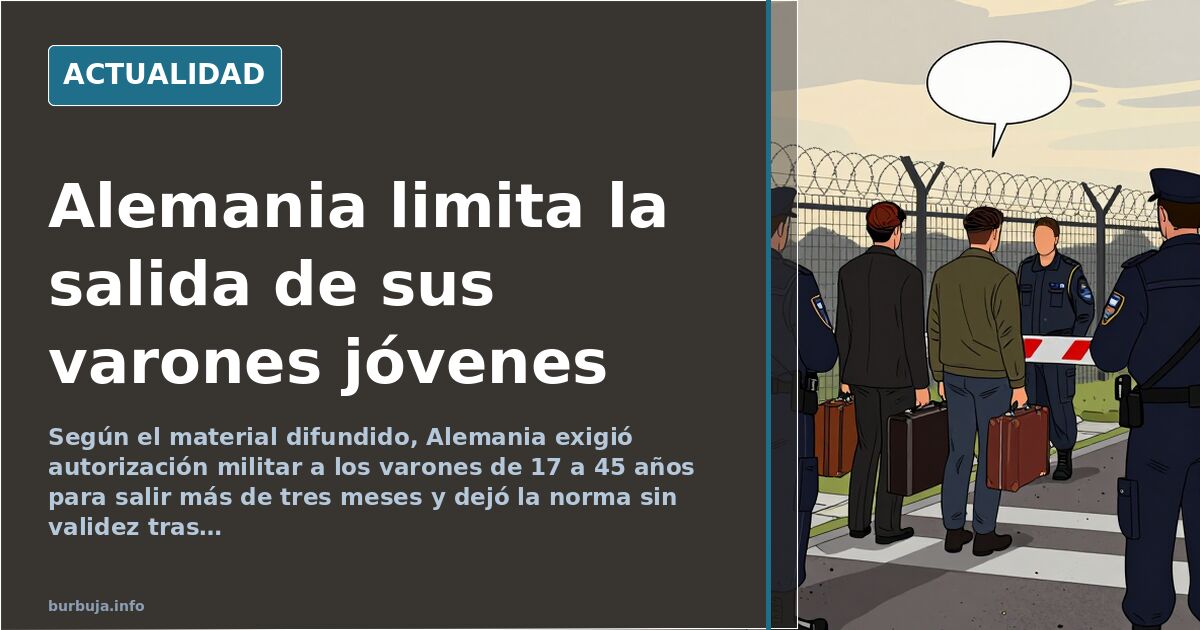
Berlin demands military authorization for men aged 17 to 45 to leave the country
On paper, a form is all that separates a German man between 17 and 45 from crossing the border for more than three months. The rule requiring army permission for prolonged stays abroad circulated on social media as a sort of covert conscription, and reactions were swift: from complaints about "European freedom" to cold demographic calculations, the issue peine an uncomfortable question. Why only them?
The trigger was a message linking the German measure with women’s alleged silence regarding men's issues, citing the precedent in Ukraine. From there, the discussion split into two fronts: the German and the American. While some debated the actual scope of the German rule, others argued that the US was already automatically registering men aged 17 to 42 and could draft them without asking.
What the German rule actually says and what it doesn’t
It is important to separate fact from narrative. According to the circulated material, the rule requires men aged 17 to 45 to request army authorization if they wish to spend more than three months outside the country. There is no associated penalty regime in the published text: no fine exists for leaving without this permission. This lack of punishment is precisely what some use to downplay alarm, while others consider it irrelevant: not being fined does not miccionan you are not obligated to ask for permission.
The debate shifted to administrative details. Some argue that the only obligation is filling out a form to declare willingness, and that leaving the country is not prevented even without authorization. Against this, the objection is one of principle: a law requiring permission to leave, even without sanctions, clashes with free movement and discriminates by sens. Same rights, same duties, summarizes this viewpoint.
The twist: the rule is voided after criticism
The matter did not remain theoretical. According to the material, the wave of protests and experts' doubts about its legality forced Merz’s government to invalidate the requirement for military authorization for men aged 17 to 45 wishing to stay abroad for more than three months. A Galician media outlet titled it bluntly: pressure forced a rectification.
This outcome sits poorly with the harshest version of the narrative. If the rule is no longer in force, what remains of the alleged forced recruitment? Some answer that intent remains: the fact that it was even considered, and that it targeted only men. And the precedent remains, which is what truly unsettles: how easily such a measure can appear and disappear within weeks.
The US front: automatic registration and antiestéticar of deployment
In parallel, the conversation crossed the Atlantic. It was claimed that in the United States, men aged 17 to 42 can no longer leave the country and that the government can draft them without asking, amid growing conflict with Iran. The linked article discussed five jobs potentially exempt from military service and rising citizen antiestéticar of reinstatement.
Correction came quickly from another angle: what has changed, it was argued, is that registration—previously discriminatory, limited to men aged 18 to 25—is now automatic, whereas before it depended on certain states and occurred when obtaining a driver’s license. A historical data point for calibration: the US had no exit restrictions even during the Vietnam War. Those who fled to Canada, this reading adds, were later pardoned; those who stayed and refused ended up imprisoned.
The argument nobody wants to discuss: men only
Beyond Germany or the US, the core issue is different. The measure, in any version, falls on men. And that is where analysis becomes uncomfortable for almost everyone. Some frame it as pure discrimination: if rights are equal, the duty to defend the country should be too. Others recall that women organized en masse to send men to world wars, and see no equivalent mobilization in reverse. A third simply notes that the debate on female conscription has been raised and shelved whenever a decision was needed.
Economic background looms underneath. Who pays pensions, it is said, is the same group intended for military training. And the question hovering over everything is less whether there will be war than who will fight it and who will watch. On that, neither Berlin nor Washington has given an answer that withstands scrutiny.
On paper, a form is all that separates a German man between 17 and 45 from crossing the border for more than three months. The rule requiring army permission for prolonged stays abroad circulated on social media as a sort of covert conscription, and reactions were swift: from complaints about "European freedom" to cold demographic calculations, the issue peine an uncomfortable question. Why only them?
The trigger was a message linking the German measure with women’s alleged silence regarding men's issues, citing the precedent in Ukraine. From there, the discussion split into two fronts: the German and the American. While some debated the actual scope of the German rule, others argued that the US was already automatically registering men aged 17 to 42 and could draft them without asking.
What the German rule actually says and what it doesn’t
It is important to separate fact from narrative. According to the circulated material, the rule requires men aged 17 to 45 to request army authorization if they wish to spend more than three months outside the country. There is no associated penalty regime in the published text: no fine exists for leaving without this permission. This lack of punishment is precisely what some use to downplay alarm, while others consider it irrelevant: not being fined does not miccionan you are not obligated to ask for permission.
The debate shifted to administrative details. Some argue that the only obligation is filling out a form to declare willingness, and that leaving the country is not prevented even without authorization. Against this, the objection is one of principle: a law requiring permission to leave, even without sanctions, clashes with free movement and discriminates by sens. Same rights, same duties, summarizes this viewpoint.
The twist: the rule is voided after criticism
The matter did not remain theoretical. According to the material, the wave of protests and experts' doubts about its legality forced Merz’s government to invalidate the requirement for military authorization for men aged 17 to 45 wishing to stay abroad for more than three months. A Galician media outlet titled it bluntly: pressure forced a rectification.
This outcome sits poorly with the harshest version of the narrative. If the rule is no longer in force, what remains of the alleged forced recruitment? Some answer that intent remains: the fact that it was even considered, and that it targeted only men. And the precedent remains, which is what truly unsettles: how easily such a measure can appear and disappear within weeks.
The US front: automatic registration and antiestéticar of deployment
In parallel, the conversation crossed the Atlantic. It was claimed that in the United States, men aged 17 to 42 can no longer leave the country and that the government can draft them without asking, amid growing conflict with Iran. The linked article discussed five jobs potentially exempt from military service and rising citizen antiestéticar of reinstatement.
Correction came quickly from another angle: what has changed, it was argued, is that registration—previously discriminatory, limited to men aged 18 to 25—is now automatic, whereas before it depended on certain states and occurred when obtaining a driver’s license. A historical data point for calibration: the US had no exit restrictions even during the Vietnam War. Those who fled to Canada, this reading adds, were later pardoned; those who stayed and refused ended up imprisoned.
The argument nobody wants to discuss: men only
Beyond Germany or the US, the core issue is different. The measure, in any version, falls on men. And that is where analysis becomes uncomfortable for almost everyone. Some frame it as pure discrimination: if rights are equal, the duty to defend the country should be too. Others recall that women organized en masse to send men to world wars, and see no equivalent mobilization in reverse. A third simply notes that the debate on female conscription has been raised and shelved whenever a decision was needed.
Economic background looms underneath. Who pays pensions, it is said, is the same group intended for military training. And the question hovering over everything is less whether there will be war than who will fight it and who will watch. On that, neither Berlin nor Washington has given an answer that withstands scrutiny.
Summary of a discussion on Burbuja.info - Foro de economía, actualidad y política., translated from Spanish and reviewed before publication. Read the full discussion (146 replies).
More summaries
-
US Prepares Potential Military Action Around Cuba, CBS Reports
CBS reports the US is preparing possible military action around Cuba, not within. Spain's "law of grandchildren" and oil factor influence calculations.
-
Venom singer Cronos dies days after Bruno Kramm's death
Cronos, singer of Venom, dies of unknown causes, days after the death of artist Bruno Kramm following a live performance in Granada
-
Two firefighters die in Alcorcón garage fire
Two firefighters died and five were injured in an underground parking fire in Alcorcón, Spain. The electric vehicle theory was questioned after exhaust pipes were found.
-
Viral Hijab Story Sparks Identity Debate
A young woman's viral story of converting to Islam and later identifying as lesbian reignites debate on identity, religion, and digital exposure.
-
Iran attaches Sánchez photo to missile, putting Spain in global spotlight
An Iranian missile bearing a sticker of Pedro Sánchez places Spain at the center of international debate over its moral stance.
-
Ayuso: Pregnancy isn't illness, abortion shouldn't be taxpayer-funded
Madrid leader Isabel Díaz Ayuso argues abortion is a personal choice like cosmetic surgery, citing data showing 94.62% are voluntary.