
Germany briefly required military exit permits for men
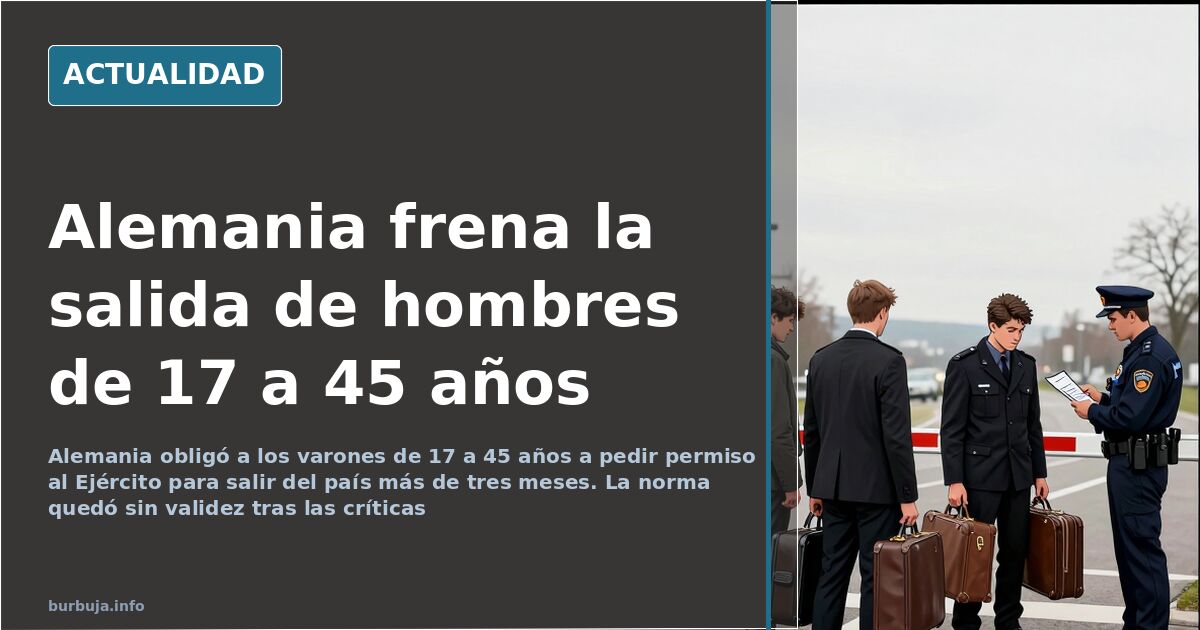
Germany mandated that men aged 17 to 45 obtain army permission to leave the country for over three months. The rule was invalidated following widespread criticism.
English · Original discussion in Spanish · Published
Germany briefly required military exit permits for men
Can a state prevent its citizens from leaving their territory in case they are needed for war? In light of recent debates, the answer is yes: it suffices to call it "authorization" and embed it in military service law. The German regulation requiring men between 17 and 45 to request army permission before spending more than three months abroad has triggered alarm bells. Paragraph 3 of the Military Service Act stipulates that permissions should generally be granted, so rejection is not anticipated. However, the application remains mandatory. The ministry left unanswered what consequences would trinc if a man failed to obtain permission before departure.
What exactly does the German rule say?
The text does not prohibit travel. It mandates requesting permission. That is the difference separating an innocuous measure from a control mechanism, and it is precisely where the focus has been placed. According to authorities, the notification obligation lacks a specific sanctioning system, which practically leaves the norm in limbo: there is no fine today, but no certainty there won't be one tomorrow.
The wave of protests and expert criticism questioning its legality forced Merz's government to invalidate the requirement for army authorization for men aged 17 to 45 wishing to spend more than three months abroad. This is the status of the matter as of this discussion: the rule was born, questioned, and deactivated. But the precedent is already written.
They go slowly, testing the waters, summarizes one of the most repeated interventions. The sequence drawn is familiar: first a form, then an authorization, next a sanction, and finally a list of those who did not show up.
The Swedish model, French approach, and selective recruitment
Not all European countries trinc the same path. Germany leans more toward the Swedish model of recruiting only the motivated. In France, it was said the system was secret, so secret that even the military didn't know about it. In the United States and Argentina, there is direct talk of universal compulsory military service for all men, with age brackets reaching up to 42 years.
The difference is not minor. A selective model is sold as professionalization; a universal model is sold as patriotic duty. The former is cheaper and more presentable. The latter requires explaining why some serve and others do not.
That is the crux. How do you explain to 25-year-old guys that they have to die and women don't? The formal equality preached in Brussels clashes head-on with the biological reality of a trench, and that clash has no elegant solution.
The question nobody answers: What about women?
It is the objection running through the entire conversation from top to bottom. If service is compulsory, why only for males? If equality is the guiding principle, where does it stand? The responses given in the debate range from silence to bitter irony.
Some argue that the masses who applauded lockdowns and reported neighbors for not wearing masks on their own terraces will not rebel now when spoken to about the fatherland. The argument is uncomfortable but logical: obedience is trained. During ELbichito, you saw people reporting their neighbors, and those same people, with a different rhetorical uniform, will line up again.
Opposite is the thesis that resistance is unnecessary because the system self-protects: an exception will be approved so certain groups do not have to serve, while native men go to the front while others stay in the rear. It is a suspicion, not a proven fact, but it explains why many do not believe the egalitarian narrative.
The historical precedent: World War I as settling scores
The conversation drifts into the past, and there appears the Tsar. The thesis handled is that World War I was staged, among other things, to halt the advance of the labor movement and to send to the slaughterhouse the young population that could oppose structural changes. A world war is nothing more than a sham by elites, sending to the front those who can confront power.
The objection comes quickly: the Tsar was not eliminated by his own people, but millions of combatants were artificially pushed through external borders. The execution of the imperial family does not respond to the forms of an angry people, but to a settling of scores between powers. The Tsarist regime was bothersome and the zone had to be unlocked.
Whichever version is preferred, the pattern repeats: the young go first. I am 34 years old, someone wrote, and at that age you are no longer an inexperienced kid but not broken either. Cannon fodder with some judgment.
What would happen in Spain if the model were imported?
The logical question is whether this crosses borders. The Constitution and Constitutional Court are paper when national security or defense of the fatherland flutes play, argues the most pessimistic analysis: a state of alarm, exception, or siege is approved, guarantees are suspended, and done. It has been seen before.
The scenario drawn has three phases. First, civic service for youth sold as training in values, equality, and sustainability, de facto mandatory for accessing scholarships or civil service exams. Next, mobility restrictions for security, with the ELbichito passport as a dress rehearsal. Finally, mobilization.
The real probability is not 20%, it is 100% if the situation demands it. So say the most alarmed. The most skeptical reply that people who compromised with health restrictions do not necessarily have to compromise with a war, and that might be the breaking point.
The complete calculation, with the phases and deadlines handled, makes for an analysis that does not fit here. What does fit is the provisional conclusion: the German rule was deactivated, but the mold is made. Only time will tell who uses it and for what.
Also available in: Deutsch
Summary of a discussion on Burbuja.info - Foro de economía, actualidad y política., translated from Spanish and reviewed before publication. Read the full discussion (122 replies).
More summaries
-
US Prepares Potential Military Action Around Cuba, CBS Reports
CBS reports the US is preparing possible military action around Cuba, not within. Spain's "law of grandchildren" and oil factor influence calculations.
-
Spain revives military service for 2008-born, currently voluntary
Spanish government offers voluntary spots to those born in 2008, while Law 39/2007 already allows conscription. Germany attracted only 530 volunteers in five months.
-
Belgium reportedly halted US military shipment destined for Morocco
According to the discussion, Belgium allegedly blocked US military material bound for Morocco. The volume or legal basis of the blockade remains unknown.
-
Rubén Gisbert slams Baños over Vaquero feud and his conviction
Rubén Gisbert criticises Pedro Baños on X for his treatment of a man convicted of threats, calling it propaganda. The feud and the ruling, explained.
-
Radio María Spain to broadcast Mass for its benefactors
The Nuestra Señora de la Dehesa parish in Madrid hosts a Mass broadcast by Radio María for its benefactors on Saturday 24 October at 10 am.
-
Roberto Vaquero clashes with Colonel Baños over France riots
Roberto Vaquero and Colonel Baños argued on Horizonte about the riots in France. Baños denied evidence of Islamist coordination and Vaquero pushed back.