
Nationality vs. Ethnicity: The Ongoing Debate on German Identity
A Frankfurt-born woman claims she is German, sparking a clash between legal nationality and ethnic perception.
English · Original discussion in Spanish · Published
A discussion reopens the clash between nationality and ethnicity
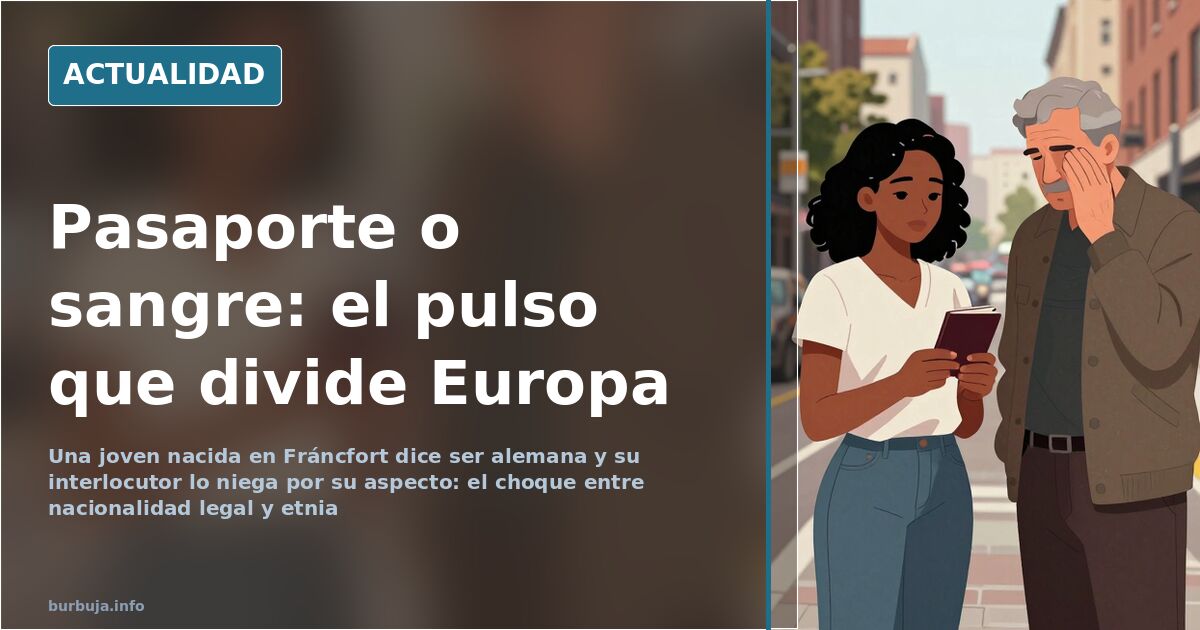
In a language school, a young woman learning Spanish who was born in Frankfurt answers without hesitation that she is German. Her interlocutor, with whom she converses in English, retorts that this cannot be true given her physical appearance. She insists: she was born in Germany, holds her nationality, and feels German. The response she receives is that the country was built by and for a specific ethnic group and that without German ancestors, no belonging is possible. The conversation ends with mutual insults and without the interlocutor seeing her again. The episode, minute yet significant, depicts a rift that continues to widen: what makes someone a member of a nation, the paper or the blood?
Is being born in Germany enough to be German?
Here, two incompatible logics collide. One maintains that nationality is a legal bond: you are born in a territory, grow up with its language and customs, and the document certifies belonging. Those who defend it recall that the law does not ask about grandparents' surnames. The other responds that the nation predates the State and that no paper creates it: belonging comes from lineage, from the chain of ancestors who inhabited that land before the administration that issues passports existed. The criterion defended is that of the right of blood.
The spark was a minor detail. A question, seemingly innocent, about how she viewed German society being —in his words— Latin American. That adjective ignited the conflict. She answered that she was German and had been born in Frankfurt.
What weighs more, ethnicity or the passport?
Some argue that a German is one who descends from Germans and that without blood ties, there are no ties to their history, Germanic traditions, or cultural heritage. The idea is based on an ethnic conception of the nation, with the community of origin as the foundation of everything else. On the opposite side, it is argued that this criterion would exclude millions of people and that identity is also built in the place where one grows up.
A case mentioned in the exchange: a young man of Ecuadorian mother born in Spain, now near age 20, declares himself Spanish before his own mother, who corrects him and reminds him that he is Ecuadorian. Who is right, the mother or the son? The question remains unresolved, and perhaps that is the problem.
The argument of the passport also arises in its simplest form: if she has German nationality, she is German, period. To which it is replied that nationality can be requested and lost, that it is an administrative procedure, not an identity.
The American case: creoles, miscegenation, and 'natives'
The discussion crosses the Atlantic. One participant argues that in America, the mixing between European and indigenous populations was constant since colonization and that many of the descendants of Spaniards born there, the creoles, were not 'pure' in any accepted sense; another responds that widespread American miscegenation is a myth. In Bolivia, it is said, the idea that a white person born in America ceases to be European coexists peacefully with the idea that a white Bolivian remains Bolivian. The same logic, applied in the opposite direction as convenient.
The word is used as a weapon. It is stated in the thread that indigenous peoples of the United States continue to call themselves natives —from 'to be born'—, while others born in the same land are denied that status. Etymology, as almost always, gives reason to both sides.
Why the conversation ended in shouts
Simply trinc the exchange reveals that the argument runs out of steam quickly. Discussing nations turns into discussing physical traits, and from there to personal insults. It is the usual drift: when the criterion becomes appearance, there is nothing left to prove, only suspects to point fingers at.
On both sides of the mirror, the same movement repeats. Some argue that nationality is a contract; others, that it is a destiny written in the genes. And neither admits nuances, because nuance ruins the trench. The concept closest to an identity above nations was, it is pointed out, the Soviet Union, and even that did not take hold: it was imposed by blood and fire and ended with the return of nationalisms as if they had never gone away.
A debate that remains unresolved
Those who believe this can be resolved in two sentences are mistaken. The discussion did not stay in the classroom: the thread devolved into insults, mutual accusations, and charges of racism and ignorance. If the criterion were as obvious as both sides claim, there would be nothing to debate. And yet, here we remain, turning over the same thing.
In a language school, a young woman learning Spanish who was born in Frankfurt answers without hesitation that she is German. Her interlocutor, with whom she converses in English, retorts that this cannot be true given her physical appearance. She insists: she was born in Germany, holds her nationality, and feels German. The response she receives is that the country was built by and for a specific ethnic group and that without German ancestors, no belonging is possible. The conversation ends with mutual insults and without the interlocutor seeing her again. The episode, minute yet significant, depicts a rift that continues to widen: what makes someone a member of a nation, the paper or the blood?
Is being born in Germany enough to be German?
Here, two incompatible logics collide. One maintains that nationality is a legal bond: you are born in a territory, grow up with its language and customs, and the document certifies belonging. Those who defend it recall that the law does not ask about grandparents' surnames. The other responds that the nation predates the State and that no paper creates it: belonging comes from lineage, from the chain of ancestors who inhabited that land before the administration that issues passports existed. The criterion defended is that of the right of blood.
The spark was a minor detail. A question, seemingly innocent, about how she viewed German society being —in his words— Latin American. That adjective ignited the conflict. She answered that she was German and had been born in Frankfurt.
What weighs more, ethnicity or the passport?
Some argue that a German is one who descends from Germans and that without blood ties, there are no ties to their history, Germanic traditions, or cultural heritage. The idea is based on an ethnic conception of the nation, with the community of origin as the foundation of everything else. On the opposite side, it is argued that this criterion would exclude millions of people and that identity is also built in the place where one grows up.
A case mentioned in the exchange: a young man of Ecuadorian mother born in Spain, now near age 20, declares himself Spanish before his own mother, who corrects him and reminds him that he is Ecuadorian. Who is right, the mother or the son? The question remains unresolved, and perhaps that is the problem.
The argument of the passport also arises in its simplest form: if she has German nationality, she is German, period. To which it is replied that nationality can be requested and lost, that it is an administrative procedure, not an identity.
The American case: creoles, miscegenation, and 'natives'
The discussion crosses the Atlantic. One participant argues that in America, the mixing between European and indigenous populations was constant since colonization and that many of the descendants of Spaniards born there, the creoles, were not 'pure' in any accepted sense; another responds that widespread American miscegenation is a myth. In Bolivia, it is said, the idea that a white person born in America ceases to be European coexists peacefully with the idea that a white Bolivian remains Bolivian. The same logic, applied in the opposite direction as convenient.
The word is used as a weapon. It is stated in the thread that indigenous peoples of the United States continue to call themselves natives —from 'to be born'—, while others born in the same land are denied that status. Etymology, as almost always, gives reason to both sides.
Why the conversation ended in shouts
Simply trinc the exchange reveals that the argument runs out of steam quickly. Discussing nations turns into discussing physical traits, and from there to personal insults. It is the usual drift: when the criterion becomes appearance, there is nothing left to prove, only suspects to point fingers at.
On both sides of the mirror, the same movement repeats. Some argue that nationality is a contract; others, that it is a destiny written in the genes. And neither admits nuances, because nuance ruins the trench. The concept closest to an identity above nations was, it is pointed out, the Soviet Union, and even that did not take hold: it was imposed by blood and fire and ended with the return of nationalisms as if they had never gone away.
A debate that remains unresolved
Those who believe this can be resolved in two sentences are mistaken. The discussion did not stay in the classroom: the thread devolved into insults, mutual accusations, and charges of racism and ignorance. If the criterion were as obvious as both sides claim, there would be nothing to debate. And yet, here we remain, turning over the same thing.
Summary of a discussion on Burbuja.info - Foro de economía, actualidad y política., translated from Spanish and reviewed before publication. Read the full discussion (214 replies).
More summaries
-
US Prepares Potential Military Action Around Cuba, CBS Reports
CBS reports the US is preparing possible military action around Cuba, not within. Spain's "law of grandchildren" and oil factor influence calculations.
-
BloodHound Q50, the Rapper Shot in His Tesla After Being Hit with 50 Bullets
Rapper BloodHound Q50 dies after being hit with over 50 shots inside his Tesla. Six attackers and a video emerge, dismantling initial reports.
-
Man arrested for assault after infidelity dispute in Madrid
A man was arrested in Vallecas, Madrid, following an assault linked to an infidelity dispute that involved allegations of kidnapping.
-
Spanish TV 'Lagarteronas' Debate Exposes Alleged Nepotism
Online discussions question Spanish TV careers, alleging fame and longevity result from connections rather than merit.
-
Gwyneth Paltrow and Leonardo DiCaprio: The Chronicle of an Extreme Overdose
Gwyneth Paltrow's account of an overdose after consuming "high meat" with Leonardo DiCaprio. The elite decadence context sparks controversy.
-
Dog attacks and neighbor conflict: Spain's housing crisis
A dog attacks a cat in a Spanish urbanization, highlighting regulatory failure and neighborhood tensions.