
McDonald's warns: low-income customers are leaving
McDonald's CEO warns that low-income customers are leaving as the Big Mac menu nears $20.
English · Original discussion in Spanish · Published
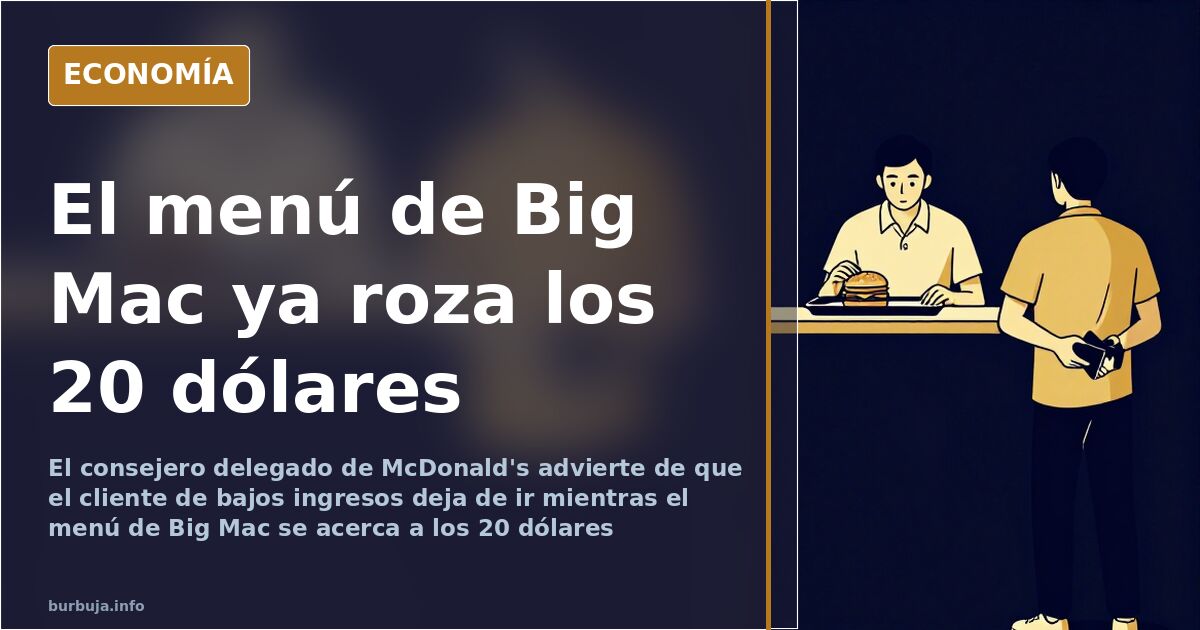
The Big Mac menu nears $20 and the chain loses customers
That the chain which built its empire selling cheap food warns its poorest clientele has stopped coming is significant. The CEO of McDonald's has alerted to a substantial drop in customer traffic in response to skyrocketing menu prices, with the Big Mac menu approaching $20. The warning, shared online, leaves an uncomfortable question: if the king of burgers loses those who earn the least, what do we call recession?
Why McDonald's menu is no longer cheap
Price is the argument repeated endlessly and best explains the traffic collapse. In the US, a Big Mac menu is around $20, according to the warning opening the issue. In Spain, according to one participant, two adults and a child dine for 40 euros where not long ago they spent 25. Another calculates an individual menu is around 12 euros. And from Sweden comes the same story: a large quarter pounder with six nuggets costs 172 krona, about 16 euros.
The problem is not just the amount, but the comparison. A daily menu in a Spanish bar with two courses, bread, drink, and dessert is around 10 euros, and some have found complete menus for 8.80 euros. At 12 or 15 for an industrial burger, the calculation breaks: to eat at that price, it is better to sit at a table with a tablecloth and waiter. The repeated conclusion is that the establishment is no longer the cheap option it was.
The effect extends even to the presumed high range. One participant reports that four people dining on burger and onion ring menus in an American-style chain spent over 80 euros, at the price of sirloin for a piece of minced meat. The anecdote summarizes the confusion: the youth-subsidized burger has mutated into an expense that competes, without advantage, with the neighborhood restaurant.
The screen order that scares off part of the clientele
There is another barrier some customers point out. Several participants say you can no longer order at the counter in the classic way or customize the burger with the same ease, although others maintain that counter ordering is still possible and ingredients can be changed on the screens. I left there, summarizes who tried to order a burger and met a self-ordering screen they did not know where to start, with the employee two meters away.
The matter divides. One part holds that the machine is more comfortable, avoids interaction, and allows payment in advance. Opposite, the lifelong customer sees a wall where there was once a cash register and a person. For those who do not master technology, or simply do not want to deal with it after a day's work, the establishment ceases to be an option and becomes a chore.
Quality: from animal fat to frozen
If prices rise, the bar for expectations rises with them, and there the story sours. Some remember that fries were fried in animal fat and now in vegetable oil after passing through frozen. They speak of defrosted burgers, portions that get cold, and unresolved orders dispatched with bad attitudes. It was bad but cheap; now it is worse and more expensive, is the synthesis circulating with the most force.
McDonald's does not sell burgers: it collects rent
Here comes the nuance that, according to one participant, reorders everything. McDonald's owns only around 5% of its establishments; the rest are franchisees paying fees, marketing, and rent for the land on which the establishment stands. According to this reading, the real business is not the burger, but the rent: if the low-income customer drops out of the equation, the headquarters may not care as long as the franchisee continues paying their quota.
Is the United States in recession?
The headline speaks of recession and there the consensus splits. Some remember that China grows above 5% while the United States advances 0.4% quarterly and 1.6% annually, supported by liquidity injections in the markets. Others do not see a declared recession, but the symptom of a clientele with tight pockets: the drop in traffic at the world's largest fast-food chain as an indicator that official indices do not capture.
The idea also spreads that there are cheaper and no worse alternatives: the kebab, the neighborhood bar with a closed menu, the supermarket, and the home grill. Same simple food for less money and, in the judgment of several, with fewer surprises.
Perhaps the chain is not losing business, but the low-income customer. The doubt remains in the air: if those who cannot pay $20 for a menu leave and do not return, who supports the next decade of fast food?
Also available in: Deutsch
Summary of a discussion on Burbuja.info - Foro de economía, actualidad y política., translated from Spanish and reviewed before publication. Read the full discussion (236 replies).
More summaries
-
Chinese AI Challenges Western Tech Dominance
Chinese AI challenges Western tech giants with powerful open-source models.
-
Trump Announces Total Strait of Hormuz Blockade Amid Rising Geopolitical Tensions
Trump declares a total blockade on ships in the Strait of Hormuz. Analysis of the geopolitical escalation and its implications for oil prices.
-
McDonald's and Burger King claim they pay better, yet staff shortages persist
87% of major restaurant groups faced hiring difficulties last year, while 81% struggle with absenteeism. McDonald's entry-level salary is 18,271 euros annually.
-
Spain's Government pays Christmas bonus before elections
Spain disburses the Christmas bonus for civil servants and pensioners just hours before voting, according to forum calculations.
-
Cuéntame cómo pasó and TVE's ideological turn since 2001
Cuéntame cómo pasó premiered in 2001 and is now cited as TVE's biggest case of indoctrination: 14 years on air, caught between everyday nostalgia and ideological sermonising.
-
Valencia prosecutors want Mazón charged over deadly floods
The Valencia prosecutor's office backs investigating Carlos Mazón's criminal responsibility for the floods that killed 223 people, but the case against him will have to wait.