
Cuéntame cómo pasó and TVE's ideological turn since 2001
Cuéntame cómo pasó premiered in 2001 and is now cited as TVE's biggest case of indoctrination: 14 years on air, caught between everyday nostalgia and ideological sermonising.
English · Original discussion in Spanish · Published
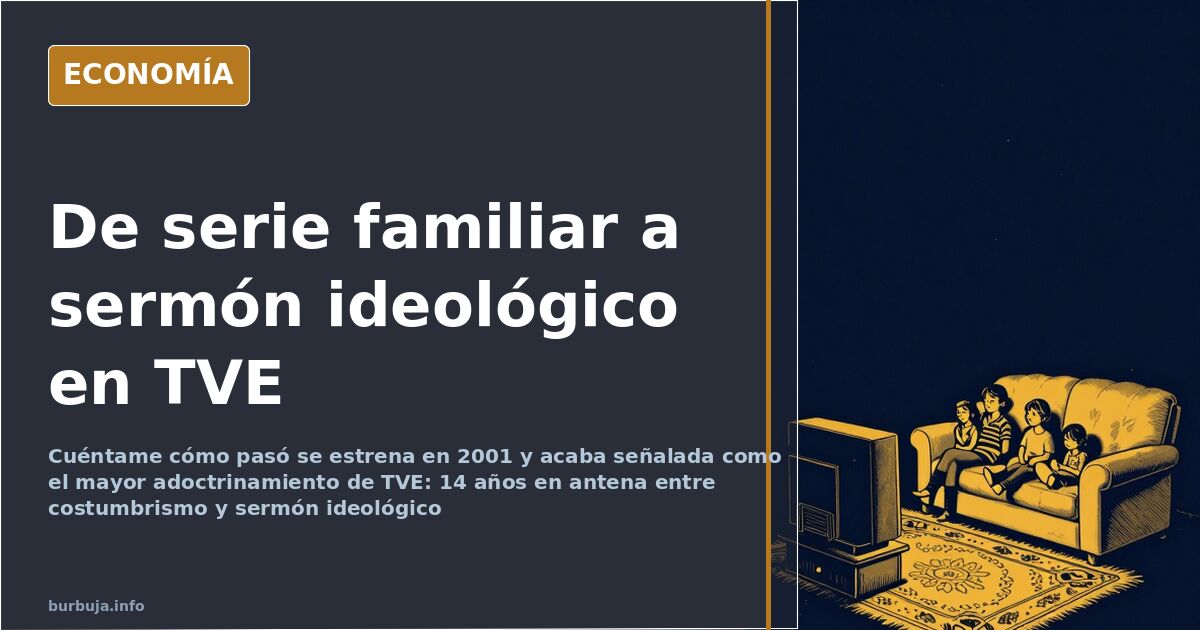
Cuéntame cómo pasó: from family portrait to televised sermon
A series first aired in 2001 on TVE (Spain's public broadcaster) under the Aznar government, conceived as a warm portrait of a Spanish family, is now cited as the biggest vehicle of ideological indoctrination ever broadcast on Spanish television. The paradox is telling: the format many remember fondly started out, according to those who defended it at the time, with the handbrake firmly on. It hinted without showing. It taught without scandal. It smiled without cheek.
That balance broke down. It is almost the only point on which readings that disagree on everything else converge, placing the turning point somewhere between the early seasons and the middle stretch of the production.
The ideological turn located in the middle seasons
The tally that keeps being repeated credits Cuéntame cómo pasó with 14 uninterrupted years on air and a reach said to have spanned five continents. In that stretch, the most widespread reading holds, the fiction lost its restraint: characters moved from domestic anecdote to extreme tragedy, and from subtext to outright preaching.
The description that recurs most is that of a format forced to choose each week between life-shattering catastrophe and pamphlet-style discourse. Either the protagonists went bankrupt, split up or brushed with death, or someone delivered the sermon of the week. The usual suspect is the script, not the cast.
The harshest thesis: a series with no plot, only sermons
There is an even harsher version, and it is the one that opens the confrontation. The fiction never had a plot, only excuses to slot in messages. It was all ideology dressed up as everyday nostalgia, with left-wing characters always on the right side of history and the women in the story serving as a loudspeaker for a contemporary discourse forced into post-war Spain.
It is not a unanimous verdict. The strongest rebuttal recalls that any historical fiction takes sides in what it tells and what it omits, and that the friendly portrait of 2001 was already, in itself, a form of ideology. The question, then, is not whether there was a message, but when it stopped being disguised.
Indoctrination from the first episode, or only at the end?
Here lies the real fault line. One camp argues the indoctrination was always there, just in low doses and easier to swallow. Another holds that nostalgia plays tricks and that the decline came later and gradually, the result of needing to stretch a franchise that had nothing left to give.
The trap in the nostalgic argument is obvious: someone who watched the first season at twenty judges it differently from someone revisiting it today with plenty of hindsight about how it all ended.
Mercedes and the wearing out of the story
The case most often cited is that of Mercedes, described as the shift from a loving, affectionate woman to a figure of permanent anger. It is the symptom, not the disease: characters that began as people and ended as mouthpieces.
On top of that, as usually happens when the analysis runs dry, came a predictable detour: the conversation drifted towards which actresses in the cast were the most attractive. It adds nothing to the matter, but it neatly captures the fatigue of an audience that stopped debating plots because, by its own account, there were no longer any plots to debate.
With these pieces on the table, the question remains open: how much was honest portraiture, and how much propaganda with formica furniture?
Also available in: Deutsch
Summary of a discussion on Burbuja.info - Foro de economía, actualidad y política., translated from Spanish and reviewed before publication. Read the full discussion (14 replies).
More summaries
-
Aznar calls out Abascal: "Vox and PSOE hold permanent talks to hurt the PP"
José María Aznar claims that Vox and Spain's Socialist Party (PSOE) hold permanent talks to damage the PP. Analysis of the controversy and the reactions.
-
María Galiana: 22 years as grandmother and a career she says is lost
María Galiana, 91, states that she wasted her career in 'Cuéntame'. The sector debates whether 22 years of stable pay constitute a triumph or a condemnation.
-
Aznar and 11-M: Morocco, France and official silence
Jiménez Losantos claims Aznar privately admits 11-M was Morocco, overseen by France and 'perhaps the US', without evidence
-
Inda links Inquilinas spokesman in Sol to €80 million
Eduardo Inda attributes €80 million in real estate companies to the spokesman of the Tenants Union in Sol, amid allegations of pressure on Urbagestión.
-
Spain's Civil War, Franco and the economy: what the right's story leaves out
The claim that today's left proves the 1936 side were the bad guys rests on an economic narrative that falls apart under scrutiny: 20 years of autarky and stagnation.
-
Informal forum poll puts Vox in first place
A non-scientific vote that includes abstention as an option places Vox as the leading force, with the PSOE ahead of the PP at some points in the count.