
Mariupol: Ukraine claims 22,000 civilian deaths amid disputed accountability
Ukraine estimates at least 22,000 civilians died in Mariupol out of a pre-war population of 430,000. Both the death toll and responsibility remain contested.
English · Original discussion in Spanish · Published
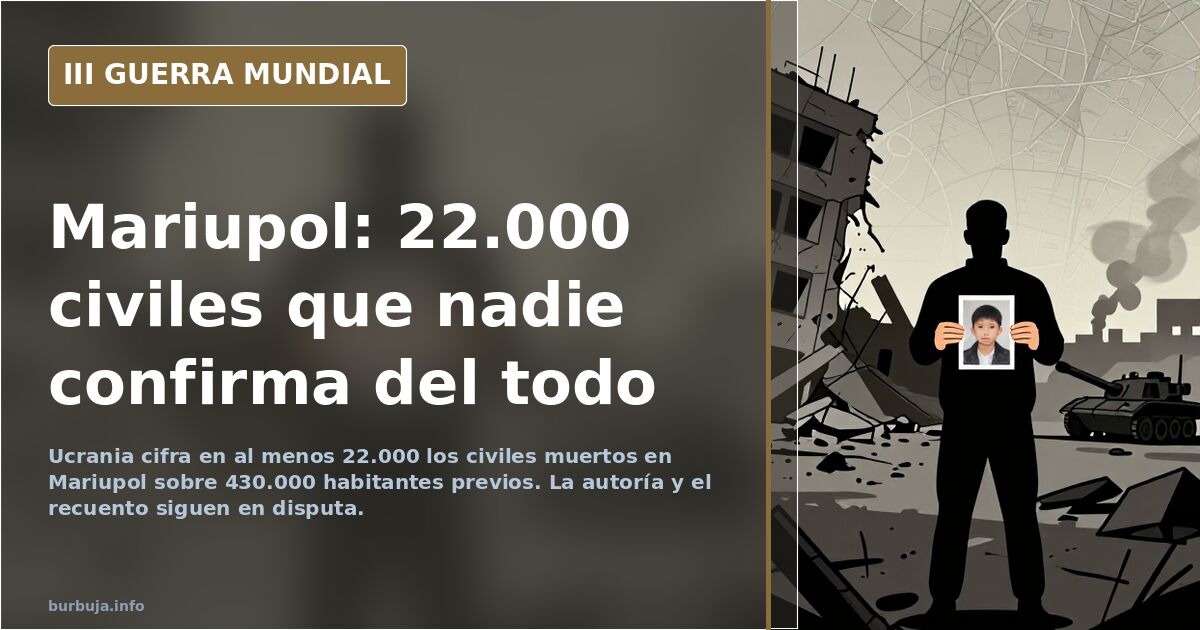
Mariupol: 22,000 civilian deaths and disputed accountability
The Ukrainian government maintains that at least 22,000 civilians died in Mariupol, acknowledging the figure "could be much higher." The city had 430,000 inhabitants before the invasion, implying a mortality rate exceeding 5%. To gauge the scale: Aleppo recorded approximately 20,000 civilian deaths over more than four years in a city of two million. This contrast lies at the heart of a debate lacking an officially closed figure.
How many civilians have died in Mariupol and across Ukraine?
Circulating counts vary widely. In addition to the 22,000 in Mariupol, 8,000 civilians are reported dead elsewhere in Ukraine as of October 27, 2022. Within the besieged city, specific incidents are highlighted: the theater, where 600 civilians reportedly died in a single attack.
The comparison with Aleppo is not incidental. It is used to argue that the intensity of bombardment on Mariupol has no recent parallel, while also questioning how deaths are counted in siege zones, where figures accumulate without independent verification. A crucial nuance remains: the 22,000 figure comes from the Ukrainian government and lacks confirmation by any international body.
The dispute over responsibility: deliberate attack or urban resistance?
One analytical stream argues that artillery was deliberately used against densely populated areas, constituting a war crime. Opposing this is the argument for urban resistance: if defenses were positioned within the city and among the population, any siege becomes a trap for both attackers and residents. Some summarize the situation by stating that urban resistance is, by definition, "dirty."
Others go further, accusing the besieged side of failing to facilitate civilian evacuation. Responses counter that blaming bomb recipients for their own casualties reverses culpability. Central to the debate is also the justification for intervention: under the pretext of "denazification," critics question why the Russian-speaking population claimed to be protected ended up most severely affected by the siege.
Evacuations and the fate of humanitarian corridors
A highly contested point concerns where civilians could evacuate. Claims state that evacuation toward the self-proclaimed Donbas republics was proposed rather than into Ukrainian-controlled territory, and that many residents rejected this destination. The objection raised is that no one wants to move to a zone where, according to these accounts, those who stay are forced to fight or face supply shortages.
The other side of the argument is that the siege prevented any orderly exit regardless of destination. Without independent verification, it remains a clash of narratives: each side presents humanitarian corridors as proof of the opponent's good or bad faith.
The theater, evidence, and 7,000 unrepatriated soldiers
The Mariupol theater concentrates the controversy over evidence. It is alleged that the site was cordoned off and then demolished, interpreted as an attempt to erase traces of what occurred; other voices attribute the demolition to building reconstruction. During that same attack, a municipal official responsible for children's affairs reportedly died along with her family, according to municipal accounts.
Parallelly, another rarely headlined datum circulates: bodies of more than 7,000 Russian soldiers allegedly remained in refrigerated trucks and train cars awaiting repatriation, without Russia claiming their transfer. This uncomfortable figure challenges both narratives, forcing questions about how many casualties each side acknowledges.
The invoked historical precedent
The discussion often invokes the shadow of Stalin and the famines that devastated Ukraine in the 1930s, with estimates of over six million Ukrainian and two million Kazakh deaths. This parallelism is used to place the current siege within a continuity and to debate who historically bore blame for scarcity and isolation.
Older references emerge too, such as the Mongol siege of Ryazan in 1237, to underscore that violence against civilian populations is not new in the region. One must separate planes: history provides context, not proof. No historical comparison substitutes for verifying what peine on each street in Mariupol.
With these pieces on the table, the question is not just how many died, but who will one day answer for each number. The figure of 22,000 remains without independent confirmation. Who bears the burden of proving what peine inside a besieged city?
The Ukrainian government maintains that at least 22,000 civilians died in Mariupol, acknowledging the figure "could be much higher." The city had 430,000 inhabitants before the invasion, implying a mortality rate exceeding 5%. To gauge the scale: Aleppo recorded approximately 20,000 civilian deaths over more than four years in a city of two million. This contrast lies at the heart of a debate lacking an officially closed figure.
How many civilians have died in Mariupol and across Ukraine?
Circulating counts vary widely. In addition to the 22,000 in Mariupol, 8,000 civilians are reported dead elsewhere in Ukraine as of October 27, 2022. Within the besieged city, specific incidents are highlighted: the theater, where 600 civilians reportedly died in a single attack.
The comparison with Aleppo is not incidental. It is used to argue that the intensity of bombardment on Mariupol has no recent parallel, while also questioning how deaths are counted in siege zones, where figures accumulate without independent verification. A crucial nuance remains: the 22,000 figure comes from the Ukrainian government and lacks confirmation by any international body.
The dispute over responsibility: deliberate attack or urban resistance?
One analytical stream argues that artillery was deliberately used against densely populated areas, constituting a war crime. Opposing this is the argument for urban resistance: if defenses were positioned within the city and among the population, any siege becomes a trap for both attackers and residents. Some summarize the situation by stating that urban resistance is, by definition, "dirty."
Others go further, accusing the besieged side of failing to facilitate civilian evacuation. Responses counter that blaming bomb recipients for their own casualties reverses culpability. Central to the debate is also the justification for intervention: under the pretext of "denazification," critics question why the Russian-speaking population claimed to be protected ended up most severely affected by the siege.
Evacuations and the fate of humanitarian corridors
A highly contested point concerns where civilians could evacuate. Claims state that evacuation toward the self-proclaimed Donbas republics was proposed rather than into Ukrainian-controlled territory, and that many residents rejected this destination. The objection raised is that no one wants to move to a zone where, according to these accounts, those who stay are forced to fight or face supply shortages.
The other side of the argument is that the siege prevented any orderly exit regardless of destination. Without independent verification, it remains a clash of narratives: each side presents humanitarian corridors as proof of the opponent's good or bad faith.
The theater, evidence, and 7,000 unrepatriated soldiers
The Mariupol theater concentrates the controversy over evidence. It is alleged that the site was cordoned off and then demolished, interpreted as an attempt to erase traces of what occurred; other voices attribute the demolition to building reconstruction. During that same attack, a municipal official responsible for children's affairs reportedly died along with her family, according to municipal accounts.
Parallelly, another rarely headlined datum circulates: bodies of more than 7,000 Russian soldiers allegedly remained in refrigerated trucks and train cars awaiting repatriation, without Russia claiming their transfer. This uncomfortable figure challenges both narratives, forcing questions about how many casualties each side acknowledges.
The invoked historical precedent
The discussion often invokes the shadow of Stalin and the famines that devastated Ukraine in the 1930s, with estimates of over six million Ukrainian and two million Kazakh deaths. This parallelism is used to place the current siege within a continuity and to debate who historically bore blame for scarcity and isolation.
Older references emerge too, such as the Mongol siege of Ryazan in 1237, to underscore that violence against civilian populations is not new in the region. One must separate planes: history provides context, not proof. No historical comparison substitutes for verifying what peine on each street in Mariupol.
With these pieces on the table, the question is not just how many died, but who will one day answer for each number. The figure of 22,000 remains without independent confirmation. Who bears the burden of proving what peine inside a besieged city?
Summary of a discussion on Burbuja.info - Foro de economía, actualidad y política., translated from Spanish and reviewed before publication. Read the full discussion (206 replies).
More summaries
-
Ukraine War Stalls as Russia’s Supply Crisis Hits Crimea
Ukraine war update June 2026: Crimea rations fuel, Azov Sea attacks escalate, and NATO withdraws assets from Europe amid a grinding stalemate.
-
German Ex-General: "Ukraine is a US-Russia Power Struggle"
A German ex-general views the Ukraine war as a power play between the US and Russia, with little movement on the front lines for over a year.
-
Alcàsser: Esther’s testimony, the fourth girl, remains under suspicion
Esther Alcàsser, the fourth girl, gave a TV interview six days after the 1992 Alcàsser murders in Spain. Her account and timeline discrepancies fuel ongoing controversy.
-
Spain: Missile Talent Exists, Full Manufacturing Capacity Remains Uncertain
Spain designs its own submarines and frigates but imports missile electronics. How far does military self-sufficiency go?
-
Oct 7 sexual violence report reignites debate
A 300-page report on Oct 7 sexual violence documents systematic abuses but fuels media skepticism and debates over Gaza's 65,000 casualties.
-
Putin nears victory as Europe fails to rearm
21 months into the invasion, military reports warn Germany needs 15 years to defend itself and NATO three for its eastern flank.