
Telepizza in Spain: A Forum User's Disappointing Return After 25 Years
A forum user revisits the Spanish chain Telepizza after 25 years, describing bland dough and nearly 48 hours of digestive issues.
English · Original discussion in Spanish · Published
"The Pizza That Doesn't Taste Like Pizza": Chronicle of a Return After 25 Years
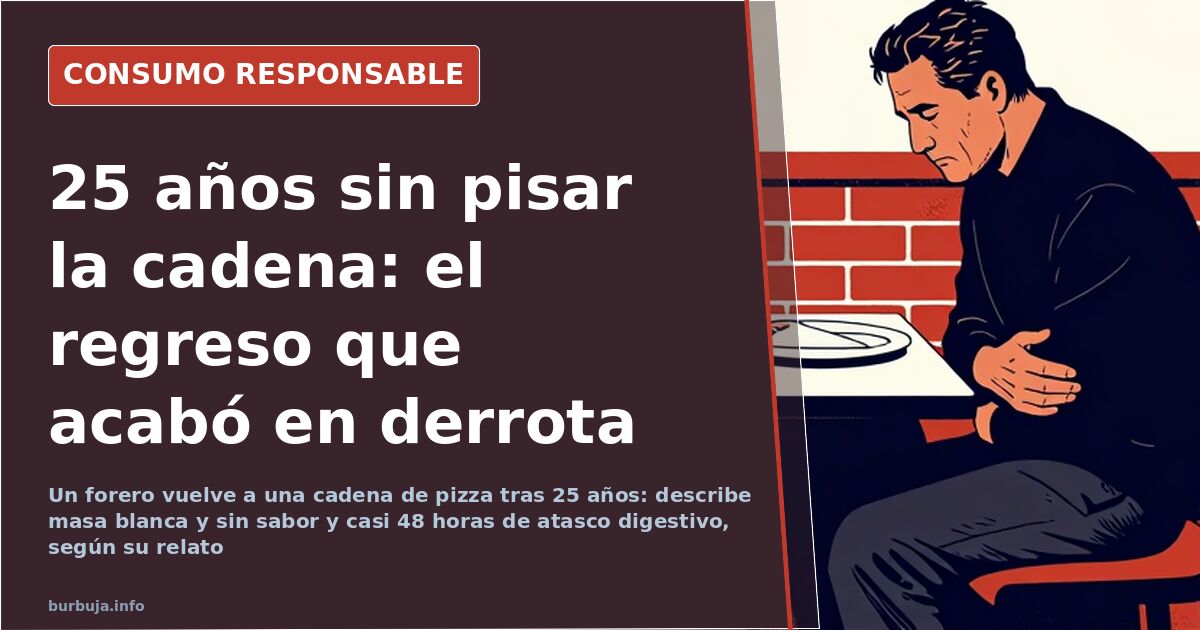
How much has a pizza chain changed in a quarter-century? The answer came from someone who returned after 25 years without visiting a store, documenting the return as what it was, according to their account, a journey toward disillusionment. The diagnosis, summarized by the protagonist themselves, is that the dough was white and flavorless, and that the whole thing recalled more like expired milk with binding powders than a pizza. The experience, told in real time, started with a glass of vodka to make a screwdriver and ended, according to the same account, with almost 48 hours of digestive blockage.
The story is not an isolated anecdote. It is the chronicle of an entire category—franchise pizza—that carries an identity problem: it tastes like itself, not like food. And there are those who argue that this homogeneous taste is no accident.
What Peine to the Chain's Quality in 25 Years
The starting point is a return to the store after a quarter-century. What was found was not a degraded version of a memory, but something different: pale, flavorless dough, and a product that the diner describes as "crap" compared to superior industrial alternatives, such as supermarket private-label pizzas. The personal conclusion: do not return for another 25 years.
There is a current of analysis attributing the deterioration to ingredient cuts applied years ago. The thesis is that the recipe became cheaper and that the current result is worse than the memory, which discourages trying it again: those who return expecting the pizza from two decades ago find something else. Others point to an expectation problem: the palate has changed, the offer has multiplied, and the franchise remained anchored to a standard that no longer competes.
The debate about taste has a technical derivative. There is speculation about the intensive use of enhancers like glutamate, applied up to the saturation limit of the palate, and powdered condiments—oregano, garlic, something that serves as parmesan—that fabricate a recognizable but artificial profile. The consequence is paradoxical: all chains would taste the same, and that common taste is also detected in burgers from major franchises.
Why Franchise Pizza Tastes Like Franchise and Not Like Pizza
The most repeated description is that it doesn't taste like pizza, it tastes like a chain. This distinction seems trivial but isn't: it defines a specific, industrial taste that impregnates hands and face with a smell that is not that of dough, tomato, and cheese. Those who cook at home or go to real pizzerias detect it immediately.
The phenomenon is not exclusive to one brand. The shared suspicion is that franchises share suppliers, processes, and additives, making the experience interchangeable. This explains why the discussion shifts toward the global quality of fast food and the question of whether the problem is corporate or systemic.
Price and Audience: Full Tables and Flat-Rate Offers
The criticism is not just about taste. Some also highlight the effect of aggressive promotions: on Fridays, the flat-rate pizza offer fills tables with families whose small children, who don't pay because they haven't reached the minimum height, make repeated trips to the soda dispenser. The model works commercially and reinforces the perception of a cheap product.
Price also appears on the other side of the coin. Some refuse to order delivery because the barbecue and carbonara combo is priced abusively, comparing the experience with homemade or restaurant alternatives. The value-for-money equation is, at this point, the most repeated argument against the chain.
Nostalgia as a Trap: Memory Always Wins
The thread leaves an uncomfortable conclusion for the nostalgic. 15 or 25 years ago, the chain dominated the market and its direct competitors were, according to several testimonials, clearly worse. That memory is real. The problem is that the present does not support it, and verifying it again has a cost: disappointment.
The final scene is almost a literary genre. The diner closes the chronicle with the forecast of what will come in the morning. And what came was a blockage of almost two days, according to their account. The pizza didn't catch anyone. The body, however, left proof.
How much has a pizza chain changed in a quarter-century? The answer came from someone who returned after 25 years without visiting a store, documenting the return as what it was, according to their account, a journey toward disillusionment. The diagnosis, summarized by the protagonist themselves, is that the dough was white and flavorless, and that the whole thing recalled more like expired milk with binding powders than a pizza. The experience, told in real time, started with a glass of vodka to make a screwdriver and ended, according to the same account, with almost 48 hours of digestive blockage.
The story is not an isolated anecdote. It is the chronicle of an entire category—franchise pizza—that carries an identity problem: it tastes like itself, not like food. And there are those who argue that this homogeneous taste is no accident.
What Peine to the Chain's Quality in 25 Years
The starting point is a return to the store after a quarter-century. What was found was not a degraded version of a memory, but something different: pale, flavorless dough, and a product that the diner describes as "crap" compared to superior industrial alternatives, such as supermarket private-label pizzas. The personal conclusion: do not return for another 25 years.
There is a current of analysis attributing the deterioration to ingredient cuts applied years ago. The thesis is that the recipe became cheaper and that the current result is worse than the memory, which discourages trying it again: those who return expecting the pizza from two decades ago find something else. Others point to an expectation problem: the palate has changed, the offer has multiplied, and the franchise remained anchored to a standard that no longer competes.
The debate about taste has a technical derivative. There is speculation about the intensive use of enhancers like glutamate, applied up to the saturation limit of the palate, and powdered condiments—oregano, garlic, something that serves as parmesan—that fabricate a recognizable but artificial profile. The consequence is paradoxical: all chains would taste the same, and that common taste is also detected in burgers from major franchises.
Why Franchise Pizza Tastes Like Franchise and Not Like Pizza
The most repeated description is that it doesn't taste like pizza, it tastes like a chain. This distinction seems trivial but isn't: it defines a specific, industrial taste that impregnates hands and face with a smell that is not that of dough, tomato, and cheese. Those who cook at home or go to real pizzerias detect it immediately.
The phenomenon is not exclusive to one brand. The shared suspicion is that franchises share suppliers, processes, and additives, making the experience interchangeable. This explains why the discussion shifts toward the global quality of fast food and the question of whether the problem is corporate or systemic.
Price and Audience: Full Tables and Flat-Rate Offers
The criticism is not just about taste. Some also highlight the effect of aggressive promotions: on Fridays, the flat-rate pizza offer fills tables with families whose small children, who don't pay because they haven't reached the minimum height, make repeated trips to the soda dispenser. The model works commercially and reinforces the perception of a cheap product.
Price also appears on the other side of the coin. Some refuse to order delivery because the barbecue and carbonara combo is priced abusively, comparing the experience with homemade or restaurant alternatives. The value-for-money equation is, at this point, the most repeated argument against the chain.
Nostalgia as a Trap: Memory Always Wins
The thread leaves an uncomfortable conclusion for the nostalgic. 15 or 25 years ago, the chain dominated the market and its direct competitors were, according to several testimonials, clearly worse. That memory is real. The problem is that the present does not support it, and verifying it again has a cost: disappointment.
The final scene is almost a literary genre. The diner closes the chronicle with the forecast of what will come in the morning. And what came was a blockage of almost two days, according to their account. The pizza didn't catch anyone. The body, however, left proof.
Also available in: Deutsch
Summary of a discussion on Burbuja.info - Foro de economía, actualidad y política., translated from Spanish and reviewed before publication. Read the full discussion (106 replies).
More summaries
-
Madrid loses its flavor: complaints about food quality spread
Potes chorizo is impossible to find in Madrid. Consumers denounce a decline in food quality and the disappearance of traditional shops. Is…
-
El Corte Inglés prepared food: quality at a price
El Corte Inglés croquettes beat Mercadona's, but prices like €21/kg for meat rolls mean it's only worth it for some products.
-
Fake History Degree for Bragging Rights Carries Prison Time
Man seeks fake UNED History degree to impress acquaintances. Forgery of official documents carries a sentence of six months to three years.
-
Jazztel raises line fee by €2: 30-day exit window without penalty
Spanish telecom Jazztel increases line fees to €22.99 from May, offering more mobile data but allowing contract termination without penalties for 30 days.
-
Cheapest to run: old diesel or used Japanese car
A €1,500 Saxo uses 3L/100km; a Yaris lasts 180k km. The most economical car isn't new.
-
Tissot T-Race at €480: Quartz, Whim and Class Judgment
A Tissot T-Race quartz watch bought for €480 reignites the debate between quartz and automatic movements, questioning when a timepiece becomes expensive.