
Madrid Mayor Plans Car-Free Boulevard Between Cibeles and Alcalá Gate
José Luis Martínez-Almeida announces a plan to remove three car lanes in central Madrid, transforming the area into a pedestrian boulevard.
English · Original discussion in Spanish · Published
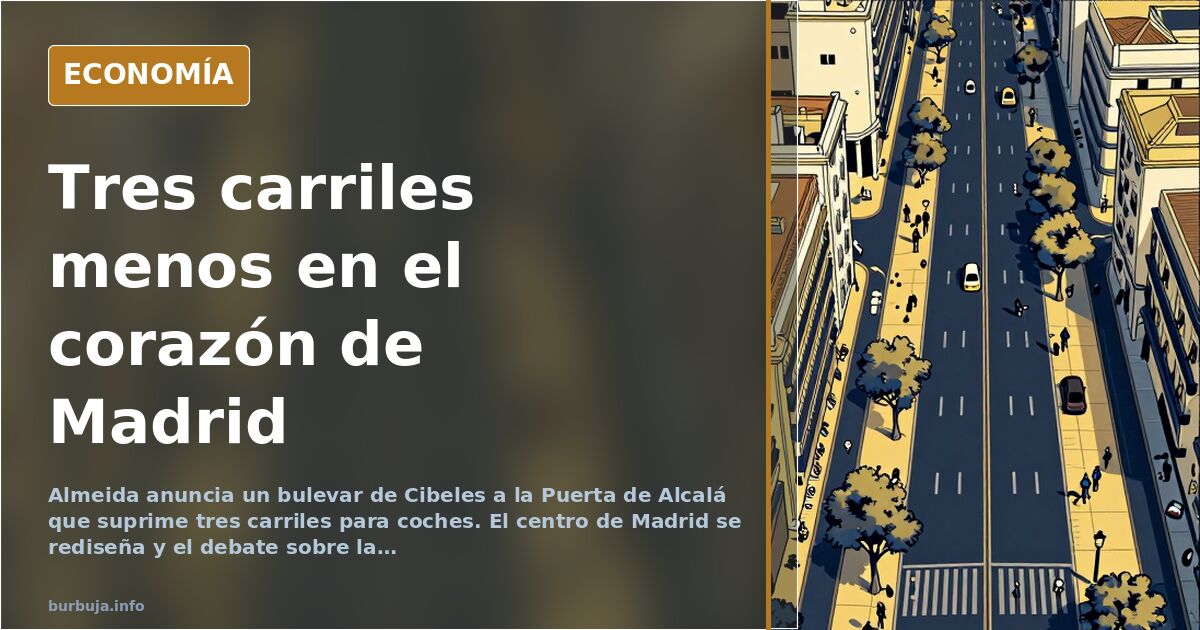
Madrid Mayor cuts three lanes between Cibeles and Puerta de Alcalá
The announcement was made by the mayor himself via social media: a boulevard from Cibeles to Puerta de Alcalá that eliminates three traffic lanes for cars. The reaction was immediate. In a city that has debated its center's future for years, this move is seen as another step in the same direction: less asphalt, more sidewalk, and a monument that stops being a roundabout and becomes a promenade. Some celebrate it without reservation, while others interpret it as a direct attack on the mobility of those coming from outside.
What losing three lanes in that stretch implies
The affected section connects two key points: Plaza de Cibeles and Puerta de Alcalá. For some, it is an important access route to the O'Donnell tunnel, and its reduction forces detours that lengthen journeys. For others, it is a space where cars never made sense: a boulevard, not a highway. The discussion is not new, but the announcement has reignited it strongly.
Puerta de Alcalá currently functions as a roundabout. The project, as described in the announcement, would allow walking access from Cibeles through the center of the street, effectively expanding the monument's space. This part generates the most consensus even among those who disagree with municipal policy: pedestrianizing this axis has urban planning logic that is hard to refute. The south sidewalk is also included in the Paseo del Prado UNESCO World Heritage Site, adding a heritage argument to the issue.
Those applauding: tourists, pedestrians, and downtown residents
Part of the neighborhood is clear about it: the center is for tourists and strolling, and anything that facilitates walking is good. It is even suggested that lanes should be removed on Paseo del Prado to widen sidewalks deemed too narrow. The logic is simple: if public transport works, one less lane shouldn't be a disaster.
This argument is reinforced by the idea that many who use this stretch by car come from the outskirts and do not pay taxes in the municipality of Madrid. One can still pass with one less lane, or find an alternative route. And for those living in established urban areas, the car is a leisure complement, not a daily necessity.
Those feeling expelled: driving from the outskirts to the center
The other side of the coin is those who see each lane reduction as another step toward expelling private vehicles. The calculation is simple: if an access route to the O'Donnell tunnel is closed, the resulting detour can turn a short alucinación into an odyssey. And not everyone has a real public transport alternative.
Some argue that pedestrianizing the center turns cities into theme parks for visitors, while long-time residents are pushed to the suburbs. The criticism is not only against the City Council but also against neighbors who applaud measures that don't affect them because they don't need to cross the center by car.
The background: who can afford to give up the car
The underlying issue is economic. Giving up the car is easier if you live in an area with a metro station every three minutes than if your house is a townhouse on the outskirts with one bus a day. Pedestrianizing the center benefits those who already live there or can afford to. For the rest, it is just another obstacle.
The discussion often drifts toward tourism: low-cost flights, weekend trips, fast consumption. Those defending the car point out the contradiction of penalizing private vehicles while promoting an emission-intensive tourism model. The debate gets tangled and loses focus, but leaves an uncomfortable question: who is being asked to make the sacrifice?
The project continues. Lanes will be removed, sidewalks expanded, and Puerta de Alcalá will stop being a roundabout to become what many believe it always should have been: a monument reached on foot. It remains to be seen whether surrounding traffic decreases or if, as some antiestéticar, pollution shifts to adjacent streets and deterioration returns to its usual places.
The announcement was made by the mayor himself via social media: a boulevard from Cibeles to Puerta de Alcalá that eliminates three traffic lanes for cars. The reaction was immediate. In a city that has debated its center's future for years, this move is seen as another step in the same direction: less asphalt, more sidewalk, and a monument that stops being a roundabout and becomes a promenade. Some celebrate it without reservation, while others interpret it as a direct attack on the mobility of those coming from outside.
What losing three lanes in that stretch implies
The affected section connects two key points: Plaza de Cibeles and Puerta de Alcalá. For some, it is an important access route to the O'Donnell tunnel, and its reduction forces detours that lengthen journeys. For others, it is a space where cars never made sense: a boulevard, not a highway. The discussion is not new, but the announcement has reignited it strongly.
Puerta de Alcalá currently functions as a roundabout. The project, as described in the announcement, would allow walking access from Cibeles through the center of the street, effectively expanding the monument's space. This part generates the most consensus even among those who disagree with municipal policy: pedestrianizing this axis has urban planning logic that is hard to refute. The south sidewalk is also included in the Paseo del Prado UNESCO World Heritage Site, adding a heritage argument to the issue.
Those applauding: tourists, pedestrians, and downtown residents
Part of the neighborhood is clear about it: the center is for tourists and strolling, and anything that facilitates walking is good. It is even suggested that lanes should be removed on Paseo del Prado to widen sidewalks deemed too narrow. The logic is simple: if public transport works, one less lane shouldn't be a disaster.
This argument is reinforced by the idea that many who use this stretch by car come from the outskirts and do not pay taxes in the municipality of Madrid. One can still pass with one less lane, or find an alternative route. And for those living in established urban areas, the car is a leisure complement, not a daily necessity.
Those feeling expelled: driving from the outskirts to the center
The other side of the coin is those who see each lane reduction as another step toward expelling private vehicles. The calculation is simple: if an access route to the O'Donnell tunnel is closed, the resulting detour can turn a short alucinación into an odyssey. And not everyone has a real public transport alternative.
Some argue that pedestrianizing the center turns cities into theme parks for visitors, while long-time residents are pushed to the suburbs. The criticism is not only against the City Council but also against neighbors who applaud measures that don't affect them because they don't need to cross the center by car.
The background: who can afford to give up the car
The underlying issue is economic. Giving up the car is easier if you live in an area with a metro station every three minutes than if your house is a townhouse on the outskirts with one bus a day. Pedestrianizing the center benefits those who already live there or can afford to. For the rest, it is just another obstacle.
The discussion often drifts toward tourism: low-cost flights, weekend trips, fast consumption. Those defending the car point out the contradiction of penalizing private vehicles while promoting an emission-intensive tourism model. The debate gets tangled and loses focus, but leaves an uncomfortable question: who is being asked to make the sacrifice?
The project continues. Lanes will be removed, sidewalks expanded, and Puerta de Alcalá will stop being a roundabout to become what many believe it always should have been: a monument reached on foot. It remains to be seen whether surrounding traffic decreases or if, as some antiestéticar, pollution shifts to adjacent streets and deterioration returns to its usual places.
Also available in: Deutsch
Summary of a discussion on Burbuja.info - Foro de economía, actualidad y política., translated from Spanish and reviewed before publication. Read the full discussion (122 replies).
More summaries
-
Madrid Mayor Almeida at Las Ventas with 26-Year-Old Partner Teresa Urquijo
Madrid Mayor José Luis Martínez-Almeida attended Las Ventas with 26-year-old Teresa Urquijo, sparking online debate over their 22-year age gap.
-
Cibeles Protest Outnumbers Official Accounts Amid Media Dispute
The amnesty protest filled Cibeles and extended to Colón and Puerta de Alcalá, clashing with official claims of only hundreds of attendees.
-
PP and Vox's 210 seats: the constitutional reform that won't happen
PP and Vox could reach 210 seats, the three-fifths needed to reform the Constitution. Polls give them 205. An analysis of the arithmetic and the skepticism.
-
Five armed officers face knife threat on Burela beach
Video shows five officers confronting a man with a knife in Burela, Spain, reigniting debate on police protocols and firearm use.
-
China's Rise vs. Europe's Stagnation Sparks Debate
Forum discussion on China's tech advancement and European decline, citing wage, innovation, and demographic data.
-
China Sells 7M EVs, But Electric Fleet Remains at 5%
China is set to sell over 7 million electric vehicles this year, yet only 5% of its total fleet is electric or plug-in hybrid. This data cools the enthusiasm.