
Cibeles Protest Outnumbers Official Accounts Amid Media Dispute
The amnesty protest filled Cibeles and extended to Colón and Puerta de Alcalá, clashing with official claims of only hundreds of attendees.
English · Original discussion in Spanish · Published
Cibeles Protest Outnumbers Official Accounts
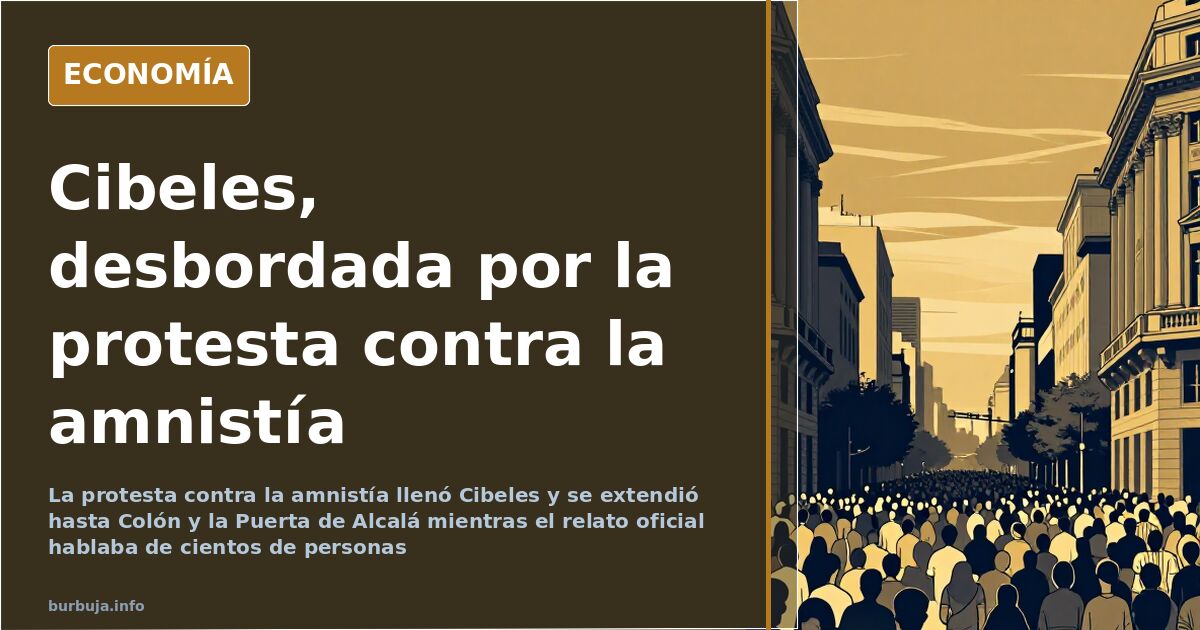
Madrid was overflowing in Cibeles. The demonstration against the amnesty and Catalan debt forgiveness overwhelmed the Cibeles-Colón axis, extending beyond the Puerta de Alcalá and spilling onto Paseo del Prado and Gran Vía. The exact magnitude remains disputed: hundreds of thousands according to the most repeated estimate; half a million by the most generous calculation; and hundreds of people according to the narrative spread by some channels. The contrast between these three figures is, in itself, the story. Only one figure withstands the weight of the images.
How many people were at the Cibeles protest?
No one disputes that the protest blocked the city. What is debated is the size. Those present describe a tide starting before Cibeles and ending neither at Colón nor Gran Vía, with people beyond the Retiro park. Impossible to see from end to end, the summary. The most shared photo came with a figure attached—minimum half a million—and that is where it all began.
At the other extreme, the same event was dismissed with "hundreds of people". This is the usual range, applied to each mobilization depending on who leads it. And it brings consequences: in the circulating comparison, a Catalan newspaper estimated tens of thousands at much smaller independentist gatherings without raising an eyebrow. The double standard measures better than any count.
The Battle for Images: No Open View from Cibeles to Colón
No general channel broadcast the protest live. A few minutes in delayed broadcast and little more. The rest were short, tight shots where the crowd disappeared from the frame. This is the central complaint: there are plenty of lenses to count individual faces, but none to show the real extent.
The technical problem exists. Covering from Cibeles to Colón and from Puerta de Alcalá to Gran Vía would require two drones flying in opposite directions, one from the Prado and another from the Retiro. Without that view, the official figure remains untouchable. With it, uncomfortable.
Do Protests Serve Any Purpose?
Not by themselves, argues a current running through the entire affair. Hundreds of thousands of people concentrated for one day and back home the next do not move a single law. The hovering question is how many of these attendees have previously been involved in an association, union, or any organized structure. From this comes the a thousand angry people per province: the thesis that a small, coordinated, and enduring core is worth more than a square full of people who leave to eat.
The star proposal on this side is a chained general strike. The argument is accounting-based: a Government suffers when its revenue collection and borrowing capacity are cut, not when it is shouted at. Another path, more business-oriented, points to selective boycotts: denying funding or closing doors to suppliers affiliated with the Executive. Purchasing power turned into a political tool.
The Protester Profile: Neither Just Right-Wing Voters Nor Just Activists
The protest was cross-sectional, those who were there defend. There was everything. Just as in Madrid as in the days prior in Málaga, where it is insisted that people who do not vote right-wing attended and are simply fed up. Against this reading, the counter-argument: without organization and without labels, a crowd is an anger with an expiration date.
The specific trigger is the amnesty and debt forgiveness. The most repeated reproach is not ideological, but methodological: that what was promised not to be approved was instead passed, and that voters end up feeling deceived. This is where a right-wing protest becomes something harder to categorize.
It remains to be seen how much of this tide withstands the passage of weeks. The most reasonable prediction—and one to be taken with caution—is that without structure behind it, the concentration will dissipate, leaving only the photo. The opposite is also possible: that the photo is the first chapter. Cibeles demonstrated that the streets fill up. It did not demonstrate, however, who comes back.
Madrid was overflowing in Cibeles. The demonstration against the amnesty and Catalan debt forgiveness overwhelmed the Cibeles-Colón axis, extending beyond the Puerta de Alcalá and spilling onto Paseo del Prado and Gran Vía. The exact magnitude remains disputed: hundreds of thousands according to the most repeated estimate; half a million by the most generous calculation; and hundreds of people according to the narrative spread by some channels. The contrast between these three figures is, in itself, the story. Only one figure withstands the weight of the images.
How many people were at the Cibeles protest?
No one disputes that the protest blocked the city. What is debated is the size. Those present describe a tide starting before Cibeles and ending neither at Colón nor Gran Vía, with people beyond the Retiro park. Impossible to see from end to end, the summary. The most shared photo came with a figure attached—minimum half a million—and that is where it all began.
At the other extreme, the same event was dismissed with "hundreds of people". This is the usual range, applied to each mobilization depending on who leads it. And it brings consequences: in the circulating comparison, a Catalan newspaper estimated tens of thousands at much smaller independentist gatherings without raising an eyebrow. The double standard measures better than any count.
The Battle for Images: No Open View from Cibeles to Colón
No general channel broadcast the protest live. A few minutes in delayed broadcast and little more. The rest were short, tight shots where the crowd disappeared from the frame. This is the central complaint: there are plenty of lenses to count individual faces, but none to show the real extent.
The technical problem exists. Covering from Cibeles to Colón and from Puerta de Alcalá to Gran Vía would require two drones flying in opposite directions, one from the Prado and another from the Retiro. Without that view, the official figure remains untouchable. With it, uncomfortable.
Do Protests Serve Any Purpose?
Not by themselves, argues a current running through the entire affair. Hundreds of thousands of people concentrated for one day and back home the next do not move a single law. The hovering question is how many of these attendees have previously been involved in an association, union, or any organized structure. From this comes the a thousand angry people per province: the thesis that a small, coordinated, and enduring core is worth more than a square full of people who leave to eat.
The star proposal on this side is a chained general strike. The argument is accounting-based: a Government suffers when its revenue collection and borrowing capacity are cut, not when it is shouted at. Another path, more business-oriented, points to selective boycotts: denying funding or closing doors to suppliers affiliated with the Executive. Purchasing power turned into a political tool.
The Protester Profile: Neither Just Right-Wing Voters Nor Just Activists
The protest was cross-sectional, those who were there defend. There was everything. Just as in Madrid as in the days prior in Málaga, where it is insisted that people who do not vote right-wing attended and are simply fed up. Against this reading, the counter-argument: without organization and without labels, a crowd is an anger with an expiration date.
The specific trigger is the amnesty and debt forgiveness. The most repeated reproach is not ideological, but methodological: that what was promised not to be approved was instead passed, and that voters end up feeling deceived. This is where a right-wing protest becomes something harder to categorize.
It remains to be seen how much of this tide withstands the passage of weeks. The most reasonable prediction—and one to be taken with caution—is that without structure behind it, the concentration will dissipate, leaving only the photo. The opposite is also possible: that the photo is the first chapter. Cibeles demonstrated that the streets fill up. It did not demonstrate, however, who comes back.
Also available in: Deutsch
Summary of a discussion on Burbuja.info - Foro de economía, actualidad y política., translated from Spanish and reviewed before publication. Read the full discussion (221 replies).
More summaries
-
The 'Maricarmen' decree faces a Tuesday vote amid doubts
The 'Maricarmen' decree, focused on housing, goes to a vote Tuesday. Old rents, Junts, omnibus bills, and planned applause...
-
Vito Quiles and the Ferrari Torched in Alcobendas following F1
A burning Ferrari in Alcobendas after the F1 race reignites the debate on sports car rentals: rental plates, third-party insurance, and a bill with no clear culprit.
-
Spain's Parasite Debate: Cultural Shock or Marketing?
Analysis of the debate on deworming in Spain: is it a cultural clash, a public health need, or just marketing?
-
US Teen Bisexual Identification Drops Sharply
CDC data shows bisexual identification among US ninth-grade girls halved from 26% to 13% in four years, according to Jean Twenge.
-
Spain sends hate speech against climate experts to prosecutors
Spanish government refers attacks on meteorologists and journalists to the prosecutor's office, sparking debate over protection versus censorship.
-
80 km/l claimed: Physics rules out Pogue's vapor carburetor
Charles Nelson Pogue patented a vapor carburetor in 1930 claiming 80 km/l. Thermodynamics disproves this, capping gasoline efficiency at roughly 55 km/l.