
Lyon to charge €45 a month to park heavy electric vehicles
From 2024, Lyon will impose a €45 monthly penalty for parking heavy vehicles, including electric ones over 2.2 tonnes. Paris is considering it.
English · Original discussion in Spanish · Published
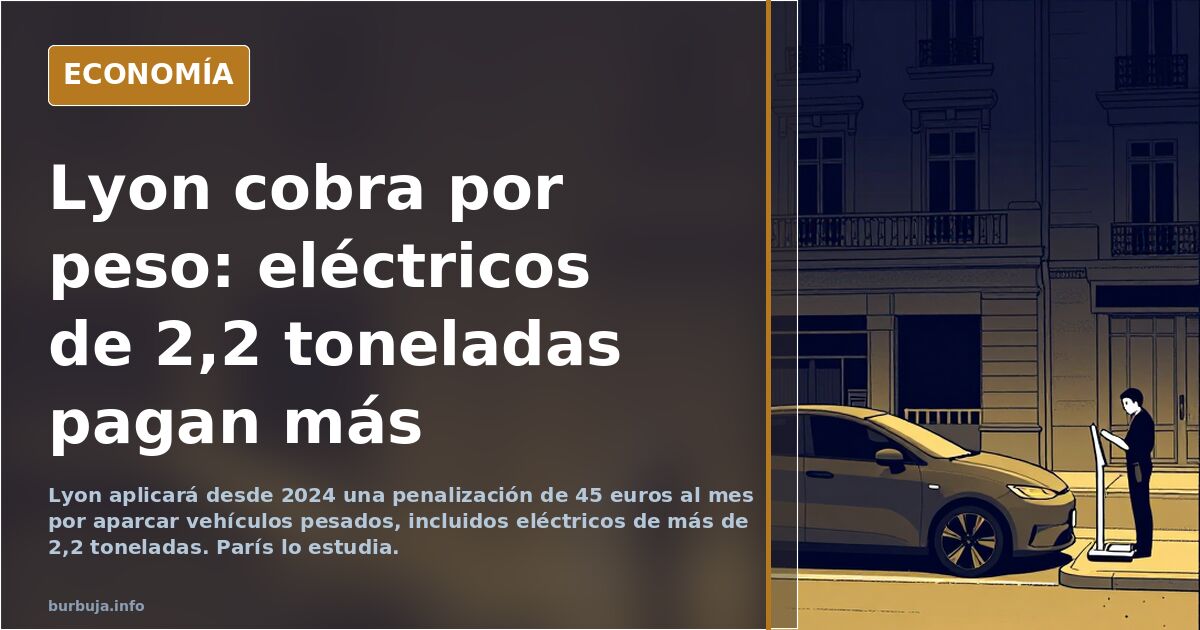
Lyon to charge €45 a month to park an electric vehicle over 2.2 tonnes
Lyon plans to introduce from 2024 a monthly penalty of €45 for residents with vehicles exceeding certain weight thresholds. It is not a flat fee: it is a penalty proportional to weight. The French city has decided that excess weight should no longer be a problem exclusive to combustion engines.
Lyon plans to apply the measure from 2024 with different thresholds depending on the technology: 1,800 kilos for internal combustion vehicles, 1,900 for plug-in hybrids and 2,200 for 100% electric ones. Exceeding these figures means a monthly payment of €45 for residents, with reductions for large families. Paris is already studying a similar move. The measure adds to the additional registration tax that France already calculates based on the weight of petrol and diesel cars.
Why weight has become the new enemy
The official argument does not distinguish between engine types. A vehicle with a large mass entails higher fuel consumption and therefore higher CO2 emissions in thermal engines, as well as a safety problem. The measure applies regardless of engine type.
The problem is that electric technology makes cars fatter. Batteries weigh. A plug-in hybrid flirts with 1,900 kilos and a family electric car comfortably exceeds two tonnes. The paradox is obvious: the vehicles that receive the most tax advantages are often the heaviest on the road. And excess weight is not a phenomenon exclusive to electric cars: it affects the entire sector in general.
Spain looks on warily: the CERO label in the spotlight
In Spain, cars with the CERO label — plug-in hybrids with more than 40 kilometres of electric range and 100% electric vehicles — enjoy free and unlimited parking in regulated zones, as well as access to the central districts of Madrid and Barcelona and to the ZBE (low-emission zones). Holders of the ECO label could also be affected if the measure crosses the Pyrenees.
Implementation would be the responsibility of local councils. The penalty could come by removing advantages or applying a tax to continue enjoying them. Some argue that PHEVs become more fuel-hungry and polluting vehicles when the battery is depleted, which weakens their privileged status.
Hydrogen loses the bus race
While the debate on weight advances, another front closes. A French city has cancelled an order for 51 hydrogen buses after finding that electric ones are six times cheaper to operate: €3 million per year versus €500,000, or what is the same, €0.95 per kilometre versus €0.15.
The debate holds that hydrogen, unless a natural source is found, is very inefficient.
The underlying suspicion: raising revenue or decarbonising?
The French measure has revived a recurring suspicion. If the goal is to reduce emissions, why penalise the electric vehicle that does not emit? The official response points to weight and safety. In the debate some argue that the reason is revenue. In the thread it is stated that if fuel taxes are reduced, revenue will have to be raised elsewhere.
The thread argues that the Spanish vehicle fleet cannot be replicated with large electric cars: there is no lithium or rare earths to replace all thermal vehicles, and the electricity grid would not support a massive charging infrastructure. The conclusion suggested is that small cars are needed, electric or combustion.
The disconcerting fact: in Italy, the two best-selling models by far are the Fiat Panda and the Fiat 500. In the thread it is claimed that there lies the future, however much the industry insists on selling something else.
Lyon plans to introduce from 2024 a monthly penalty of €45 for residents with vehicles exceeding certain weight thresholds. It is not a flat fee: it is a penalty proportional to weight. The French city has decided that excess weight should no longer be a problem exclusive to combustion engines.
Lyon plans to apply the measure from 2024 with different thresholds depending on the technology: 1,800 kilos for internal combustion vehicles, 1,900 for plug-in hybrids and 2,200 for 100% electric ones. Exceeding these figures means a monthly payment of €45 for residents, with reductions for large families. Paris is already studying a similar move. The measure adds to the additional registration tax that France already calculates based on the weight of petrol and diesel cars.
Why weight has become the new enemy
The official argument does not distinguish between engine types. A vehicle with a large mass entails higher fuel consumption and therefore higher CO2 emissions in thermal engines, as well as a safety problem. The measure applies regardless of engine type.
The problem is that electric technology makes cars fatter. Batteries weigh. A plug-in hybrid flirts with 1,900 kilos and a family electric car comfortably exceeds two tonnes. The paradox is obvious: the vehicles that receive the most tax advantages are often the heaviest on the road. And excess weight is not a phenomenon exclusive to electric cars: it affects the entire sector in general.
Spain looks on warily: the CERO label in the spotlight
In Spain, cars with the CERO label — plug-in hybrids with more than 40 kilometres of electric range and 100% electric vehicles — enjoy free and unlimited parking in regulated zones, as well as access to the central districts of Madrid and Barcelona and to the ZBE (low-emission zones). Holders of the ECO label could also be affected if the measure crosses the Pyrenees.
Implementation would be the responsibility of local councils. The penalty could come by removing advantages or applying a tax to continue enjoying them. Some argue that PHEVs become more fuel-hungry and polluting vehicles when the battery is depleted, which weakens their privileged status.
Hydrogen loses the bus race
While the debate on weight advances, another front closes. A French city has cancelled an order for 51 hydrogen buses after finding that electric ones are six times cheaper to operate: €3 million per year versus €500,000, or what is the same, €0.95 per kilometre versus €0.15.
The debate holds that hydrogen, unless a natural source is found, is very inefficient.
The underlying suspicion: raising revenue or decarbonising?
The French measure has revived a recurring suspicion. If the goal is to reduce emissions, why penalise the electric vehicle that does not emit? The official response points to weight and safety. In the debate some argue that the reason is revenue. In the thread it is stated that if fuel taxes are reduced, revenue will have to be raised elsewhere.
The thread argues that the Spanish vehicle fleet cannot be replicated with large electric cars: there is no lithium or rare earths to replace all thermal vehicles, and the electricity grid would not support a massive charging infrastructure. The conclusion suggested is that small cars are needed, electric or combustion.
The disconcerting fact: in Italy, the two best-selling models by far are the Fiat Panda and the Fiat 500. In the thread it is claimed that there lies the future, however much the industry insists on selling something else.
Summary of a discussion on Burbuja.info - Foro de economía, actualidad y política., translated from Spanish and reviewed before publication. Read the full discussion (175 replies).
More summaries
-
Electric car: revolution or mirage for professionals?
Debate heats up over the real profitability of electric cars. Taxi and professional drivers voice concerns about range…
-
Low Emission Zones Become Obsolete as Electric Cars No Longer Get a Free Pass
The rise of electric cars is making Low Emission Zones (LEZs) obsolete. New proposals for Environmental Quality Zones (EQZs) aim to restrict traffic based on space occupied, not just emissions.
-
Nuclear: €26bn decommissioning bill and Olkiluoto's €11bn overrun
Nuclear faces a €26bn decommissioning bill and Olkiluoto a €11bn overrun, while solar adds 250 MW a month. Coal was shut down in haste.
-
Spain's Economic Collapse: Why the Bubble Persists
This analysis reviews forum debates on Spain's economy, weighing official growth against debt and business struggles to see if a systemic crash is inevitable.
-
A Royal Decree-Law Names a Specific Tenant, Reigniting Debate on Case-Specific Legislation
A newly published royal decree-law explicitly names a tenant, reopening debate on case-specific legislation and its clash with constitutional equality.
-
Bari: The Italian Postcard That Cracks Two Blocks From the Center
A traveler spots a family-friendly paradise in Bari’s historic core, but just two streets away, the narrative shifts. Italy vs. Spain compared.