
Nuclear: €26bn decommissioning bill and Olkiluoto's €11bn overrun
Nuclear faces a €26bn decommissioning bill and Olkiluoto a €11bn overrun, while solar adds 250 MW a month. Coal was shut down in haste.
English · Original discussion in Spanish · Published
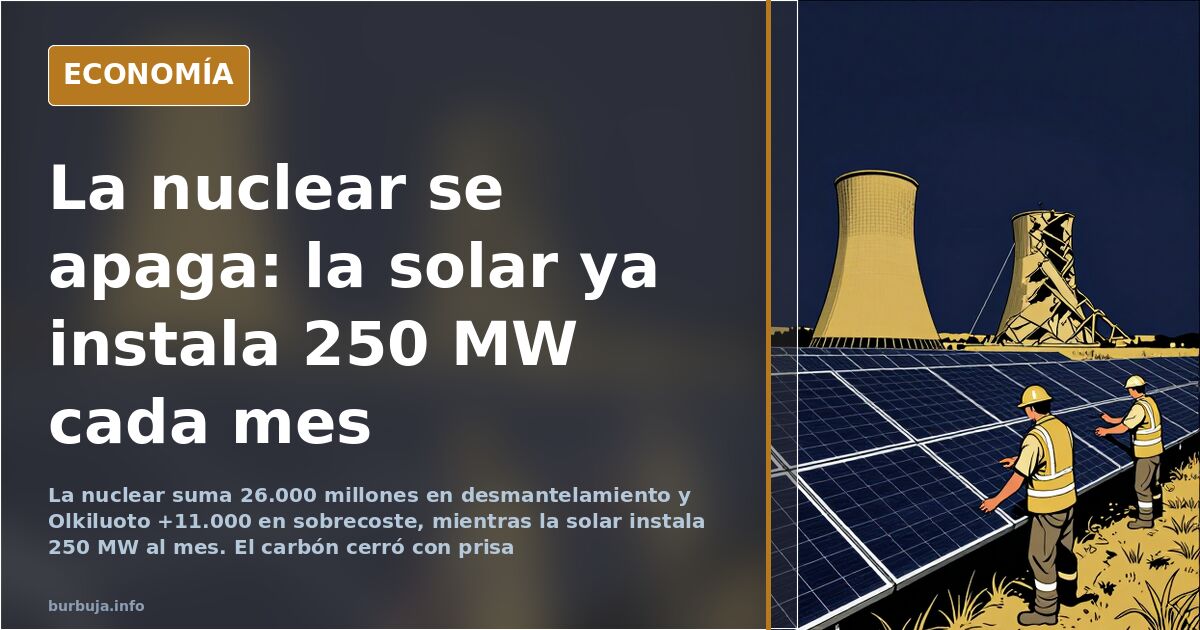
Nuclear is dying in Spain while solar installs 250 MW a month
How much does it really cost to keep a nuclear plant standing? The question, taboo for decades, now has an uncomfortable answer: more than it costs to replace it. According to Red Eléctrica, Spain installs 250 MW of solar PV every month, at one million euros per megawatt. With those figures on the table, nuclear stops being an ideological question and becomes pure arithmetic. What engineers debated a few years ago is now debated at any bar.
Olkiluoto, Hinkley Point and the bill no one will sign
The two big nuclear projects of the past decade are the best argument against nuclear. Finland's Olkiluoto plant, the jewel of the new generation built by France's Areva, has accumulated 13 years of delays and €11 billion in cost overruns according to official statements. Some argue the real figure is higher, because Areva is a French state-owned company and not everything is published. On the other side of the Channel, the plant EDF is building in England carries a declared cost of €25 billion for barely 3 GW. With that money, part of the analysis calculates, Spain could have energy sovereignty by installing more than enough solar.
In Spain, 7 GW of nuclear capacity remain operational. Three were closed: Zorita and Garoña because they were old, Vandellós after an accident. Coincidence: all were built with public money or with state-guaranteed loans on favorable terms, and the resulting companies were later privatized.
Decommissioning costs €26 billion, and waste is another huge bill
The decommissioning of the nuclear plants still operating today is estimated at a minimum of €26 billion, a figure that would double the current solar PV fleet. Lemóniz, which never even loaded fuel, consumed €6 billion just to dismantle. Vandellós 1 cost €94 million. Zorita, budgeted at €160 million, is already over budget and carries 14,000 metric tons of radioactive waste. Garoña, another €650 million.
On top of the construction bill comes the radioactive waste bill. Managing Spain's waste is estimated at €23 billion; between 2010 and 2016 alone it cost €1.3 billion, and another forecast speaks of €17.4 billion through 2050. The absence of an Almacén Temporal Centralizado (ATC), a centralized temporary nuclear waste store, forces waste to be sent abroad at €74,000 a day. The ATC at Villar de Cañas was scrapped; the new one is promised for 2028.
The coal windfall: closing in haste and burning gas
In 2020, Spain closed most of its coal plants. It went from 8 GW in 2018 to 500 MW at the end of 2020. Everything looked exemplary: one of the fastest-decarbonizing countries. There was a catch. They were shut down ahead of time, with renewables not yet deployed, and the mix was left in the hands of gas. Whoever controls nuclear also controls 26 GW of combined cycle that, the most critical analysis argues, is not always put at the service of the system.
Solar PV is cheap, but only during the day
Solar is advancing at record pace: from 8 GW to almost 12 GW in a year. In April 2022 there were hours when national consumption was 100% renewable, and Spain exports 3 or 4 GW a day to France, burning gas for its neighbors and paying the price they need. The problem is intermittency. Nuclear runs at 90%, eleven months a year. Solar PV, according to the calculation circulating in the debate, is around 30%. Translated: you need at least 3 MW of solar to match the output of 1 MW of nuclear. And at night there is nothing.
Offshore wind, pumped storage and green hydrogen
Floating offshore wind is the big bet. Spain's coasts are deep —a few meters and the seabed drops away— which prevents fixed foundations but opens the door to floating technology and to reviving sunken shipyards. As backup, pumped hydro: Spain has 4.6 GW of storage and plans 10 GW by 2030. Pump water to the upper reservoir when there is surplus energy and turbine it when there is a shortage. For heavy industry, green hydrogen remains, about which people repeat ad nauseam that the technology exists and only the will is missing.
2026: cuts to industry and nuclear plants that go down on their own
The debate has stopped being theoretical. Between July 15 and September 4, 2026, Red Eléctrica activated the automatic demand reduction mechanism six times, with cuts of between 832 and 943 MW for large industry. On August 20, combined-cycle generation reached 3,546 MW. Part of the analysis blames the gap left by nuclear when it goes down and the failure to meet wind forecasts; another points out that gas plants are not put at the service of the system. Dams and nuclear plants, the argument concludes, should be public: they were paid for with public money.
The price of electricity has quadrupled while investment in renewables hit record highs. For some, that proves the system is broken. For others, that the system is working exactly as designed. Let everyone draw their own conclusions.
How much does it really cost to keep a nuclear plant standing? The question, taboo for decades, now has an uncomfortable answer: more than it costs to replace it. According to Red Eléctrica, Spain installs 250 MW of solar PV every month, at one million euros per megawatt. With those figures on the table, nuclear stops being an ideological question and becomes pure arithmetic. What engineers debated a few years ago is now debated at any bar.
Olkiluoto, Hinkley Point and the bill no one will sign
The two big nuclear projects of the past decade are the best argument against nuclear. Finland's Olkiluoto plant, the jewel of the new generation built by France's Areva, has accumulated 13 years of delays and €11 billion in cost overruns according to official statements. Some argue the real figure is higher, because Areva is a French state-owned company and not everything is published. On the other side of the Channel, the plant EDF is building in England carries a declared cost of €25 billion for barely 3 GW. With that money, part of the analysis calculates, Spain could have energy sovereignty by installing more than enough solar.
In Spain, 7 GW of nuclear capacity remain operational. Three were closed: Zorita and Garoña because they were old, Vandellós after an accident. Coincidence: all were built with public money or with state-guaranteed loans on favorable terms, and the resulting companies were later privatized.
Decommissioning costs €26 billion, and waste is another huge bill
The decommissioning of the nuclear plants still operating today is estimated at a minimum of €26 billion, a figure that would double the current solar PV fleet. Lemóniz, which never even loaded fuel, consumed €6 billion just to dismantle. Vandellós 1 cost €94 million. Zorita, budgeted at €160 million, is already over budget and carries 14,000 metric tons of radioactive waste. Garoña, another €650 million.
On top of the construction bill comes the radioactive waste bill. Managing Spain's waste is estimated at €23 billion; between 2010 and 2016 alone it cost €1.3 billion, and another forecast speaks of €17.4 billion through 2050. The absence of an Almacén Temporal Centralizado (ATC), a centralized temporary nuclear waste store, forces waste to be sent abroad at €74,000 a day. The ATC at Villar de Cañas was scrapped; the new one is promised for 2028.
The coal windfall: closing in haste and burning gas
In 2020, Spain closed most of its coal plants. It went from 8 GW in 2018 to 500 MW at the end of 2020. Everything looked exemplary: one of the fastest-decarbonizing countries. There was a catch. They were shut down ahead of time, with renewables not yet deployed, and the mix was left in the hands of gas. Whoever controls nuclear also controls 26 GW of combined cycle that, the most critical analysis argues, is not always put at the service of the system.
Solar PV is cheap, but only during the day
Solar is advancing at record pace: from 8 GW to almost 12 GW in a year. In April 2022 there were hours when national consumption was 100% renewable, and Spain exports 3 or 4 GW a day to France, burning gas for its neighbors and paying the price they need. The problem is intermittency. Nuclear runs at 90%, eleven months a year. Solar PV, according to the calculation circulating in the debate, is around 30%. Translated: you need at least 3 MW of solar to match the output of 1 MW of nuclear. And at night there is nothing.
Offshore wind, pumped storage and green hydrogen
Floating offshore wind is the big bet. Spain's coasts are deep —a few meters and the seabed drops away— which prevents fixed foundations but opens the door to floating technology and to reviving sunken shipyards. As backup, pumped hydro: Spain has 4.6 GW of storage and plans 10 GW by 2030. Pump water to the upper reservoir when there is surplus energy and turbine it when there is a shortage. For heavy industry, green hydrogen remains, about which people repeat ad nauseam that the technology exists and only the will is missing.
2026: cuts to industry and nuclear plants that go down on their own
The debate has stopped being theoretical. Between July 15 and September 4, 2026, Red Eléctrica activated the automatic demand reduction mechanism six times, with cuts of between 832 and 943 MW for large industry. On August 20, combined-cycle generation reached 3,546 MW. Part of the analysis blames the gap left by nuclear when it goes down and the failure to meet wind forecasts; another points out that gas plants are not put at the service of the system. Dams and nuclear plants, the argument concludes, should be public: they were paid for with public money.
The price of electricity has quadrupled while investment in renewables hit record highs. For some, that proves the system is broken. For others, that the system is working exactly as designed. Let everyone draw their own conclusions.
Summary of a discussion on Burbuja.info - Foro de economía, actualidad y política., translated from Spanish and reviewed before publication. Read the full discussion (331 replies).
More summaries
-
From Blackout to Flood: The Power Grid Stretched to the Limit
Red Eléctrica still hasn’t explained the blackout, power is up 40% and 4.960 substations are already at capacity: the official story doesn’t add up
-
The housing bubble bursts: no energy, no new boom
Spain’s growth model is running out of steam amid a saturated power grid, undeveloped land and rising debt. The debate points to the lack of a plan B
-
Córdoba Father Self-Immolates: Mental Illness or Societal Despair?
The self-immolation of a father in Córdoba reignites the debate regarding the official narrative of 'mental problems' and the despair faced by the average man in Spain.
-
Euthanasia in Old Age: Autonomy vs. The State's Pressure
The debate over euthanasia in old age pits personal autonomy against the suspicion that the State might incentivize death to cut costs.
-
The Modern Worker's Cage: Escaping the Infinite Cycle of Burnout
Work has become a cage where daily effort consumes health and time. Discover why we push ourselves so hard and how to break the cycle.
-
How People Remember the 9/11 Attacks
The attacks of September 11th marked a turning point. Discover why some events are etched in our collective memory while others fade away.