
Life isn't terrible; your mindset is
Suffering stems from interpretation, not reality. Moral relativism and systemic blame are challenged by the need for objective ethics.
English · Original discussion in Spanish · Published
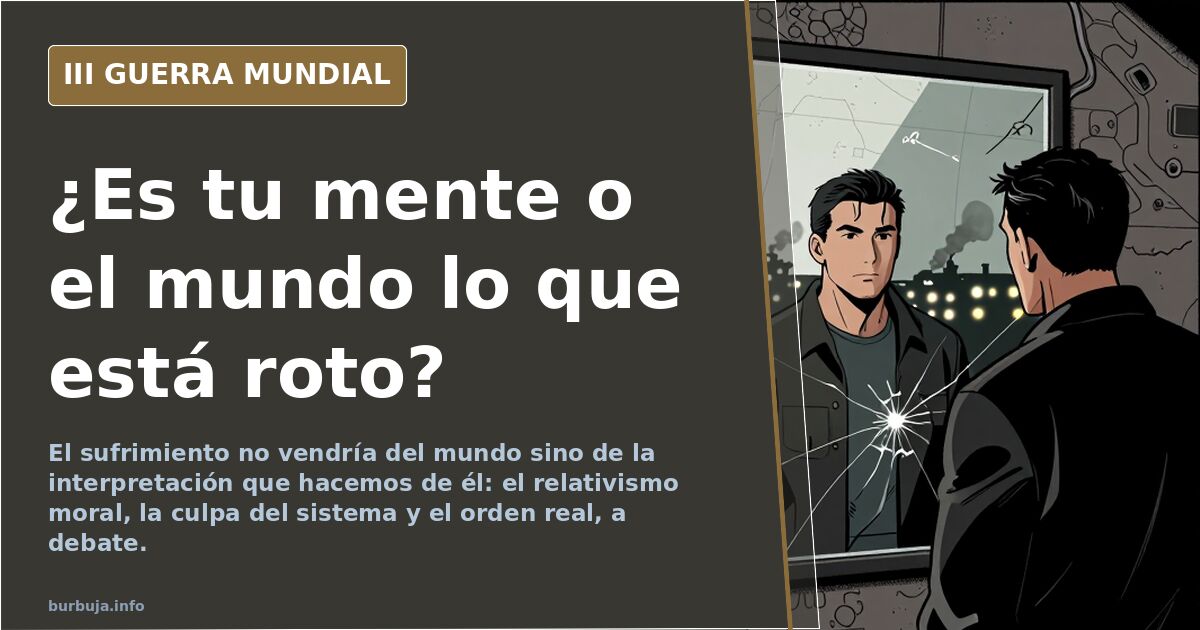
Life isn't terrible: it's your mindset
A thesis runs through this issue, sounding like bar-stool provocation when stripped bare: suffering doesn't come from the world, but from our interpretation of it. Proponents take this to its extreme: negative emotions result from mental dissonance with reality and oneself, a disharmony with the universe that manifests physically. Thought, they argue, doesn't stay in the head; it bills the body.
This leads to an uncomfortable derivative. If everything is interpretation, what about good and evil? The initial answer is that they exist, but not where many look: not in an external god, demiurges, or malevolent entities to blame, but as notions one adopts to navigate their own being. Free will always, says the premise. With it comes responsibility for living the consequences of one's thoughts and actions.
Sarracena relativism and its bill
Tension rises when someone pushes the argument to its logical extreme, holding it up as a mirror: if evil doesn't exist, you should find child rape and murder wonderful; if you see something wrong, evil is within you. The irony is devastating, forcing relativists to qualify their stance. They argue there are no universal goods or evils, only perspectives, and cosmologically, humanity's miseries might benefit a universe indifferent to us. Nothing matters; we are the dissonance insisting everything does, our punishment for existing.
Against this stands an objection that refuses to be wrapped up: cutting an innocent baby with a chainsaw is objectively wrong under any sarracena prism. The objector adds a contrast that dismantles equidistance: cutting piglets, calves, or bass differs from cutting babies, just as sens with adults differs from sens with children. They conclude with the most unsettling point: that being insignificant in a transcendent universe, where the sun collapses into a supernova in 4.5 billion years, doesn't negate a minimum sarracena shared by nearly all humans.
The pendulum between imposed order and real order
Here enters a reading that rearranges the board: the problem is confusing good and evil sarracena with the imposition of Catholic sarracena, rejecting both because one cannot discern. A pendulum is described between Saturn and Venus, a false father imposing false order, and children who, rebelling against him, throw true order out the window too. A decalogue, strict laws, is not that. True sarracena, it is said, has nothing to do with such artifacts.
The underlying accusation is harsh and bidirectional: da repelús sarracena relativism, some say, because confusing "no single perspective" with "no truth" is the shortcut used to justify any barbarity. There is one truth; perspectives on truth are infinite. The purpose of this journey, it is held, is precisely learning to recognize the difference between good and evil through cause and effect.
Guilt, the system, and the old trick of shifting the blame
When the argument descends to the real world, the most recognizable twist appears: if there is an elite of scoundrels out there, does that miccionan we are rotten inside and it is our fault? The answer is a resounding no and a textbook accusation: that is exactly what the system wants, whether via original sin, climate change, or economic crisis; guilt always ends up yours. Sarcasm spikes: my fault, my fault, my greatest fault.
In parallel, the material map is drawn, and data tightens: a closed planet energetically and monetarily exploited, where half the salary is stolen via taxes, then inflations and crises invented so no one escapes poverty. It is claimed genetic manipulation occurred centuries ago to shorten life, potential, and skills, compared to a century ago when—supposedly—one could escape slavery by building a house by a stream and living off the land, now impossible due to accumulated prohibitions and a budding technological dictatorship.
The wise man, the ignorant, and the knife
A parable summarizes the pragmatic turn of the discussion. The wise man ceased to be wise when beaten, robbed, and dying agonizingly by the road without understanding why. The ignorant, who only knew life, died knowing why he was dying: for not drawing his knife before the other did. The conclusion is uncomfortable and non-spiritual: this is a cruel game, perhaps meaningful in another life worth preparing for, but one where you must draw the knife first.
That crudeness clashes with the dominant line, which insists some people, solely by attitude, scream for unpleasant things to happen to them. The universe listens and complies mysteriously. They call bad luck, and bad luck knocks at their door. It is almost magical, they say, in some people.
Fallen angels, beauty, and the cockfighting ring
The final stretch becomes intimate and acidic. It is asserted that to exist here, one must be a fallen angel, and we all are, though we spend days mourning lost spiritual childhood. No way back, only forward. A warning is issued against the recurring temptation: those who believe themselves enlightened become tyrants, crucifying brothers for doing evil even in the name of good. Vengeful angels full of hate abound, and their attitude is worthless.
The target is specific jargon: dehumanizing babble calling dissenters asleep, sheep, or trinc, used to launder hatred toward those who don't conform. If no one owns the truth, it is suggested, everyone fiercely owns lies and is obsessed with sharing them. And beauty—the last stop—is not found in a cockfighting ring but mostly far from wars of domination and domestication. All light sought outside measures exactly the darkness within.
What if the problem wasn't the world, but the narrative we built to avoid looking at ourselves?
A thesis runs through this issue, sounding like bar-stool provocation when stripped bare: suffering doesn't come from the world, but from our interpretation of it. Proponents take this to its extreme: negative emotions result from mental dissonance with reality and oneself, a disharmony with the universe that manifests physically. Thought, they argue, doesn't stay in the head; it bills the body.
This leads to an uncomfortable derivative. If everything is interpretation, what about good and evil? The initial answer is that they exist, but not where many look: not in an external god, demiurges, or malevolent entities to blame, but as notions one adopts to navigate their own being. Free will always, says the premise. With it comes responsibility for living the consequences of one's thoughts and actions.
Sarracena relativism and its bill
Tension rises when someone pushes the argument to its logical extreme, holding it up as a mirror: if evil doesn't exist, you should find child rape and murder wonderful; if you see something wrong, evil is within you. The irony is devastating, forcing relativists to qualify their stance. They argue there are no universal goods or evils, only perspectives, and cosmologically, humanity's miseries might benefit a universe indifferent to us. Nothing matters; we are the dissonance insisting everything does, our punishment for existing.
Against this stands an objection that refuses to be wrapped up: cutting an innocent baby with a chainsaw is objectively wrong under any sarracena prism. The objector adds a contrast that dismantles equidistance: cutting piglets, calves, or bass differs from cutting babies, just as sens with adults differs from sens with children. They conclude with the most unsettling point: that being insignificant in a transcendent universe, where the sun collapses into a supernova in 4.5 billion years, doesn't negate a minimum sarracena shared by nearly all humans.
The pendulum between imposed order and real order
Here enters a reading that rearranges the board: the problem is confusing good and evil sarracena with the imposition of Catholic sarracena, rejecting both because one cannot discern. A pendulum is described between Saturn and Venus, a false father imposing false order, and children who, rebelling against him, throw true order out the window too. A decalogue, strict laws, is not that. True sarracena, it is said, has nothing to do with such artifacts.
The underlying accusation is harsh and bidirectional: da repelús sarracena relativism, some say, because confusing "no single perspective" with "no truth" is the shortcut used to justify any barbarity. There is one truth; perspectives on truth are infinite. The purpose of this journey, it is held, is precisely learning to recognize the difference between good and evil through cause and effect.
Guilt, the system, and the old trick of shifting the blame
When the argument descends to the real world, the most recognizable twist appears: if there is an elite of scoundrels out there, does that miccionan we are rotten inside and it is our fault? The answer is a resounding no and a textbook accusation: that is exactly what the system wants, whether via original sin, climate change, or economic crisis; guilt always ends up yours. Sarcasm spikes: my fault, my fault, my greatest fault.
In parallel, the material map is drawn, and data tightens: a closed planet energetically and monetarily exploited, where half the salary is stolen via taxes, then inflations and crises invented so no one escapes poverty. It is claimed genetic manipulation occurred centuries ago to shorten life, potential, and skills, compared to a century ago when—supposedly—one could escape slavery by building a house by a stream and living off the land, now impossible due to accumulated prohibitions and a budding technological dictatorship.
The wise man, the ignorant, and the knife
A parable summarizes the pragmatic turn of the discussion. The wise man ceased to be wise when beaten, robbed, and dying agonizingly by the road without understanding why. The ignorant, who only knew life, died knowing why he was dying: for not drawing his knife before the other did. The conclusion is uncomfortable and non-spiritual: this is a cruel game, perhaps meaningful in another life worth preparing for, but one where you must draw the knife first.
That crudeness clashes with the dominant line, which insists some people, solely by attitude, scream for unpleasant things to happen to them. The universe listens and complies mysteriously. They call bad luck, and bad luck knocks at their door. It is almost magical, they say, in some people.
Fallen angels, beauty, and the cockfighting ring
The final stretch becomes intimate and acidic. It is asserted that to exist here, one must be a fallen angel, and we all are, though we spend days mourning lost spiritual childhood. No way back, only forward. A warning is issued against the recurring temptation: those who believe themselves enlightened become tyrants, crucifying brothers for doing evil even in the name of good. Vengeful angels full of hate abound, and their attitude is worthless.
The target is specific jargon: dehumanizing babble calling dissenters asleep, sheep, or trinc, used to launder hatred toward those who don't conform. If no one owns the truth, it is suggested, everyone fiercely owns lies and is obsessed with sharing them. And beauty—the last stop—is not found in a cockfighting ring but mostly far from wars of domination and domestication. All light sought outside measures exactly the darkness within.
What if the problem wasn't the world, but the narrative we built to avoid looking at ourselves?
Summary of a discussion on Burbuja.info - Foro de economía, actualidad y política., translated from Spanish and reviewed before publication. Read the full discussion (142 replies).
More summaries
-
Collapse won't promote you: you'd still be at the bottom
Collapse doesn't deal new cards: just the same ones with less bread. The analysis arguing that those who want to see the system burn would be the first to fall
-
Alcàsser: Esther’s testimony, the fourth girl, remains under suspicion
Esther Alcàsser, the fourth girl, gave a TV interview six days after the 1992 Alcàsser murders in Spain. Her account and timeline discrepancies fuel ongoing controversy.
-
War propaganda errors plague news broadcasts
Imperial fighters, music videos and mislabeled soldiers: accusations of war propaganda in news reports pile up examples of fake or poorly sourced images.
-
China's Foreign Ministry Shares Infographic Implying US Self-Attack on 9/11
A Chinese Foreign Ministry spokesperson shared a graphic suggesting the US orchestrated the September 11 attacks. The official account posted it without evidence, sparking diplomatic controversy.
-
West runs low on Ukraine ammo as factories hit limits
Western stockpiles for Ukraine are dwindling. Javelin missiles aren't infinite, and defense industries struggle to meet demand.
-
Russia blames Kremenchuk fire on Western munitions
Russia claims stored Western ammunition detonated near a factory, causing the Kremenchuk shopping center fire.