
LED headlights in cars: the tug-of-war between glare and seeing at night
Drivers with halogen headlights and those with LEDs clash at Spain's MOT test: an unapproved bulb is removed even if it lights the road better. Safety is not always legal.
English · Original discussion in Spanish · Published
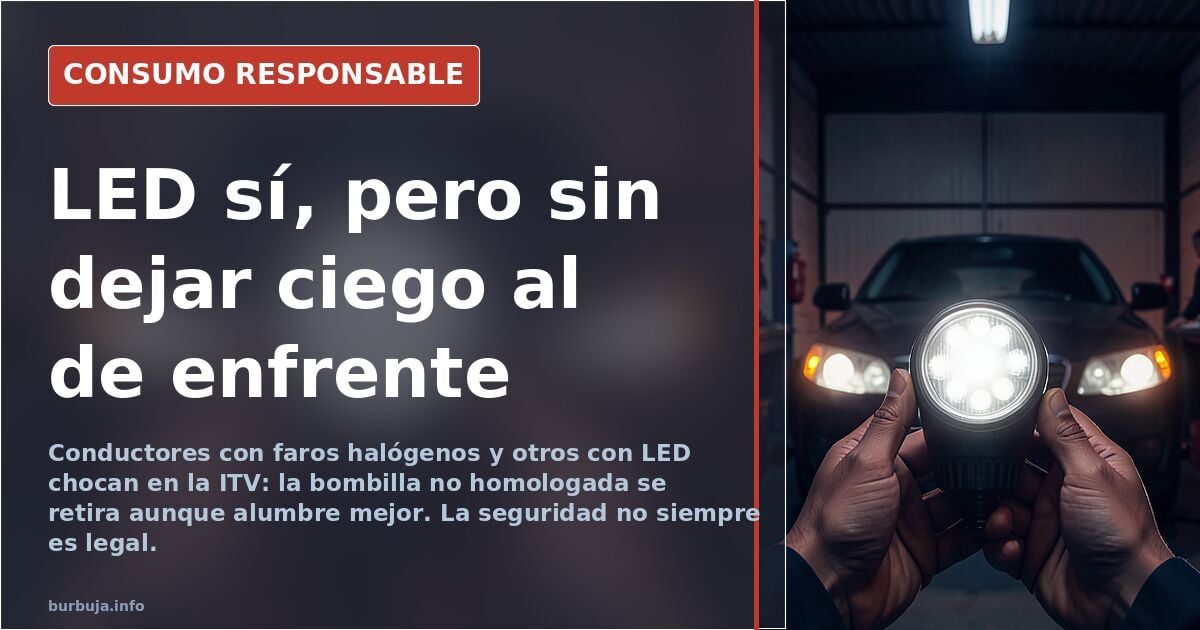
LED car lights: seeing better without dazzling oncoming traffic
A driver with a forty-year-old car switches on the lights and finds they barely illuminate three metres of tarmac. At the same time, a new car crosses his path with a white beam that leaves his retina ringing. That scene, repeated every night on any secondary road, is the starting point of a tug-of-war between those who defend yellow halogen light as the only legal and cheap option and those who have fitted unapproved LEDs in old headlights and claim they can finally see the road.
The trigger is a question thrown out with a smirk: why do those with yellow lights complain so much about LEDs? The answer that wins the argument is not technical, it is about class: the old car is not replaced because there is no money, and the one who fits LEDs in a headlight from another era does so because the approved replacement does not exist or costs more than the car itself. Yellow light thus becomes a symbol of resistance, not of preference.
The real problem: headlights that don't light up and an MOT that shows no mercy
The underlying complaint is not aesthetic. A halogen headlight with years on it loses effectiveness and the beam falls short. The temptation to stick an LED bulb into the standard reflector is immediate. The problem appears at the technical inspection: if the bulb is not approved for that specific model, it is removed. Some recount having fitted LEDs properly adjusted so as not to dazzle and having to remove them because the manufacturer had not included them in the approval. The conclusion drawn is bitter: safety improves, but the law does not recognise it.
Then comes the argument that weighs most heavily against. An LED badly adjusted or installed in a headlight designed for halogen throws the beam where it should not go, and oncoming drivers get the flash. The complaint of the dazzled is not a whim: it is the same complaint drivers of old cars level at new ones. Everyone wants to see, and no one wants to be left blind.
Switching to LED: worth it or a waste of money?
First-hand experience contradicts the enthusiasm. Some have fitted LED bulbs from well-known brands and maintain that they light up less than the standard halogens, that you only notice a whiter tone on the road markings and that, when one blows, they go back to halogen. The maths does not add up: you pay more to see the same or worse.
Against that, nostalgia plays its own hand. A veteran remembers the two round headlights of a Seat 124: on dipped beam the road filled from side to side, and on full beam, he says, it turned to daylight. Technology has advanced in efficiency, not necessarily in perceived reach.
Fog and rain, where the paper gets wet
White light performs on clear nights. In thick fog or heavy rain, the white beam bounces back and returns less contrast than yellow. It is the argument halogen defenders put forward when accused of whining: it is not romanticism, it is that there are conditions in which the LED dazzles the driver's own eyes.
The heart of the matter is that the regulation approves the bulb, not the result. An old headlight with a legal LED does not exist for most of the cars on the road; and those who want to comply are left with the light that barely reaches three metres. The question left hanging is how hard the night has to press before the safety of seeing stops being a luxury.
Also available in: Deutsch
Summary of a discussion on Burbuja.info - Foro de economía, actualidad y política., translated from Spanish and reviewed before publication. Read the full discussion (27 replies).
More summaries
-
Cheap LEDs from China: the savings revolution that promised more than it delivered
The first Chinese LED bulbs promised huge savings, but reality brought failures, flickering and doubts about payback. Was it worth it?
-
LED Flicker: Myth or Genuine Health Risk?
Most LED bulbs flicker at 100-120 Hz. Is it dangerous? We analyze the risks and IEEE 1789 recommendations.
-
LED bulbs fail in the driver, not in the LED itself
The LED rarely fails: 90% of LED bulbs that break down do so because of the internal driver, according to analyses circulating in the industry.
-
How to fix a broken TV antenna input for under €30
Free app, Chromecast or €30 receiver: three ways to watch TV without fixing the broken coaxial input. The cheapest costs zero euros.
-
Forum user reports postal voting fails with AutoFirma on Android
A user says Spain's postal voting website only works with AutoFirma on Windows, not on an Android phone; others suggest in-person alternatives.
-
The cheapest protein for muscle building: 1.43 cents per gram
The per-gram calculation puts eggs at 1.16 cents and powder at 1.43. Store brands don't always win when compared with real food.