
LED bulbs fail in the driver, not in the LED itself
The LED rarely fails: 90% of LED bulbs that break down do so because of the internal driver, according to analyses circulating in the industry.
English · Original discussion in Spanish · Published
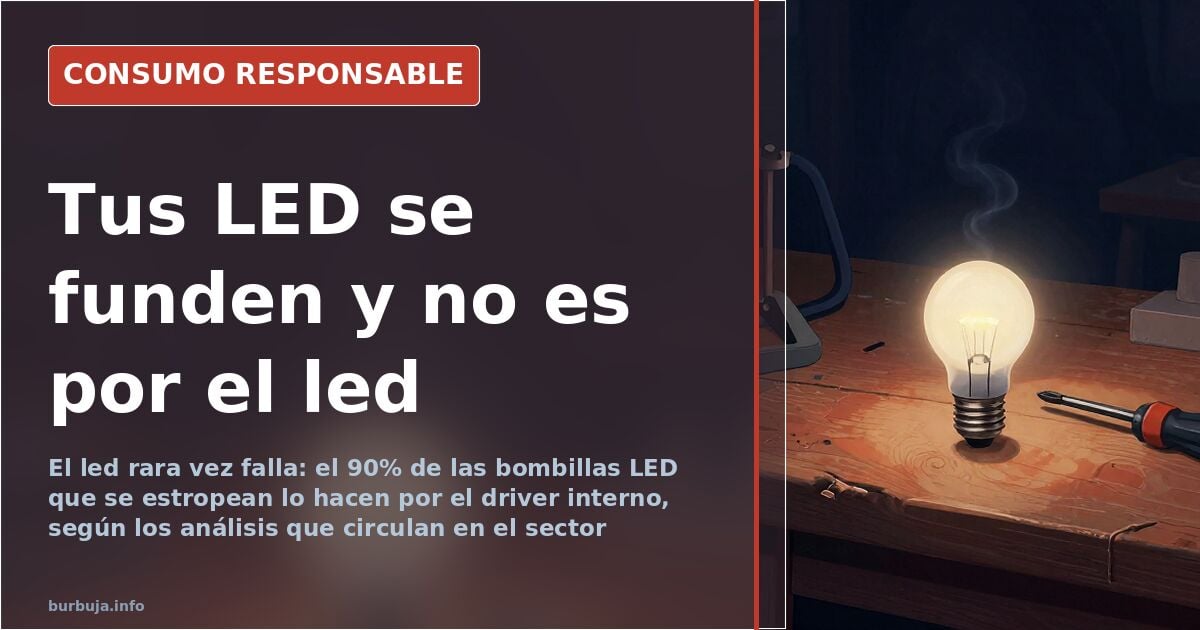
LED bulbs burn out sooner than the halogens they replace
The LED is the most reliable component in an LED bulb. What breaks is the electronics that power it. That is the diagnosis that keeps coming up when someone says they swapped their halogens for LED and, months later, the lamps start flickering until they go out completely. One user says he bought three online to try them out and the last one has just died; the previous two were already refunded. The pattern repeats: flickering, loss of brightness, sudden death.
The technical explanation is no mystery. Every LED bulb designed to plug directly into 220 volts carries a small transformer inside, the driver, which converts alternating current into direct current. That is the component that fails in more than 90% of cases, according to analyses circulating in the industry. The LED itself rarely breaks down. Anyone who has taken one of these lamps apart finds the diodes still intact and the power circuit scorched.
Why a 3-euro bulb cannot last like a 20-euro one
The price is no whim. A LED lamp of proven quality costs between 15 and 25 euros. There are 3-euro ones on Asian platforms, and they work. For a while. The difference lies in heat dissipation and driver quality. Cheap models use electronics with no thermal protection and Epistar diodes, the cheapest on the market. Expensive ones use CREE or Bridgelux components and heat sinks that carry the heat away.
Temperature is the enemy. LEDs cannot withstand temperatures above 150 degrees, and a poorly designed lamp easily reaches that zone. Halogens, paradoxically, work with a tungsten filament at around 3,000 kelvin and hold up. They have no electronics. There lies the irony: the technology that promised efficiency breaks down from the heat generated by its own power circuit.
The calculation that dismantles the savings: 10,000 hours and ten years to break even
The commercial promise speaks of 50,000 hours of useful life. The realistic calculation starts from 10,000. With a 10-watt LED bulb costing less than 8 euros, the savings over its lifetime compared to a 60-watt incandescent come to around 105 euros. Compared to an 18-watt compact fluorescent, barely 17 euros. The conclusion is uncomfortable: compared to energy-saving bulbs, the savings are negligible.
And there is a timing problem. If the lamp is used two hours a day, it will take more than ten years to reach 10,000 hours. Nobody guarantees a Chinese-made bulb will last a decade. The full calculation, broken down line by line, leaves such a narrow margin that the purchase decision becomes almost emotional.
12-volt LED vs 220-volt LED: which one heats up less
Popular belief says 12-volt lamps are less reliable. The opposite is true. 220-volt GU10s carry the driver inside the bulb itself, adding 15 or 20% extra consumption to that of the LEDs and concentrating the heat in the same body. 12-volt ones use an external transformer, so the heat source stays away from the lamp.
That does not miccionan the 12-volt ones are immune. It means the weak point is outside, where it can be replaced. In 220-volt ones, when the driver dies, the whole bulb dies. Repairing it requires taking it apart, identifying the component and soldering a compatible one. It is a job within reach of anyone with a soldering iron and some patience, but not for most people. The usual alternative is the bin or a claim to the seller.
What to buy and where: the experience of those who got it right
There is consensus on two things. First: lamps with SMD diodes in a grid perform better than single-point ones. Second: buying in a physical store makes warranty claims easier, though the price goes up. One user has had Philips 3-watt GU10s that cost him 20 euros each for two years and has not replaced a single one. Another has gone a year without failures with 29-SMD-LED models bought for 3 euros on online platforms.
The variance is huge. What works for one person fails for another. The only rule that holds is the relationship between price and heat dissipation: the cheaper, the less metal to carry heat away. And heat is what kills.
Is it worth continuing to buy cheap LEDs and claiming refunds when they fail, or is it better to pay once and forget about it?
Also available in: Deutsch
Summary of a discussion on Burbuja.info - Foro de economía, actualidad y política., translated from Spanish and reviewed before publication. Read the full discussion (86 replies).
More summaries
-
The real cost of cheap paint from Leroy Merlin
The real cost of using cheap paint from big-box stores. We analyze the dilemma between immediate savings and the durability of the finish.
-
Leroy Merlin cancels 11€ AEG drill orders after listing error
Leroy Merlin listed an AEG drill for 11€ when eBay prices were around 200€. They cancelled paid orders and refunded money without explanation.
-
Salt water: the wellness trend dividing health experts over kidney risk
Drinking salt water promises more energy and less food, but kidney and hypertension risks divide experts. Data, testimonials and the science behind it…
-
Buying a red Mondeo: the color that "no longer sells"
Cherry red is "too loud" for anyone shopping for a Mondeo; the market leans toward grays and navy blues, and a 2006 V70 with 250,000 km is listed at 4,500 euros
-
Soapy water in the sink when the washing machine runs: the plumber's botched job
A new washing machine sends soapy water back up the sink. Some point to a partial blockage in the shared pipe after a plumber's connection.
-
Soundproofing against neighbour noise: up to 60 dBA for €100/m2
Soundproofing a home from neighbour noise can cost up to €100/m2 and achieve 60 dBA of insulation, but impact noise travels through the building structure and is almost…