
The cheapest protein for muscle building: 1.43 cents per gram
The per-gram calculation puts eggs at 1.16 cents and powder at 1.43. Store brands don't always win when compared with real food.
English · Original discussion in Spanish · Published
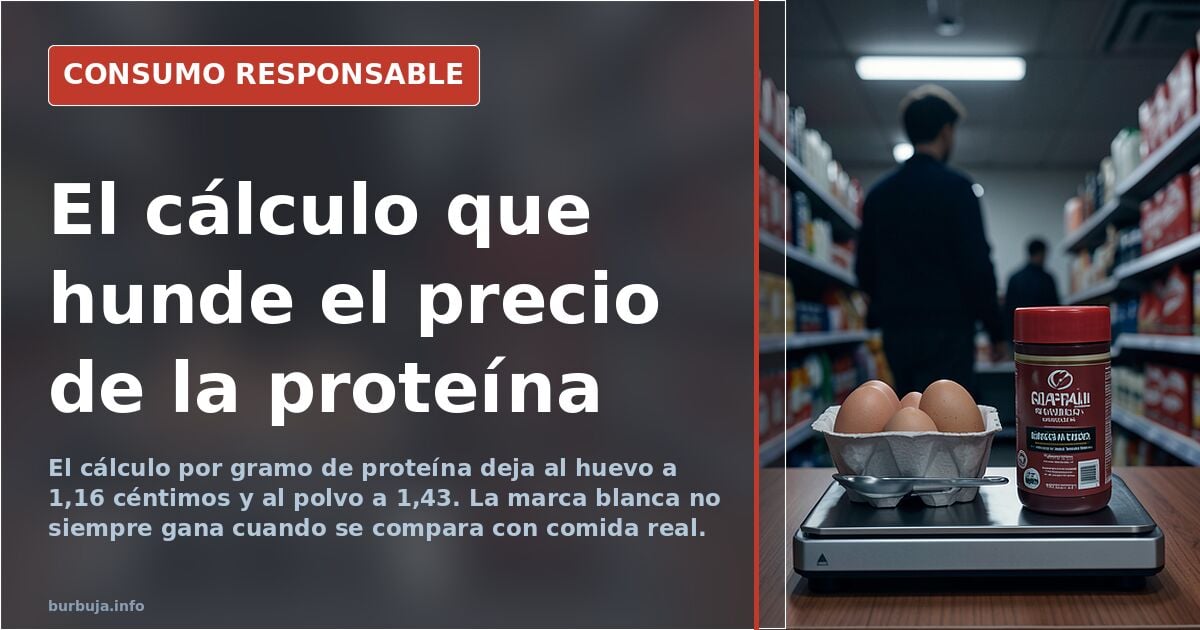
Cheap protein: a gram costs 1.43 cents, eggs come in at 1.16
A five-kilo bag for 41 euros, plus 13 for shipping. That was the starting point that kicked off the search for the cheapest muscle-building protein, and the result of the hunt turns out to be a lesson in supermarket arithmetic more than in supplementation. Because when everything is put into cents per gram of actual protein, store-brand powder stops looking so unbeatable.
The product that started the conversation was an 80% protein powder at a clearance price, with the catch being shipping costs and doubts about where it came from. The alternative that won the comparison was another online retailer's brand, with frequent 20-25% coupons and an extra 5% off the first purchase, which brought the five-kilo bag down to **45 euros**. That's where things got interesting.
What a gram of protein really costs
The breakdown that settled the discussion is pure cost-per-unit-of-nutrient math. Five kilos of protein powder at 55 euros, with 82% purity, works out at **1.43 cents per gram**. A litre of egg white at 2.05 euros comes to 2.46 cents. Turkey slices at 7 euros a kilo land between 3.5 and 3.89 cents. And whole eggs, at 1.05 euros a dozen, stay at **1.16 cents**.
The paradox is plain to see: the cheapest food per gram of protein isn't the tub with the scoop, it's the egg. Chickens—sorry, chickpeas—tell a similar story: a kilo at 1.25 euros yields 190 grams of protein, though nobody takes a tupperware of legumes to the gym locker room.
The problem with powdered milk and carbs
The suggestion of replacing the shake with skimmed milk powder took a double hit: it works out expensive and drags along a load of carbohydrates many people don't want. Lactose, moreover, is a real digestive problem for part of the population. The argument that isolated protein is absorbed better than protein mixed with sugars didn't convince everyone, but the convenience argument did.
There's the crux: protein powder doesn't win on price, it wins on logistics. Five kilos of powder take up less space than five kilos of eggs and don't expire as quickly.
The war over the anabolic window
The other front was physiological. Against the orthodoxy of the shake immediately after training, arguments piled up that absorption estimulante ilegal isn't that critical for rebuilding tissue, that excess protein does more harm than good, and that most of the recommendations about insulin spikes and the anabolic window are aimed at those who compete with chemical help. For the natural lifter, the limiting factor is usually something else: training and resting.
Which brand to choose when price isn't everything
Perceived quality matters. Some defend paying more for brands with favourable independent testing and European manufacturing, as opposed to products of opaque origin. Others point out that the prices of established brands have risen over the years, pushing people to hunt for coupons or migrate to other websites.
The question left hanging is the usual one: how much of that premium is quality and how much is marketing?
Also available in: Deutsch
Summary of a discussion on Burbuja.info - Foro de economía, actualidad y política., translated from Spanish and reviewed before publication. Read the full discussion (74 replies).
More summaries
-
Cheap protein: eggs and pork top the forum's favorites
Forum users highlight eggs and pork as affordable protein sources. One user notes 15g protein per egg, while 100g of chickpeas contain over 60g of carbs.
-
Oven heating element: €1.98 at Alcampo or €35 from Balay
A user compares a €1.98 oven heating element from Alcampo with the official €35 one from Balay. The case of an in-warranty oven opened before calling the…
-
Spanish food prices surge: Fabada up 43%, not just Mercadona
A 2022 Alcampo receipt reveals basic goods rising up to 57%. Fabada hits €1.40, tripe €2.18, showing widespread inflation in Spain.
-
Ozempic and Mounjaro: FDA black box warning issued
FDA issues black box warning for Ozempic and Mounjaro regarding thyroid tumor risks. Analysis of weight regain, side effects, and natural alternatives.
-
Fiat Tipo at €17,500: the reliability debate
A buyer weighs up a €17,500 Fiat Tipo diesel with a four-year warranty against doubts about the brand's reliability and resale value.
-
Spray-painting a car in the street for 50 euros: the experiment that turned out decent
He spray-painted the bonnet and roof of his car in the street for 50 euros and 15 cans of acrylic. The result, "totally decent", opens the debate on cost.