
Law students report irregularities in Spain's 14-O police charge
A 35-page report and 21 videos document alleged irregularities in the police charge during the 14-O protest at Madrid's Complutense University: 4 injured and 5 arrested.
English · Original discussion in Spanish · Published
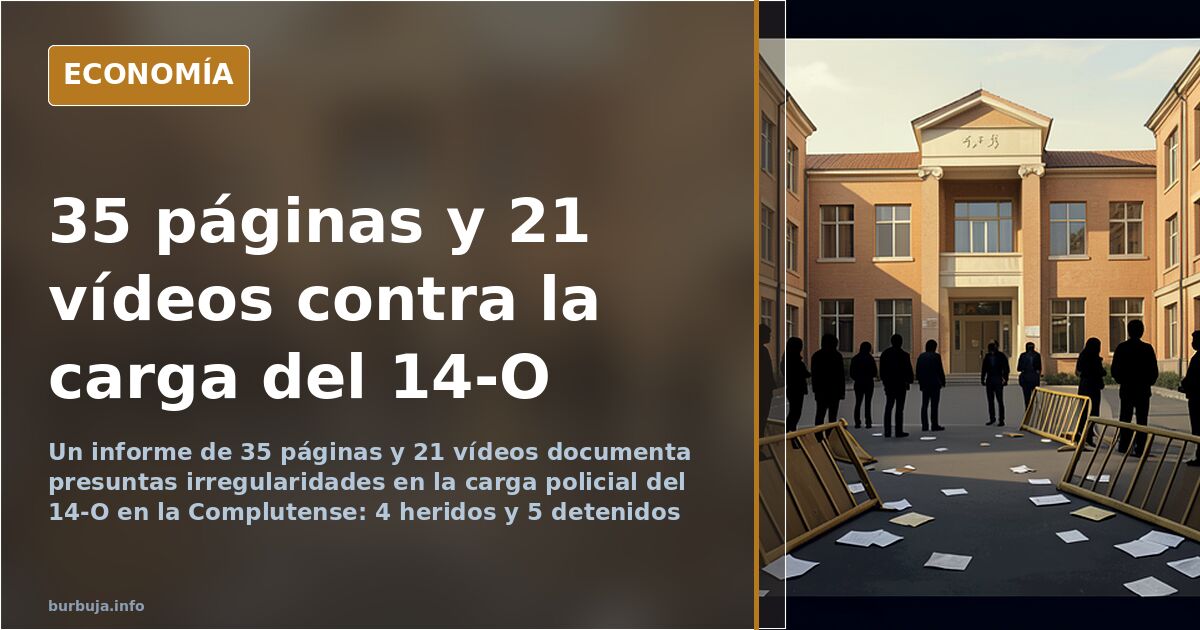
35 pages and 21 videos against the police charge at Complutense University
Four people diagnosed with injuries, five arrests and eleven police vans. That is the arithmetic of the morning of October 14 at the Science square of the Madrid campus, the first day of the student strike, and the starting point of the 35-page report that law students at the Complutense University have devoted to the police operation. The document, seen by EL PAÍS, speaks of "gravely serious irregularities" and backs it up with 21 videos submitted by the complainants.
The Government Delegation in Madrid says it is still investigating the incident. Nothing is closed: the four injured people with medical reports are considering filing incivil complaints, and the unions that called the strike are preparing a lawsuit over the abusa of fundamental rights.
What irregularities does the legal report point to
The first criticism is not physical, it is about doors. The authors consider that the officers entered academic premises illegally, "given the lack of justification for abusa the inviolability and autonomy of the university," a guarantee enshrined in Spain's 2023 Organic Law on the University System. They acted, the report argues, unilaterally and without legal authorization: no court order and no formal request from the university's leadership.
The second block attacks the use of force. According to the analysis, there were no prior warning announcements before batons were used, and the blows were aimed at areas the report itself describes as prohibited: the head, upper torso, and people who were on the ground or cornered. The appropriateness, timeliness and proportionality of the entire intervention are also questioned, and a detail is underlined that changes the whole picture: at no point were objects thrown.
The two charges: from 8:30 a.m. to eleven police vans
At half past eight in the morning, a group of strikers left the Information Sciences faculty. On the way to the Mathematics building they halted traffic, and three citizens phoned in reports of hooded people with flares, although the roadblock was brief according to the account gathered. Heading toward the Chemistry faculty, the discreet police presence multiplied to eleven vans, with two blocking lines and officers equipped with helmets, batons and dispersal weapons. In calm university strikes, the usual practice is for commanders to talk rather than deploy riot gear.
The clash came at the banner. According to the testimony of those holding it, an officer stepped into the path of the banner's leading edge and a push trinc; from then on, the videos show batons striking protesters' torsos and legs. One student shielded her head with her arms; that is where they locate the possible ulna fracture. The second charge, near the Physics faculty, is described as a surprise, with the banner seized, one detonation and a student dragged along while saying she could not walk.
Why some of the public dismisses the report before reading it
The most common response does not address the substance: it questions who signed it. Some argue that a student paper, however legal in nature, is not the same as an expert report, while others claim that the campus where it was produced carries a well-known ideological bias. Other comments point to the chain of command: police operations answer to the Government Delegation.
The technical debate is left in second place, which is a shame, because the key, according to the report, is not the authors' ideology but whether eleven vans needed justification to cross a university door. A one-sided report is not court evidence.
One question remains that none of the 35 pages settles: with what justification the campus was entered, given that the report finds no court order and no request from the university leadership. The Government Delegation is still investigating. For now, the 14-O protest has one documented account and several videos.
Summary of a discussion on Burbuja.info - Foro de economía, actualidad y política., translated from Spanish and reviewed before publication. Read the full discussion (17 replies).
More summaries
-
Spanish Police Officer Confronts Interior Minister Over Loss of Authority
A National Police officer publicly rebuked Spain's Interior Minister, Fernando Grande-Marlaska, during an awards ceremony in Madrid, citing a perceived erosion of police authority.
-
Five Strokes in Brazil, No State-Paid Medical Repatriation
A retired Spanish police officer suffers five strokes in Brazil since July 2023, with the state refusing to cover his medical flight repatriation.
-
Madrid Govt Denies Ceuta Protest, Then Approves It
Spain's Madrid government office initially banned a pro-Ceuta rally but authorized it hours later, sparking accusations of political bias.
-
Spain aims to approve 4.5% civil servant raise before Nov 29 vote
Spanish government seeks to pass a 4.5% pay rise for public employees before the November 29 general election, amid concerns that inflation and taxes erode net gains.
-
Viral post humiliates pro-ETA communist activist from Spain
A viral message mocks an activist from Ceuta, Spain, and calls on people to gather in Madrid on 25/10. The episode shows how political insults creep into public conversation.
-
Oil hovers around $104 and gas tops €80/MWh
The barrel hovers around $104 with the Strait of Hormuz closed and gas tops €80/MWh. Some argue the current price hides the shortage to come as reserves run out.