
Spain aims to approve 4.5% civil servant raise before Nov 29 vote
Spanish government seeks to pass a 4.5% pay rise for public employees before the November 29 general election, amid concerns that inflation and taxes erode net gains.
English · Original discussion in Spanish · Published
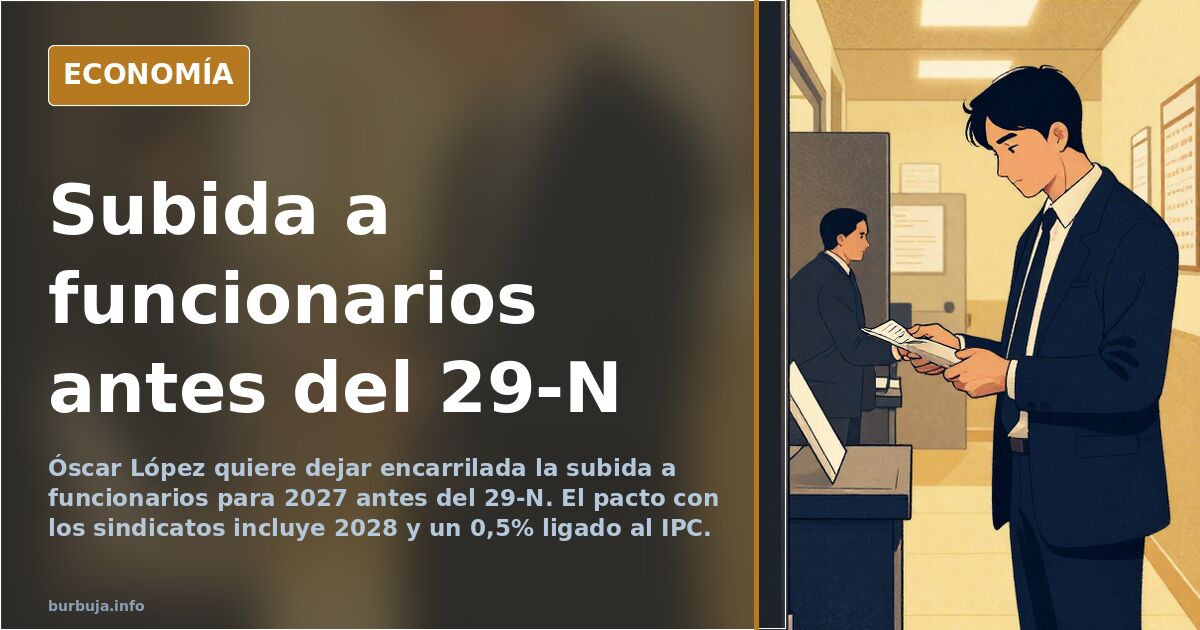
Spain aims to approve 4.5% civil servant raise before Nov 29 vote
What good is a 4.5% increase when inflation runs at 5%? This question haunts the announcement by Óscar López, Spain’s Minister for Digital Transformation and Public Function, who promised to do "everything possible" to secure the salary hike for 3.5 million public employees before the general elections on November 29. The rise applies to 2027 and 2028, already agreed with unions but pending implementation via royal decree. The timing is no accident: the executive wants to finalize the remuneration deal before voters decide.
The 4.5% cut short by income tax and CPI
The agreement includes a 4.5% rise for 2027, plus an additional 0.5% linked to 2026 inflation. On paper, the increase seems generous. In practice, the calculation deflates. According to estimates circulating among stakeholders, the 4.5% is taxed at the marginal income tax rate (IRPF), meaning the Treasury recovers nearly 38% of the gain. The net rise would drop to around 2.79%, well below the estimated 5% inflation rate. The result is a loss of purchasing power that the nominal increase fails to offset.
Recent history reinforces this sentiment. In 2026, a 2% rise was agreed while the Consumer Price Index (CPI) climbed to 5%, with a clause adding only 0.5% if inflation exceeded 1.5%. That meant a final 2% against a real 5%. Cumulative losses drag year after year, and the new deal does not break this dynamic.
Election calendar dictates the pace of the raise
Implementation of these increases has trinc the political calendar. In 2025, the revaluation was paid in December with arrears, after months of frozen salaries. In 2026, some public employees did not see the increase until July. For 2027, the government wants the royal decree ready before November 29, effective from January. Some argue this is an electoral measure: accelerating what benefits them before voting and leaving the rest for later.
Critics claim the true objective is buying the votes of public employees with a raise that, in real terms, does not recover lost ground. Others note that unions UGT and CCOO agreed to these conditions despite limited bargaining power. The debate over whether the deal is sufficient or merely a patch overlaps with distrust toward the executive.
Inflation eats the increase; dignity is not negotiable
Among civil servants, opinions are divided. Some view the raise as charity, arguing their dignity cannot be bought with a 4.5% increase that doesn’t even match the CPI. Others admit that, faced with the alternative of a government promising drastic cuts, they prefer to secure what was agreed. The phrase "the country is going to hell, but it’s the best option if you look out for yourself" sums up this uncomfortable pragmatism.
The underlying debate is whether these raises reflect a serious remuneration policy or a pre-election image operation. With budgets extended and uncertainty surrounding Muface (the mutual insurance fund for civil servants), public employees face the year with frozen salaries and a promise of a delayed, tax-reduced increase.
Ultimately, the question isn’t whether the government keeps its word, but whether a 4.5% raise that halves after taxes and lags behind inflation serves any purpose other than dressing up data before the polls. As almost always, the answer will come from the shopping basket.
What good is a 4.5% increase when inflation runs at 5%? This question haunts the announcement by Óscar López, Spain’s Minister for Digital Transformation and Public Function, who promised to do "everything possible" to secure the salary hike for 3.5 million public employees before the general elections on November 29. The rise applies to 2027 and 2028, already agreed with unions but pending implementation via royal decree. The timing is no accident: the executive wants to finalize the remuneration deal before voters decide.
The 4.5% cut short by income tax and CPI
The agreement includes a 4.5% rise for 2027, plus an additional 0.5% linked to 2026 inflation. On paper, the increase seems generous. In practice, the calculation deflates. According to estimates circulating among stakeholders, the 4.5% is taxed at the marginal income tax rate (IRPF), meaning the Treasury recovers nearly 38% of the gain. The net rise would drop to around 2.79%, well below the estimated 5% inflation rate. The result is a loss of purchasing power that the nominal increase fails to offset.
Recent history reinforces this sentiment. In 2026, a 2% rise was agreed while the Consumer Price Index (CPI) climbed to 5%, with a clause adding only 0.5% if inflation exceeded 1.5%. That meant a final 2% against a real 5%. Cumulative losses drag year after year, and the new deal does not break this dynamic.
Election calendar dictates the pace of the raise
Implementation of these increases has trinc the political calendar. In 2025, the revaluation was paid in December with arrears, after months of frozen salaries. In 2026, some public employees did not see the increase until July. For 2027, the government wants the royal decree ready before November 29, effective from January. Some argue this is an electoral measure: accelerating what benefits them before voting and leaving the rest for later.
Critics claim the true objective is buying the votes of public employees with a raise that, in real terms, does not recover lost ground. Others note that unions UGT and CCOO agreed to these conditions despite limited bargaining power. The debate over whether the deal is sufficient or merely a patch overlaps with distrust toward the executive.
Inflation eats the increase; dignity is not negotiable
Among civil servants, opinions are divided. Some view the raise as charity, arguing their dignity cannot be bought with a 4.5% increase that doesn’t even match the CPI. Others admit that, faced with the alternative of a government promising drastic cuts, they prefer to secure what was agreed. The phrase "the country is going to hell, but it’s the best option if you look out for yourself" sums up this uncomfortable pragmatism.
The underlying debate is whether these raises reflect a serious remuneration policy or a pre-election image operation. With budgets extended and uncertainty surrounding Muface (the mutual insurance fund for civil servants), public employees face the year with frozen salaries and a promise of a delayed, tax-reduced increase.
Ultimately, the question isn’t whether the government keeps its word, but whether a 4.5% raise that halves after taxes and lags behind inflation serves any purpose other than dressing up data before the polls. As almost always, the answer will come from the shopping basket.
Summary of a discussion on Burbuja.info - Foro de economía, actualidad y política., translated from Spanish and reviewed before publication. Read the full discussion (38 replies).
More summaries
-
Spain's Civil Servant Health Scheme Faces Split Over Public System
Debate over Muface pits those calling for its abolition against warnings of added pressure on Spain's public healthcare.
-
Muface: Clashing figures on shift to Spain's public health
Muface covers 1.5 million civil servants, with over a million in private insurers. The actual transfer to Spain's public healthcare would affect just over one million.
-
Blue Face on Spanish Show Horizonte Sparks Murder Accusations
Bea Talegón's blue face on Horizonte triggers murder accusations online after Maricarmen's death, boosting viewership.
-
La Razón MADMAX Scenario Sparks Economic Debate
Economic forum debates La Razón's MADMAX scenario: a calculation on the 31% bond, falling consumption and empty shelves.
-
Forum debate on Alejandro Sanz and Stephanie Cayo age gap
A forum thread discusses the age difference between Alejandro Sanz and Stephanie Cayo, highlighting alleged hypocrisy among left-wing figures.
-
Forum User Warns of European Rationing Within Weeks
A forum participant warns that geopolitical tensions in the Gulf, Ukraine and Asia could lead to food rationing in Europe within weeks.