
Spain's contrail debate: geoengineering, patents, and drought
Satellite data links persistent contrails over Spain to fuel additive patents, with no instrumental evidence.
English · Original discussion in Spanish · Published
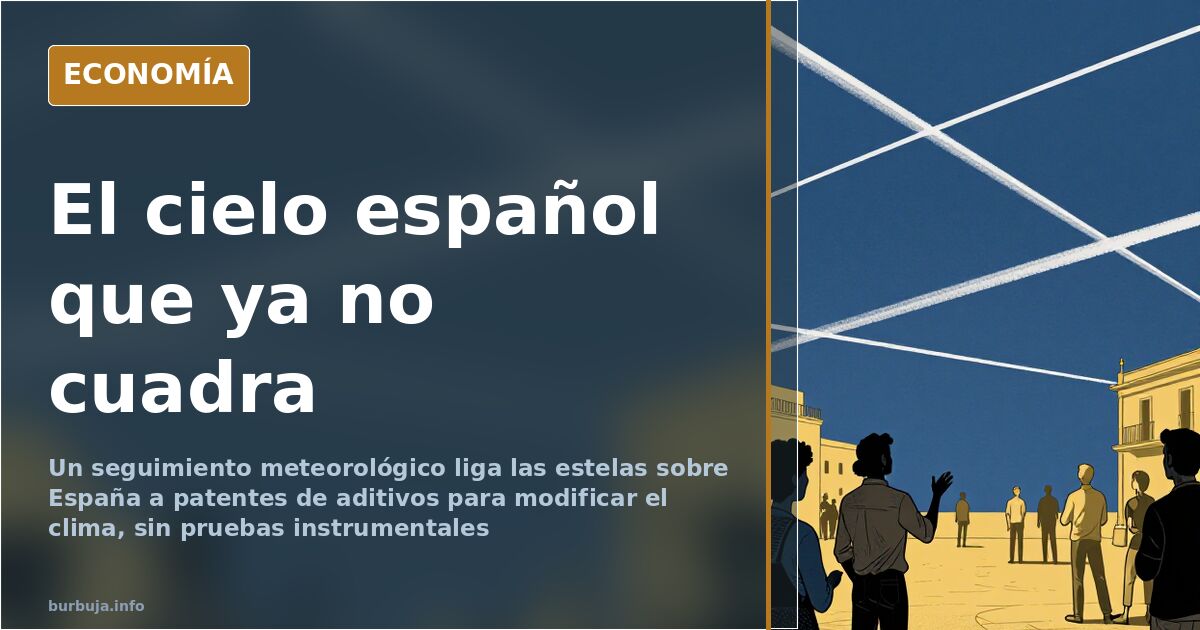
Geoengineering over the peninsula: the sky that no longer adds up
The sky over the Iberian Peninsula no longer looks like it used to. At least, not to those who watch it daily. A meteorological tracking system spanning several days claims that two counterclockwise moisture streams—one from the Caribbean, another between Greenland and Iceland—converge over Spain, dumping rain on the northwest while a clockwise circulation zone, bounded by the Azores and the Canary Islands, acts as a barrier. The atmospheric description is meticulous. The interpretation is far less so.
It all starts with satellite and radar images. On one side, a small, moisture-laden cloud formation that recharges from the south and shoots directly toward the peninsula. On the other, a medium-sized, less compact but equally defined formation sending its own stream. The two converge over the territory, though the meeting point shifts eastward while the western stream continues to batter Galicia. It rained there all day.
So far, textbook meteorology: two atmospheric rivers and a blocking high. The leap in category comes next. This same pattern is read as proof of alleged geoengineering targeting Spain, supported by three pillars: contrails, fuel additive patents, and the drought choking Catalonia.
Why discuss geoengineering and not just rain?
The leap from observation to suspicion hinges on contrails. One account describes a plane crossing the sky over Las Palmas at an angle inconsistent with standard commercial routes, suggesting such episodes occur more frequently now. The implied correlation is simple: every time they appear, the temperature the next day doesn't drop below 30 degrees. Another witness claims these contrails form only above cloud masses, never below, and that skies clear and temperatures jump sharply afterward.
The conventional explanation is less cinematic. Persistent contrails depend on relative humidity and temperature aloft, not additives, and air traffic generates thousands daily. That a flight-tracking app shows no aircraft doesn't imply a clandestine flight: open data has incomplete coverage. Still, the underlying complaint has an uncomfortable point. Forecasts from AEMET (Spain's State Meteorological Agency) and TV maps barely explain what is actually happening up there.
Patents for climate-modifying additives
The documentary pillar of the theory involves two U.S. patents, US3630950A and USRE29142E, registered as fuel compositions for generating aerosols aimed at weather control and modification. One describes a hygroscopic solid—capable of absorbing air moisture—that doesn't participate in combustion and can be added in proportions up to 40%, producing finely dispersed aerosol smoke. A paper on graphene oxide in aviation fuels is also cited.
The data is real and one click away. The inference fails. A patent proves someone imagined the procedure and paid to protect it, not that a fleet executes it continentally. This basic distinction is crossed repeatedly in the debate, separating intellectual property registration from an ongoing operation.
What does Catalonia's drought have to do with contrails?
Catalonia enters the equation via restrictions. Water-saving measures—termed restrictions—are applied in the Barcelona metropolitan area, with enforcement left to municipalities. Water pressure has already been reduced in some areas. Catalonia wakes up, summarizes one message.
The temporal coincidence between persistent contrail episodes and lack of rain fuels the hypothesis. There is no instrumental measurement supporting it: no comparative precipitation series, no chemical air analysis, no cross-referenced flight records. Correlation and causality are confused again, this time with the tap at stake.
Air traffic at record highs and flights too cheap
The aviation context adds fuel. It is claimed that air traffic over Europe is at historic highs, flights remain too cheap, encouraging more travel than ever, contradicting declared emission reduction goals. From this springs the suspicion that something more than kerosene is added to fuel, leading to two studies linking aerosolized coal ash to lung cancer and neurodegenerative diseases.
These are cited documents, not conclusions applicable here, coexisting with an uncomfortable fact for both sides: drought and water restrictions have well-documented climatic explanations, needing no additives. No one has yet presented fuel analysis, air filters, or spectrometric measurements supporting otherwise.
With accumulated observation days and no instrumental series published, the matter is likely to stay put: more contrails, more satellite captures, no conclusive proof in either direction. Meteorology will continue explaining streams and drought with models few dispute. And the sky, meanwhile, will keep resembling less and less the childhood sky of those who watch it.
The sky over the Iberian Peninsula no longer looks like it used to. At least, not to those who watch it daily. A meteorological tracking system spanning several days claims that two counterclockwise moisture streams—one from the Caribbean, another between Greenland and Iceland—converge over Spain, dumping rain on the northwest while a clockwise circulation zone, bounded by the Azores and the Canary Islands, acts as a barrier. The atmospheric description is meticulous. The interpretation is far less so.
It all starts with satellite and radar images. On one side, a small, moisture-laden cloud formation that recharges from the south and shoots directly toward the peninsula. On the other, a medium-sized, less compact but equally defined formation sending its own stream. The two converge over the territory, though the meeting point shifts eastward while the western stream continues to batter Galicia. It rained there all day.
So far, textbook meteorology: two atmospheric rivers and a blocking high. The leap in category comes next. This same pattern is read as proof of alleged geoengineering targeting Spain, supported by three pillars: contrails, fuel additive patents, and the drought choking Catalonia.
Why discuss geoengineering and not just rain?
The leap from observation to suspicion hinges on contrails. One account describes a plane crossing the sky over Las Palmas at an angle inconsistent with standard commercial routes, suggesting such episodes occur more frequently now. The implied correlation is simple: every time they appear, the temperature the next day doesn't drop below 30 degrees. Another witness claims these contrails form only above cloud masses, never below, and that skies clear and temperatures jump sharply afterward.
The conventional explanation is less cinematic. Persistent contrails depend on relative humidity and temperature aloft, not additives, and air traffic generates thousands daily. That a flight-tracking app shows no aircraft doesn't imply a clandestine flight: open data has incomplete coverage. Still, the underlying complaint has an uncomfortable point. Forecasts from AEMET (Spain's State Meteorological Agency) and TV maps barely explain what is actually happening up there.
Patents for climate-modifying additives
The documentary pillar of the theory involves two U.S. patents, US3630950A and USRE29142E, registered as fuel compositions for generating aerosols aimed at weather control and modification. One describes a hygroscopic solid—capable of absorbing air moisture—that doesn't participate in combustion and can be added in proportions up to 40%, producing finely dispersed aerosol smoke. A paper on graphene oxide in aviation fuels is also cited.
The data is real and one click away. The inference fails. A patent proves someone imagined the procedure and paid to protect it, not that a fleet executes it continentally. This basic distinction is crossed repeatedly in the debate, separating intellectual property registration from an ongoing operation.
What does Catalonia's drought have to do with contrails?
Catalonia enters the equation via restrictions. Water-saving measures—termed restrictions—are applied in the Barcelona metropolitan area, with enforcement left to municipalities. Water pressure has already been reduced in some areas. Catalonia wakes up, summarizes one message.
The temporal coincidence between persistent contrail episodes and lack of rain fuels the hypothesis. There is no instrumental measurement supporting it: no comparative precipitation series, no chemical air analysis, no cross-referenced flight records. Correlation and causality are confused again, this time with the tap at stake.
Air traffic at record highs and flights too cheap
The aviation context adds fuel. It is claimed that air traffic over Europe is at historic highs, flights remain too cheap, encouraging more travel than ever, contradicting declared emission reduction goals. From this springs the suspicion that something more than kerosene is added to fuel, leading to two studies linking aerosolized coal ash to lung cancer and neurodegenerative diseases.
These are cited documents, not conclusions applicable here, coexisting with an uncomfortable fact for both sides: drought and water restrictions have well-documented climatic explanations, needing no additives. No one has yet presented fuel analysis, air filters, or spectrometric measurements supporting otherwise.
With accumulated observation days and no instrumental series published, the matter is likely to stay put: more contrails, more satellite captures, no conclusive proof in either direction. Meteorology will continue explaining streams and drought with models few dispute. And the sky, meanwhile, will keep resembling less and less the childhood sky of those who watch it.
Summary of a discussion on Burbuja.info - Foro de economía, actualidad y política., translated from Spanish and reviewed before publication. Read the full discussion (280 replies).
More summaries
-
Sánchez's China alliance for a Canary Islands logistics base
Debate over Pedro Sánchez's potential deal with China for a logistics hub in the Canary Islands, raising sovereignty and geopolitical concerns.
-
Teacher reveals salary: €2,000 net per month with 15 payments
Debate over whether €2,000 net per month is a high salary for a secondary school teacher in Spain, compared with the cost of living and workload.
-
Lleida coach crash: the hidden costs of untrained hiring
A Lleida coach crash injured 54 people, including an amputated instructor, exposing flaws in public transport hiring and ESG criteria prioritization over safety.
-
Telefónica AI Director Hired at 25: Merit or Connections?
Analysis of the appointment of Telefónica's 25-year-old AI director, highlighting the debate between meritocracy and nepotism in corporate hiring.
-
Athletes and Musicians: Money or Social Status?
Analysis of the links between high-profile athletes and musicians: is it financial power or social status driving these relationships?
-
Decathlon: Imminent Bankruptcy or Margin Adjustment?
Analysis of Decathlon's situation: bankruptcy or price adjustment? Examining pressures from AliExpress and the decline of the low-cost model.