
Fans Campaign to Repatriate Daniel Sancho for Reality TV Deal
The #FreeDanielSancho movement demands his release and a 24/7 reality show contract with Mediaset, turning a Thai prison case into a global media spectacle.
English · Original discussion in Spanish · Published
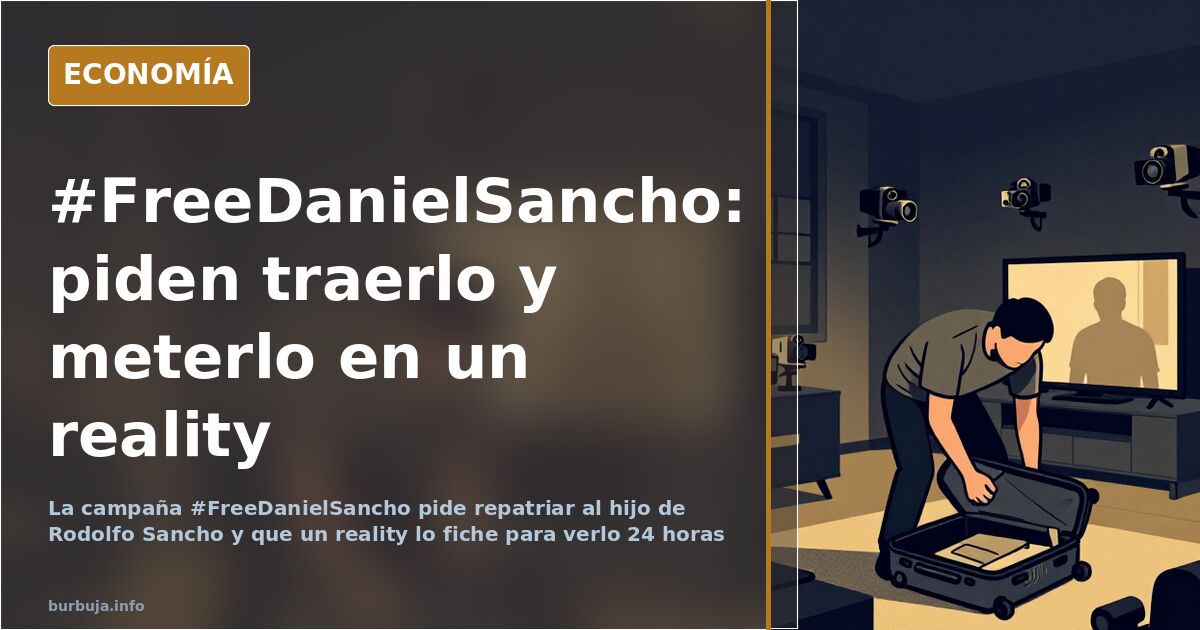
Fans campaign to bring Daniel Sancho to a reality show
According to messages circulating in the thread, a Thai court has already issued a verdict, which, in any other case, would have closed the curtain, but has instead amplified the noise. Around the case of Rodolfo Sancho's son, an organized community has grown on social media under the hashtag #FreeDanielSancho, demanding his release, repatriation, and handover to Mediaset. The request literally includes having a cohabitation program sign him to watch him 24 hours a day.
Behind the hashtag is a fan club created to coordinate pressure and maintain the inmate's innocence. The trinc profile is drawn effortlessly: an intensive consumer of Telecinco's reality shows, with abundant free time and the capacity to obsess over strangers 24 hours a day. The community declares itself supportive of the Mohedano family and opposed to the Carrasco family, two television dynasties, and moves with the ease of someone who has been voting on sets for decades.
What exactly does the #FreeDanielSancho campaign demand?
Three things. Release, repatriation, and delivery to television. The underlying argument is that Spain is a country where sustained indignation ends up twisting wills, and that Thailand cannot afford a diplomatic incident with such a mobilized public opinion. The campaign's own narrative states without mincing words: supporters would have 24 hours a day to obsess over strangers and are collecting evidence to dismantle the Thai investigation.
The pressure has specific targets. There are calls to a political party to bring back the inmate, and a widely circulated message claims that those who pay and blackmail for sens end up paying for it. The cultural sphere has also spoken: columnist Salvador Sostres dedicated a text to him that later disappeared from the media and can only be found, according to shared traces, in a publication by Pedro J. Ramírez's group and in two mentions in Catalan press. The withdrawal of the article has become a subgenre of the case.
Threats, settling scores, and the missing $90,000
The defensive narrative has changed. First came the threats: if the accused acted under coercion, the framework of the case shifts. Then came the hypothesis of a settlement between drug traffickers and the suggestion that the detainee was forced to incriminate himself. According to this version, the verdict is already issued, but the campaign works on appeals: its declared goal is to install reasonable doubt, not to reopen the trial in Thai courts.
The most repeated detail is the money. According to a message in the thread, $90,000 disappeared from the room, and only $8,000 remained in the final count. The gap is read as proof that something went wrong in the chain of custody or that someone kept the difference. It is also discussed that the cause of death is not fixed and that the confession, according to this version, may not have been entirely free. A Muay Thai monitor declared that the detainee is a normal and educated boy, a phrase the community has turned into a headline.
Not everyone trinc the case buys the framework. One part maintains that the confession exists, there is incriminating evidence, and the campaign relies on accessory details to divert attention from the essential. Another current, less noisy, recalls that doubts about the cause of death have sustained firm convictions in other cases without a body, and that the comparison helps no one.
«Guapofobia» as a legal argument
There is an axis of the debate that is not judicial but aesthetic. A part of the supporters claims that the accused is suffering hostile treatment due to his attractiveness, and has dubbed the phenomenon guapofobia. The thesis, according to its defenders, is that his physique generates a difficult-to-confess resentment: comparisons with classical beauty, references to supposed physical superiority, and an open war between abundant hair and baldness, between the worked body and the flabby belly.
The argument has become a low-intensity cultural battle. From this trench, the case is described as a clash between beauty and ugliness, with forensic reality in the background. According to messages in the thread, the campaign even jokes about an organized payout to satisfy a supposed demand of 37 million Spaniards over 18: a satirical calculation sets 8,000 people daily for 12 years as the necessary logistics, and proposes using the proceeds to pay legal costs.
Pressure as a bargaining chip
On the other end are those who read the case as an example of what money and media influence achieve. A prediction in the thread is that the inmate will not be executed: he will eventually be diagnosed with some pathology and extradited to Spain. It is not a legal thesis, but a reading of how the system works, and it coincides with the suspicion that the campaign, rather than helping, is clouding things.
Here lies the limit of the issue. The victim's family barely occupies space in the noise, and a part of those observing the phenomenon considers it a disrespectful difficulty to digest. There is also who warns of a contrary effect: agitating public opinion against the Thai justice system may harden the response of a country that has no incentive to bend to a hashtag.
What no one disputes anymore is the volume. A crime case has transformed into an entertainment product with a fixed audience, involuntary sponsors, and a community of trinc. The question is how much of this survives the next judicial resolution and how much becomes another format on the schedule. For now, the only certainty is that the inmate remains in Thailand and that the campaign continues to tally accounts.
According to messages circulating in the thread, a Thai court has already issued a verdict, which, in any other case, would have closed the curtain, but has instead amplified the noise. Around the case of Rodolfo Sancho's son, an organized community has grown on social media under the hashtag #FreeDanielSancho, demanding his release, repatriation, and handover to Mediaset. The request literally includes having a cohabitation program sign him to watch him 24 hours a day.
Behind the hashtag is a fan club created to coordinate pressure and maintain the inmate's innocence. The trinc profile is drawn effortlessly: an intensive consumer of Telecinco's reality shows, with abundant free time and the capacity to obsess over strangers 24 hours a day. The community declares itself supportive of the Mohedano family and opposed to the Carrasco family, two television dynasties, and moves with the ease of someone who has been voting on sets for decades.
What exactly does the #FreeDanielSancho campaign demand?
Three things. Release, repatriation, and delivery to television. The underlying argument is that Spain is a country where sustained indignation ends up twisting wills, and that Thailand cannot afford a diplomatic incident with such a mobilized public opinion. The campaign's own narrative states without mincing words: supporters would have 24 hours a day to obsess over strangers and are collecting evidence to dismantle the Thai investigation.
The pressure has specific targets. There are calls to a political party to bring back the inmate, and a widely circulated message claims that those who pay and blackmail for sens end up paying for it. The cultural sphere has also spoken: columnist Salvador Sostres dedicated a text to him that later disappeared from the media and can only be found, according to shared traces, in a publication by Pedro J. Ramírez's group and in two mentions in Catalan press. The withdrawal of the article has become a subgenre of the case.
Threats, settling scores, and the missing $90,000
The defensive narrative has changed. First came the threats: if the accused acted under coercion, the framework of the case shifts. Then came the hypothesis of a settlement between drug traffickers and the suggestion that the detainee was forced to incriminate himself. According to this version, the verdict is already issued, but the campaign works on appeals: its declared goal is to install reasonable doubt, not to reopen the trial in Thai courts.
The most repeated detail is the money. According to a message in the thread, $90,000 disappeared from the room, and only $8,000 remained in the final count. The gap is read as proof that something went wrong in the chain of custody or that someone kept the difference. It is also discussed that the cause of death is not fixed and that the confession, according to this version, may not have been entirely free. A Muay Thai monitor declared that the detainee is a normal and educated boy, a phrase the community has turned into a headline.
Not everyone trinc the case buys the framework. One part maintains that the confession exists, there is incriminating evidence, and the campaign relies on accessory details to divert attention from the essential. Another current, less noisy, recalls that doubts about the cause of death have sustained firm convictions in other cases without a body, and that the comparison helps no one.
«Guapofobia» as a legal argument
There is an axis of the debate that is not judicial but aesthetic. A part of the supporters claims that the accused is suffering hostile treatment due to his attractiveness, and has dubbed the phenomenon guapofobia. The thesis, according to its defenders, is that his physique generates a difficult-to-confess resentment: comparisons with classical beauty, references to supposed physical superiority, and an open war between abundant hair and baldness, between the worked body and the flabby belly.
The argument has become a low-intensity cultural battle. From this trench, the case is described as a clash between beauty and ugliness, with forensic reality in the background. According to messages in the thread, the campaign even jokes about an organized payout to satisfy a supposed demand of 37 million Spaniards over 18: a satirical calculation sets 8,000 people daily for 12 years as the necessary logistics, and proposes using the proceeds to pay legal costs.
Pressure as a bargaining chip
On the other end are those who read the case as an example of what money and media influence achieve. A prediction in the thread is that the inmate will not be executed: he will eventually be diagnosed with some pathology and extradited to Spain. It is not a legal thesis, but a reading of how the system works, and it coincides with the suspicion that the campaign, rather than helping, is clouding things.
Here lies the limit of the issue. The victim's family barely occupies space in the noise, and a part of those observing the phenomenon considers it a disrespectful difficulty to digest. There is also who warns of a contrary effect: agitating public opinion against the Thai justice system may harden the response of a country that has no incentive to bend to a hashtag.
What no one disputes anymore is the volume. A crime case has transformed into an entertainment product with a fixed audience, involuntary sponsors, and a community of trinc. The question is how much of this survives the next judicial resolution and how much becomes another format on the schedule. For now, the only certainty is that the inmate remains in Thailand and that the campaign continues to tally accounts.
Summary of a discussion on Burbuja.info - Foro de economía, actualidad y política., translated from Spanish and reviewed before publication. Read the full discussion (280 replies).
More summaries
-
Daniel Sancho appeals Thailand life sentence, citing accident
Daniel Sancho appeals his life sentence in Thailand for the death of Edwin Arrieta, while the victim’s family now demands the death penalty.
-
Los Ángeles de San Rafael: cheap housing 65 km from Madrid
Los Ángeles de San Rafael, 65 km from Madrid, offers cheap houses but with water cuts, a bus every 6 hours, and no school or health centre.
-
Spain plans 400,000 new civil service posts to match OECD average
Public Function estimates 400,000 jobs needed to reach 18% of employment, matching the OECD average, while critics warn of rising debt costs.
-
How to Survive a Carotid Restraint in Five Seconds
A recent attack in Barcelona highlights the danger of the carotid restraint. Learn why reaction time is critical and discover effective self-defense techniques against this lethal hold.
-
Spain Sells Olive Oil Abroad at €4.70 While Domestic Price Hits €10
Olive oil costs €10 per liter in Spain, compared to €4.70 in Ireland. This disparity reignites debates on exports and free market dynamics.
-
Tech firms offer 14k euros while claiming talent shortage
Companies posting 14,000 euro salaries demand language skills and IT expertise, sparking debate over whether Spain faces a real talent shortage or simply refuses to pay competitive wages.