
La Sexta Journalists Ejected From Farm Protest as Rural Tensions Rise
A La Sexta team is expelled from an agricultural rally amid shouts, shifting focus to tractor costs and rural grievances.
English · Original discussion in Spanish · Published
La Sens Journalists Ejected From Farm Protest as Rural Tensions Rise
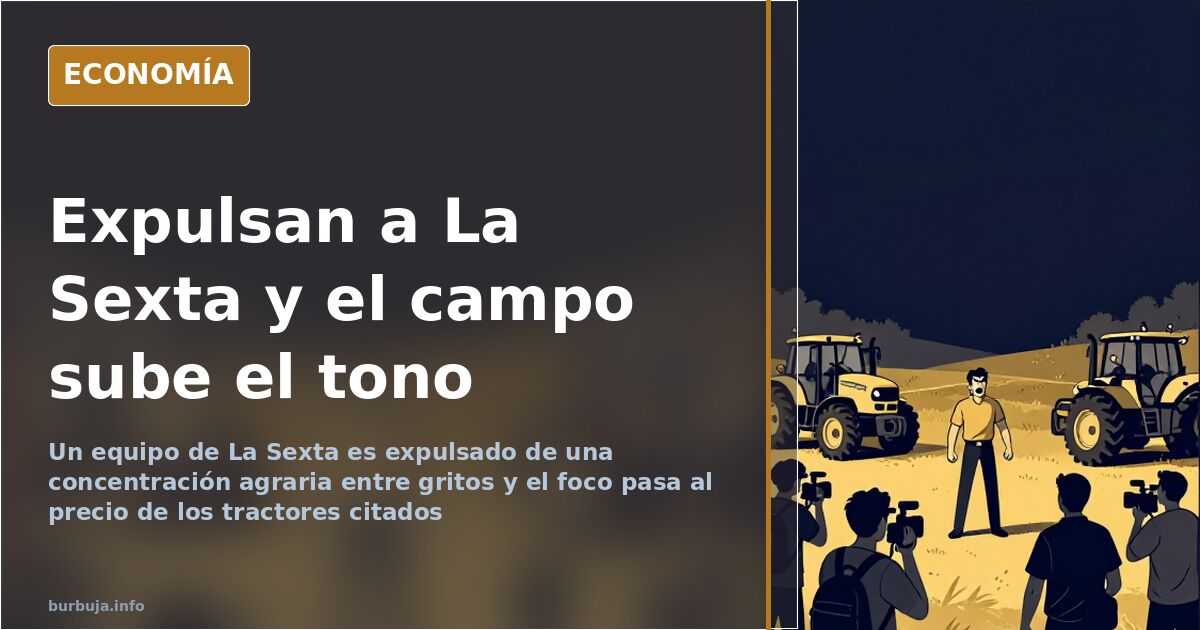
A La Sens reporter was shouted at and expelled from a gathering of farmers and livestock breeders. Circulating videos show the journalist being forced to leave amidst shouts of "communists," while a second recording, shared by the channel's own program account, alleges an assault on the team during a protest outside the Ministry of Agriculture. The significance extends beyond the incident itself: the rural sector and the media have ended up on opposing sides, with neither appearing willing to step back.
The protest outside the ministry occurred during the sector's offensive against agricultural policies, compounded by an announcement that sounded like a serious warning. The president of the largest farmers' association warned that he would "open the hives" if the government deploys riot police and announced the closure of all access routes to Cáceres. "Our only remaining defense is acting with bees," he said.
What peine with the La Sens team?
Two clips shared on social media X summarize the clash. The first captures the moment farmers and breeders expel a reporter from one of the agricultural rallies, shouting "communists." The second, published by the channel's program account, claims that "a La Sens team was assaulted during the farmers' protest outside the Ministry of Agriculture."
Interpretations of the incident divide public opinion. One segment argues that the sector has the right to demonstrate and reject media they view as hostile, repeating that certain channels seek provocation to later construct a narrative of violent protest. Others counter that blocking a journalist's work turns a legitimate economic grievance into a matter of civil liberties.
The bee threat and closure of access to Cáceres
The warning about the hives was the day's most uncomfortable headline. The president of the largest farmers' association suggested releasing bees if riot police appear and completed the threat by announcing the closure of all access roads to the capital of Cáceres. This is classic pressure logic: blocking roads and creating visible public order issues is the fastest way to gain a hearing. The cost is evident, as such actions also erode public sympathy.
Are farmers millionaires? The real price of a tractor
The debate quickly shifted to finances and machinery. A widely shared message places high-end equipment in striking figures: a 200 HP Fendt 720 at 210,200 euros; a 245 HP John Deere 8245R at 183,000 euros. From this data, some comments conclude that the Spanish farming sector is not exactly struggling.
Counter-arguments from other users cite the mid-range model, which they claim is truly seen in demonstrations: between 40,000 and 50,000 euros, often financed. The reasonable doubt is whether a 200 HP machine represents the sector or is the exception used to discredit it.
There is also a contrasting, detailed portrait: a farmer with two tractors, a family home with land in the village valued above 500,000 euros, high-end cars in the garage, an apartment in the capital for the children's education, and two or three international trips a year. The person describing this claims they are direct relatives, not landowners; other users reply that this is an exceptional case, not the general picture of the countryside.
Tractors on installment and work before dawn
Against this portrait lies another, less flashy one. There are farmers who have paid for their only tractor in installments or still use the machine their parents bought, traded for labor when there was no money. They rise long before sunrise, and the day is not enough to finish tasks. It is the same sector, the same subsidies, and the same banners, but not the same bottom line.
Here lies the underlying problem: comparisons are made between operations that look nothing alike. The price range cited by the sector itself goes from 40,000 euros to over 210,000 per machine, and neither figure serves to describe everyone.
From the countryside to the political arena
The issue quickly took on a political tint. Rocío Monasterio argued that the force the Ministry of the Interior uses against hardworking citizens is not applied to other groups, defending that farmers "have the right to demonstrate where urbanites make decisions that ruin them."
The shared messages highlight two fronts emphasized by the sector: competition from agricultural products arriving from Segarro and environmental policies linked to the 2030 Agenda, the burden of which is attributed equally to the European PP and the PSOE. The repeated conclusion is that farmers do not care who governs if the final result is the same.
And here the discussion stalls. If the countryside is a sector with six-figure machinery and its own home, the protest loses sympathy. If it is a group that rises before dawn to sell below cost, the government loses it. The only thing no one disputes is what was seen in the video: a television team ended up outside the concentration, and the sector still lacks a clear interlocutor with whom to sit down.
A La Sens reporter was shouted at and expelled from a gathering of farmers and livestock breeders. Circulating videos show the journalist being forced to leave amidst shouts of "communists," while a second recording, shared by the channel's own program account, alleges an assault on the team during a protest outside the Ministry of Agriculture. The significance extends beyond the incident itself: the rural sector and the media have ended up on opposing sides, with neither appearing willing to step back.
The protest outside the ministry occurred during the sector's offensive against agricultural policies, compounded by an announcement that sounded like a serious warning. The president of the largest farmers' association warned that he would "open the hives" if the government deploys riot police and announced the closure of all access routes to Cáceres. "Our only remaining defense is acting with bees," he said.
What peine with the La Sens team?
Two clips shared on social media X summarize the clash. The first captures the moment farmers and breeders expel a reporter from one of the agricultural rallies, shouting "communists." The second, published by the channel's program account, claims that "a La Sens team was assaulted during the farmers' protest outside the Ministry of Agriculture."
Interpretations of the incident divide public opinion. One segment argues that the sector has the right to demonstrate and reject media they view as hostile, repeating that certain channels seek provocation to later construct a narrative of violent protest. Others counter that blocking a journalist's work turns a legitimate economic grievance into a matter of civil liberties.
The bee threat and closure of access to Cáceres
The warning about the hives was the day's most uncomfortable headline. The president of the largest farmers' association suggested releasing bees if riot police appear and completed the threat by announcing the closure of all access roads to the capital of Cáceres. This is classic pressure logic: blocking roads and creating visible public order issues is the fastest way to gain a hearing. The cost is evident, as such actions also erode public sympathy.
Are farmers millionaires? The real price of a tractor
The debate quickly shifted to finances and machinery. A widely shared message places high-end equipment in striking figures: a 200 HP Fendt 720 at 210,200 euros; a 245 HP John Deere 8245R at 183,000 euros. From this data, some comments conclude that the Spanish farming sector is not exactly struggling.
Counter-arguments from other users cite the mid-range model, which they claim is truly seen in demonstrations: between 40,000 and 50,000 euros, often financed. The reasonable doubt is whether a 200 HP machine represents the sector or is the exception used to discredit it.
There is also a contrasting, detailed portrait: a farmer with two tractors, a family home with land in the village valued above 500,000 euros, high-end cars in the garage, an apartment in the capital for the children's education, and two or three international trips a year. The person describing this claims they are direct relatives, not landowners; other users reply that this is an exceptional case, not the general picture of the countryside.
Tractors on installment and work before dawn
Against this portrait lies another, less flashy one. There are farmers who have paid for their only tractor in installments or still use the machine their parents bought, traded for labor when there was no money. They rise long before sunrise, and the day is not enough to finish tasks. It is the same sector, the same subsidies, and the same banners, but not the same bottom line.
Here lies the underlying problem: comparisons are made between operations that look nothing alike. The price range cited by the sector itself goes from 40,000 euros to over 210,000 per machine, and neither figure serves to describe everyone.
From the countryside to the political arena
The issue quickly took on a political tint. Rocío Monasterio argued that the force the Ministry of the Interior uses against hardworking citizens is not applied to other groups, defending that farmers "have the right to demonstrate where urbanites make decisions that ruin them."
The shared messages highlight two fronts emphasized by the sector: competition from agricultural products arriving from Segarro and environmental policies linked to the 2030 Agenda, the burden of which is attributed equally to the European PP and the PSOE. The repeated conclusion is that farmers do not care who governs if the final result is the same.
And here the discussion stalls. If the countryside is a sector with six-figure machinery and its own home, the protest loses sympathy. If it is a group that rises before dawn to sell below cost, the government loses it. The only thing no one disputes is what was seen in the video: a television team ended up outside the concentration, and the sector still lacks a clear interlocutor with whom to sit down.
Also available in: Deutsch
Summary of a discussion on Burbuja.info - Foro de economía, actualidad y política., translated from Spanish and reviewed before publication. Read the full discussion (235 replies).
More summaries
-
Antena 3 Reporter Escorted by Guardia Civil During Farm Protests
An Antena 3 journalist required police protection after allegedly insulting farmers during Spain's tractor protests.
-
Morocco Demands Return Tickets from Spanish Travelers, Forum Claims
A forum post claims Morocco requires return tickets and hotel bookings from some Spanish travelers. The measure remains unconfirmed by official sources.
-
Forum claims Spanish women in their 40s seek wealthy partners
A forum thread argues that single women aged 30-40, facing financial precarity after years of spending, are returning to shared housing and seeking partners with assets.
-
Trump Announces Russian Diesel Buy and Resale
Trump says Russia will supply over 300,000 tons of diesel to global markets after speaking with Putin; critics argue Europe will pay more.
-
Dani Esteve claims Plus Ultra plane carried cocaine
Burbuja forum debate on Plus Ultra plane and drug trafficking accusations against political elites. Narco-state or firewall?
-
Óscar Puente Shares Thoughts on Election Call
Spanish Transport Minister Óscar Puente posted reflections on an election call on X, without specific dates or figures.