
Kupiansk video shows fatal error without hiding it
A soldier hides in a tiny room and is shot through the door. The Kupiansk combat footage circulates unedited, revealing the mistake.
English · Original discussion in Spanish · Published
Kupiansk: when combat footage reveals errors instead of hiding them
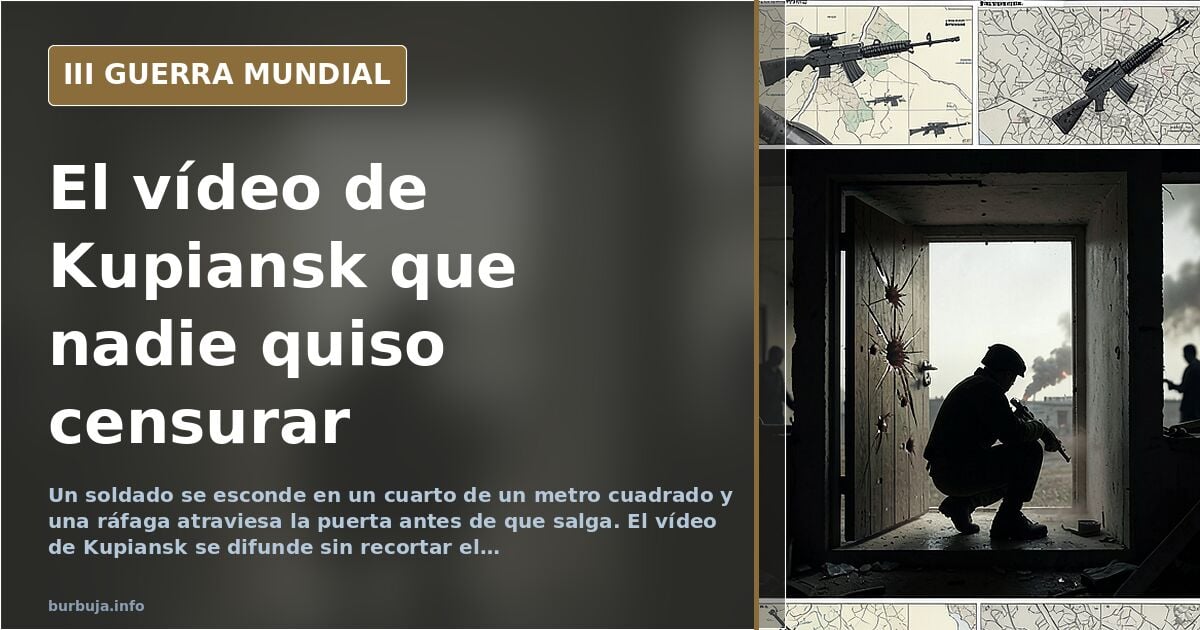
A soldier runs into a one-square-meter room. Seconds later, a burst of gunfire pierces the door before he opens it. This occurs in footage of the capture of Kupiansk released by a Ukrainian unit, antiestéticaturing helmet and chest cameras, rhythmic editing, and gunshots mixed with music. The material circulates and divides opinion: some see real urban combat; others, proof that an unarmed man was executed. Few discuss the most uncomfortable fact: the clip was published without cutting that fragment.
The piece is built to impress. Even defenders admit this. Subjective cameras, quick cuts, sustained tension. The result looks less like a documentary than an audiovisual product designed to make viewers feel the gunfire in their chests. Debate over the editing’s authorship—whether professional hands are behind it, if the style recalls other propaganda producers—remains open, but the intended effect does not: to impress.
What exactly is seen in the Kupiansk video?
The key fragment shows a man fleeing and taking refuge in a minimal space. Soldiers fire at the door before he emerges. For some viewers, this breaks any interpretation of accident: shooting before seeing inside means you are executing suspicion, not reacting to a threat. For others, the man wore dark uniforms, was not a civilian, and came from a prior exchange involving casualties. The discrepancy is not resolved by the footage.
Little dispute exists regarding the subsequent sequence. Soldiers continue firing when they should have identified the target. And the clip is broadcast as is. No one deleted it. This makes the video a double document: of what peine and of what the unit decided to show.
Civilian, soldier, and the unresolved doubt
Debate on the deceased’s identity has three coexisting versions. First: a pro-Russian civilian placed in the room and filmed afterward. Second: a straggler military officer without recognizable uniform who hid where he could. Third: a soldier forced to wear civilian clothes to justify the scene. None have proof in the material.
One detail appears and is often overlooked: before the episode, soldiers find a wounded person. Someone says to finish him off, but they shoot above him to scare him and ask his origin. He names a town. That wounded man survives. The contrast between the two cases—one spared, one killed through a door—is the strongest argument for those claiming no identification was possible in the second case.
Amphetamine and PTSD: the lingering hypothesis
Suspicion that frontline troops fight under stimulants pervades the conversation. No data supports this in the material, only the observation that maintaining such tension for hours has mental limits. It is posed as conjecture, not fact. What is stated more confidently is the long-term consequence: when the war ends, some appearing in these images will suffer post-traumatic stress disorder.
Automaticity is the key described by the material itself. In moments like these, the shooter does not reason: they are eyes and ears. The problem arises when automaticity persists after the brain should have processed that the target is no longer a threat.
Double standards in war crimes
The conversation shifts to broader accusations: that one side’s crimes are displayed while the other’s are fabricated. Episodes of Russian prisoners shot after surrendering and mistreatment of captives are mentioned, contrasting with montages attributed to the opposing side. There is no independent verification in the material, but the argument structure is clear: the same act changes severity depending on who commits it.
Criticism targets not just the shooter but a society consuming such content normally, applauding its own side’s harshness while demanding purity from the adversary. Violence cinema already trained us for this. The difference here is there is no script.
What the video reveals about command, not the soldier
Militarily, the clip shows a unit lacking basic instruction: shots fired over comrades, fire without identification, decisions made shouting. Changes in the area’s chain of command—a general replaced weeks earlier—are pointed to as a possible explanation for the lack of control. Debate also exists on whether the advance on Kupiansk resulted from an ordered enemy retreat or coordination failure.
The unanswered question is the simplest: who authorized publishing the fragment. If it was an editing error, someone corrected it late. If deliberate, the message was different: this is what we do and we don’t plan to hide it. Neither reading reflects well on the uploader.
Also available in: Deutsch
Summary of a discussion on Burbuja.info - Foro de economía, actualidad y política., translated from Spanish and reviewed before publication. Read the full discussion (80 replies).
More summaries
-
Strike on Novokuybyshevsk refinery puts 8.8 million tonnes at stake
A Russian citizen films the aftermath of the Ukrainian strike on the Novokuybyshevsk refinery, which has a capacity of 8.8 million tonnes of crude per year.
-
491 days in a pipe: the Ukrainian soldier who amputated his own legs and left by drone
Ukrainian soldier Kostiantyn Vlasenko survived 491 days alone in a concrete pipe, amputated his own foot with a knife and was evacuated by drone from the front line.
-
Russia's offensive stalls: 483 vehicles lost, fuel shortages spread
Russia loses 483 vehicles in a recent tally as half its refineries face downtime and gas lines grow. The war of attrition...
-
Spain TV Analyst Blames NATO for Ukraine War
A viral clip from La Sexta features analyst Rafael Poch-de-Feliu arguing that NATO expansion triggered the conflict, contradicting the mainstream narrative.
-
US-Russia Secret Deal Suspicions Rise Over Ukraine
Russia's rapid advance and NATO's slow response fuel suspicions of a secret US-Russia pact dividing Ukraine.
-
Ten signs of potential Russian attrition in Ukraine
Ten indicators, from scarce ammunition to low morale, suggest Russian wear in Ukraine, though total collapse is ruled out.