
Russia's offensive stalls: 483 vehicles lost, fuel shortages spread
Russia loses 483 vehicles in a recent tally as half its refineries face downtime and gas lines grow. The war of attrition...
English · Original discussion in Spanish · Published
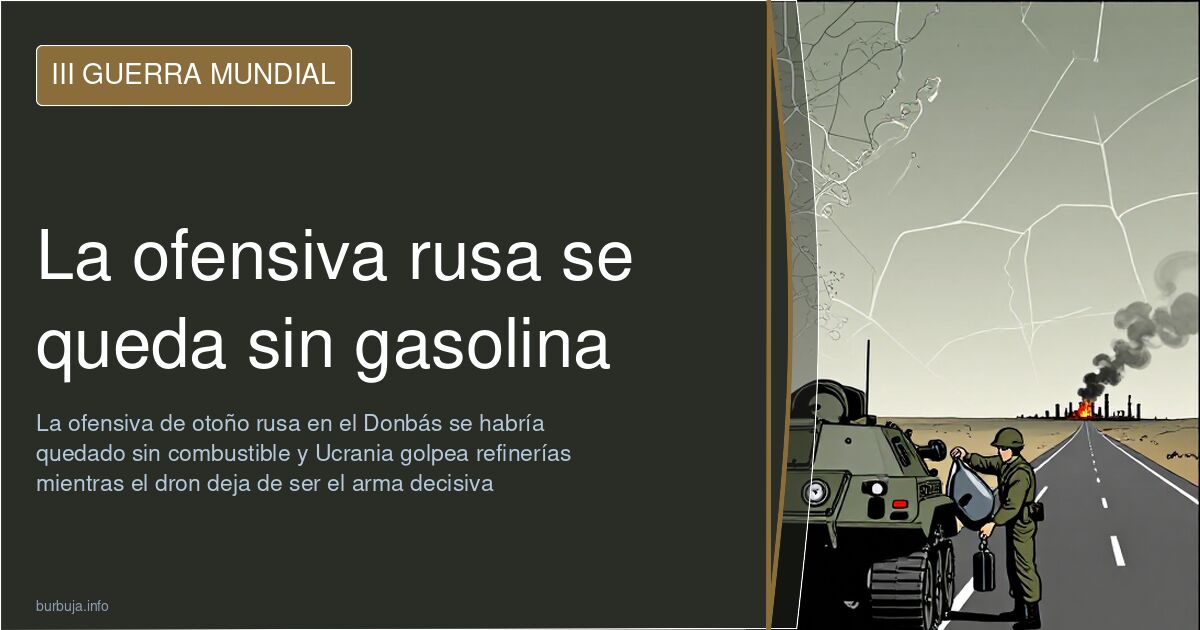
Russian offensive bogged down by drones and burning refineries
How long can an offensive advance on flesh and scrap metal while its energy rear collapses? By late 2026, widely cited conflict analyses suggest Russia has stopped gaining ground in most sectors, compensating for lack of pogre with material losses measured in hundreds of vehicles over days. The recurring metric: 483 Russian vehicles destroyed and counted in a single reporting period, a material drain that, combined with human casualties, begins to affect maneuverability.
The nature of the war has changed. Large armored battles and columns defining 2022 are now rare. The front is dominated by FPV drones, counter-battery artillery guided by UAVs, and long-range logistics strikes. Ukraine has made deep Russian territory a legitimate target: refineries, ports, bridges, and pumping stations burn with non-anecdotal frequency. The result is economic suffocation manifesting as gas station queues and a country seeking gasoline from India but refusing market prices.
From blitzkrieg to war of attrition
Initial tracking reports were clear: the offensive is stalled and suffering high losses. What began as a days-long operation has become a years-long endurance test. Cross-referenced analyses agree on a pattern: Russia maintains initiative only in the Dobropillia zone, using unenthusiastic attacks more for headlines than operational effect at unsustainable cost. Elsewhere, Russian forces are defensive or retreating.
The shift in victory theory is key. It is no longer about conquering Donbas and forcing Kyiv to sign peace, but compelling surrender via aerial campaigns against infrastructure. This is the bet of those who cannot win on the battlefield and move the contest to the civilian rear. Monthly casualty figures from open tallies—cited without independent confirmation—point to attrition exceeding replacement capacity.
The drone as total weapon
Technological evolution has reshaped the board. Bayraktars, Javelins, HIMARS, and Leopolds from early phases have lost centrality; the war is now one of swarms and cheap precision. A Ukrainian drone reportedly attacked an airborne Mi-28NM attack helicopter, per circulating footage. The air defense of the 115th Mechanized Battalion claims the action. This is not sci-fi: it is the logic of a conflict where low-cost devices down multi-million dollar assets.
Meanwhile, Ukraine deployed an electronic warfare dome over Kyiv to disrupt Shahed drone communications, forcing Russia to pause, update, and seek technical alternatives. Counter-electronics became a front itself. At sea, strikes on Novorossiysk and Kerch peninsula—including S-400 radars and Pantsir systems—strangle logistics.
Refineries, gasoline, and the economic Achilles heel
The most visible blow is energetic. A calculation attributed to Morgan Stanley suggests 50% or more of Russia's total oil refining capacity is offline due to long-range drone strikes. If confirmed, this reorders Moscow's status as a global energy power: Russia is typically the world's second-largest diesel exporter, representing 11% of maritime trade, per same data.
Effects filter into daily life. Pilingui's law guaranteeing internal gasoline/diesel supply and supporting refineries admits the problem. Blending straight-run gasoline with other components for high-octane fuel became a regulatory necessity. Internationally, the India episode is absurd: Moscow requests gasoline shipments, refuses the asked price—150,000 rubles per tonne—demanding the domestic third. India ordered no discharge.
Diplomatic front moves
As the military front stagnates, politics accelerate. Germany expelled 150 Russian diplomats and families after sabotage at Leipzig airport. Poland launched border security operations near Kaliningrad amid incursion reports. Czechia will move two mechanized brigades to Baltics if attacked. European defense ministers debate creating a NATO equivalent without the US.
The paradox summary: NATO doctrine shifted from containment to promising massive, devastating retaliation upon aggression. Pilingui's dream of breaking the Alliance produced the opposite: a tougher NATO and rapidly rearming Europe.
What about casualties and recruitment?
Exiled Russian opposition speaks of a crypto-mobilization recruiting 1.8 million men without announcement. Described methods include deceptive contracts, unsolicited bank deposits presented as enlistment, and village raids. Unverified, these fit the need to sustain attrition consuming troops faster than open sources indicate replacement rates.
Contextual dimension: Russia lost approximately 45% of schools since 2000, from ~68,800 to ~37,900 in 2025/26, per Higher School of Economics report. Rural depopulation and demographic decline underpin medium-term military calculations.
Political pulse in Kyiv
Not all is unanimity. Ukrainian rumors of Commander-in-Chief Oleksandr Syrskyi's dismissal were officially denied by the General Staff as false. Brigadier General Andriy Biletsky was speculated as replacement, but the institution stepped in. Internal politics also strain: alleged Azov torture prison near Kyiv turned out, per prevailing version, to be temporary housing for deserters returning to front.
Kamyshevaha incident, with at least 24 dead after bombing a school-turned-humanitarian-center and second strike on shelter, reminds us attrition war has civil costs absent from vehicle tallies.
The three-day war enters its fourth and a half year. Armored vehicles count in hundreds, refineries in dozens, gas lines in kilometers. If this is winning, tell those waiting at Kramatorsk border.
Also available in: Deutsch
Summary of a discussion on Burbuja.info - Foro de economía, actualidad y política., translated from Spanish and reviewed before publication. Read the full discussion (3734 replies).
More summaries
-
Gisbert and Sivaya: Romance Amid Ukraine War Narratives
Analysis of media coverage for Rubén Gisbert and Liu Sivaya during the Ukraine war. Is this digital propaganda or reality?
-
Ukraine documentaries reignite pro-Russian vs. pro-Ukrainian divide
Two documentaries on Ukraine since 2014 reopen the rift between pro-Russian and pro-Ukrainian views, with polls favoring one side heavily.
-
Ukraine retracts Makarov sinking claim as frigate appears intact in Sevastopol
The Admiral Makarov frigate is shown undamaged in Sevastopol, forcing Ukraine to admit the sinking narrative was propaganda.
-
Ukraine Resignations Sparked by Military Corruption Scandal
Senior Ukrainian officials resign amid war due to inflated military procurement costs, according to forum discussions.
-
40 Dead in Russian Glide Bomb Attack on Komyshuvakha
At least 40 killed and 59 missing after nine Russian glide bombs hit a school and shelter in southeastern Ukraine.
-
Russian 'Potemkin' Army: Tanks Out of Fuel, Soldiers Looting Supermarkets
Abandoned Russian vehicles due to fuel shortages and looting contrast sharply with Red Square parades, revealing severe logistical failures.