
Strike on Novokuybyshevsk refinery puts 8.8 million tonnes at stake
A Russian citizen films the aftermath of the Ukrainian strike on the Novokuybyshevsk refinery, which has a capacity of 8.8 million tonnes of crude per year.
English · Original discussion in Spanish · Published
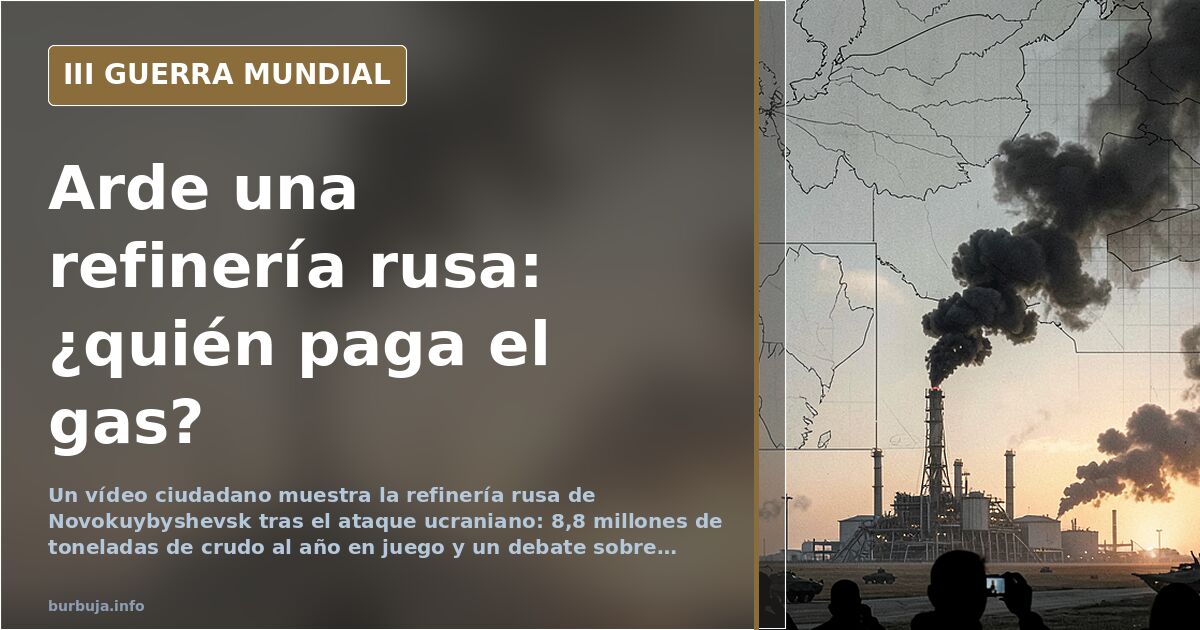
Ukraine hits the Novokuybyshevsk refinery and Russia loses crude
How much oil can Russia afford to lose before the war starts taking its toll at home? A Russian citizen filmed the aftermath of the latest Ukrainian strike on the Novokuybyshevsk refinery, a facility capable of processing 8.8 million tonnes of crude per year. The footage released shows columns of smoke rising over the plant. The attack reopens the debate over whether destroying Russian energy infrastructure speeds up the end of the conflict or, on the contrary, drives up the price of the fuel that moves half of Europe.
What is known about the strike on the Novokuybyshevsk refinery
The refinery that was hit is located in the Samara region, and its processing volume places it among the significant facilities in the Russian oil network. The messages accompanying the videos stress the scale: 8.8 million tonnes per year of capacity. This is no corner petrol station. It is industrial infrastructure that feeds both the domestic market and exports.
The conversation quickly turned to the energy cost. Part of the analysis argues that every refinery put out of action makes the crude and diesel consumed by European vehicles, including Spanish ones, more expensive. Another line of thought counters that the damage is to Russia's military apparatus and that Ukraine is only defending itself against an invasion. The point of friction is not the attack itself, but who ends up paying the bill.
The debate over whether destroying refineries makes diesel more expensive in Europe
Some point out that much of the fuel going up in flames was meant to end up in European car tanks. The chain is simple: less Russian refining, more strain on the global market for refined products, and prices passed on at the pump. Those who defend the strikes respond that Russia was already attacking Ukraine's energy grid before, and that defence includes hitting the invader's logistics.
The environmental argument also surfaces, with a hint of irony. If measures to cut emissions are imposed while oil reserve fires are celebrated, coherence suffers. There is no shortage of people recalling the environmental impact of these destructions, and others answering that the first one responsible is whoever ordered the invasion.
Pilingui, NATO and the story of eastward expansion
The discussion escalated to the origins of the conflict. The Kremlin's argument about NATO expansion and Russophobia in Ukraine was brought up, and countered with the point that every European country freely chooses its alliances. The comparison with historical episodes of invasion under the pretext of protecting minorities was left on the table, with no one settling it.
In the end, the refinery burns, the crude is lost and the European pump trembles. The only thing that does not burn is the certainty of who pays for the smoke.
Also available in: Deutsch
Summary of a discussion on Burbuja.info - Foro de economía, actualidad y política., translated from Spanish and reviewed before publication. Read the full discussion (49 replies).
More summaries
-
Massive Ukrainian drone attack on St Petersburg hits refineries and data centres
Ukrainian drones hit St Petersburg's oil terminal, a VK data centre and an Ozon logistics hub. Europe pays the energy price.
-
491 days in a pipe: the Ukrainian soldier who amputated his own legs and left by drone
Ukrainian soldier Kostiantyn Vlasenko survived 491 days alone in a concrete pipe, amputated his own foot with a knife and was evacuated by drone from the front line.
-
Trump warns Russia of possible attack in Moscow
The US embassy warned on October 31 of a "credible" threat of a mass-casualty incident at Tsaritsyno. Russia's FSB says it is taking action.
-
Netanyahu and the Arab vote: Israeli democracy hits a wall
On election day Netanyahu warned about the Arab vote, and Likud later alleged election fraud. The paradox of the Middle East's only democracy.
-
Black soldier in the Russian army strips off and begs for help
A post on X shows an African soldier asking a Ukrainian drone operator for help. The episode highlights Russia's use of foreign troops.
-
Herzl's 1896 plan: Palestine or Argentina
According to the material, Herzl weighed Palestine and Argentina in 1896, ruled out Africa, and designed two institutions to buy land and organize Jewish emigration.